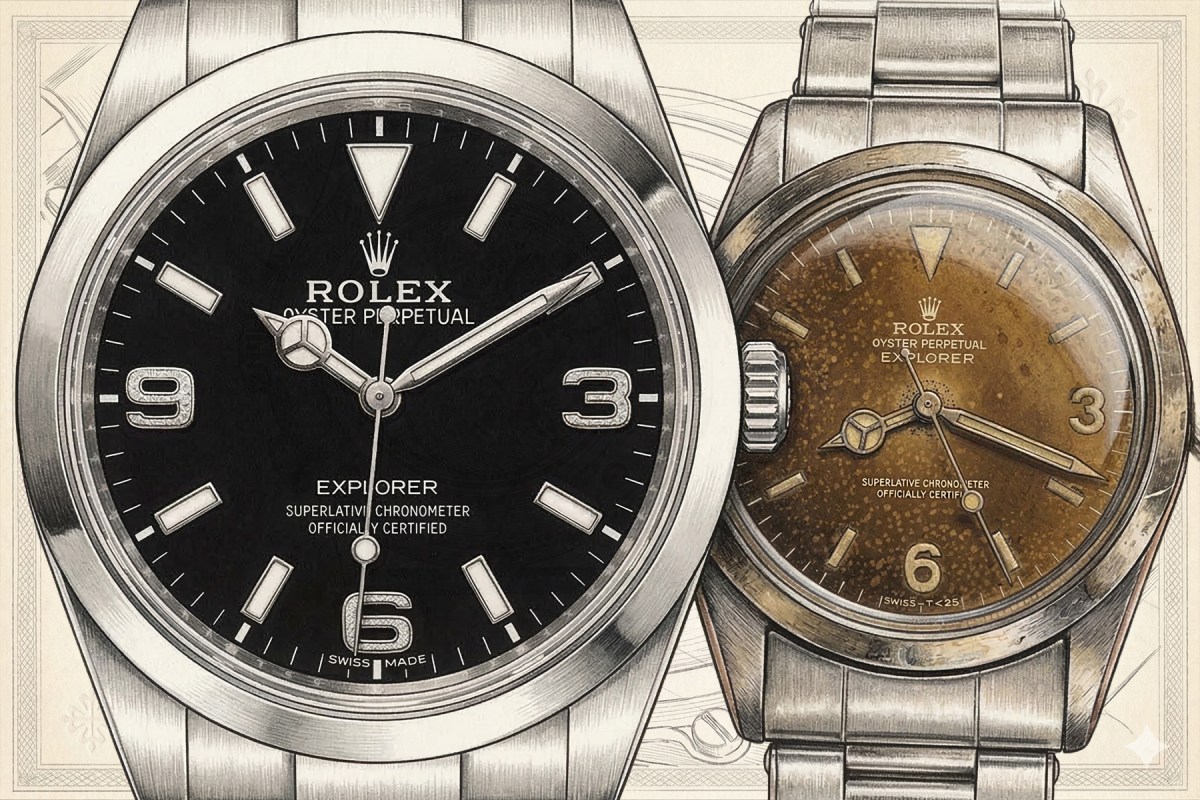
"Until roughly the late aughts, much of the vintage watch-collecting community focused on stock that remained in the best physical condition possible, rejecting patination while polishing cases and generally restoring old watches in the manner of old cars. As the watch-collecting hobby proliferated in this century, however, collectors' tastes shifted dramatically."
"The word "patina" is defined by Merriam-Webster as "a usually green film formed naturally on copper and bronze by long exposure or artificially (as by acids) and often valued aesthetically for its color" or "a surface appearance of something grown beautiful, especially with age or use." In the case of vintage watches, we typically take it to mean the degradation of the dial regardless of its underlying material."
"A tropical dial is one in which the black paint has turned a shade of brown, and ideally a relatively uniform one. How does this happen? The general thesis is that certain forms of paint used between the 1950s and 1970s were essentially defective and unstable, leading to this distinctive color transformation."
Vintage watch collecting has undergone a significant shift in aesthetic preferences. Early collectors prioritized pristine condition, avoiding patina and restoring watches like classic cars. By the 2000s, this philosophy reversed dramatically. Patina became desirable, polishing was discouraged, and faded components commanded premium prices. The tropical dial emerged as the most coveted patina type among collectors worldwide. A tropical dial occurs when black paint deteriorates to brown, typically uniformly. This phenomenon stems from defective, unstable paint formulations used between the 1950s and 1970s. The degradation process creates aesthetically pleasing results that collectors highly value, though beauty remains subjective.
#vintage-watch-collecting #tropical-dial-patina #watch-aesthetics #horological-terminology #collector-preferences
Read at InsideHook
Unable to calculate read time
Collection
[
|
...
]