#35-usc-314a

[ follow ]
#uspto
Intellectual property law
fromPatently-O
2 weeks ago

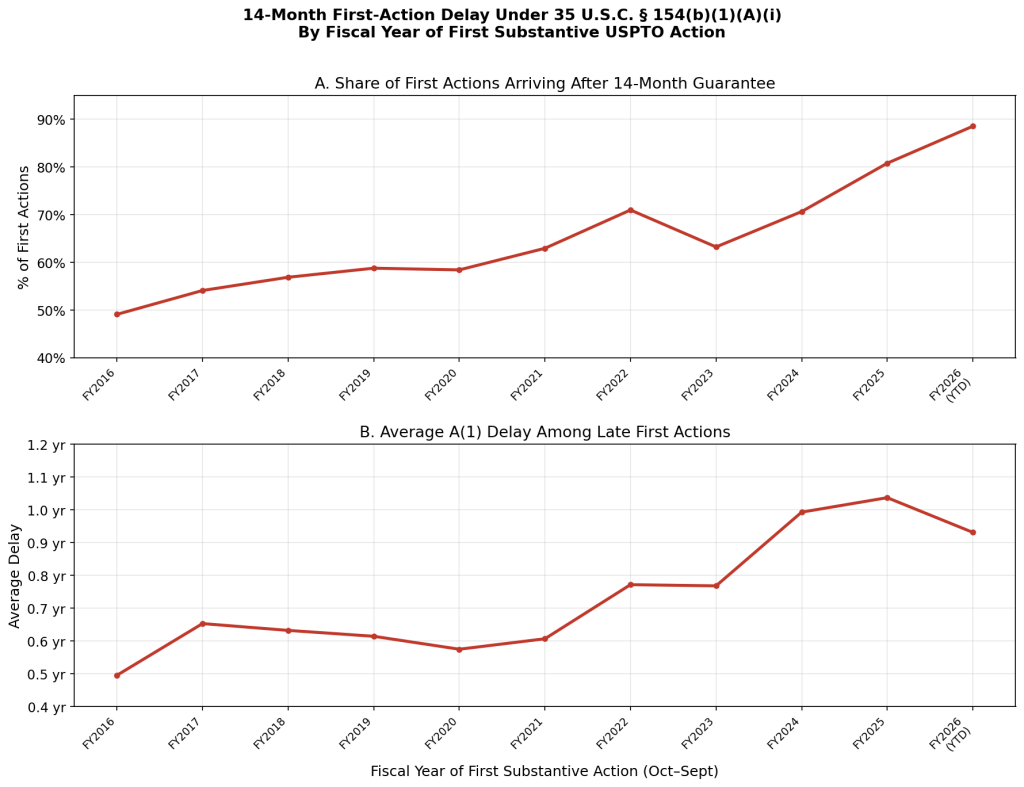
The 14-Month Fiction: Only 10% of First Actions Arrive on Time

USPTO frequently fails to meet the 14-month deadline for issuing a First Office Action or Notice of Allowance, impacting patent term adjustments.
#ptab
fromPatently-O
2 months ago
Intellectual property law

L'Office, C'est Moi: Director Squires and the Parchment Barriers of PTAB Institution Precedent

fromPatently-O
2 months ago
Intellectual property law

L'Office, C'est Moi: Director Squires and the Parchment Barriers of PTAB Institution Precedent

#patent-law
fromPatently-O
2 days ago
Intellectual property law

Words That Stick: Prosecution Disclaimer Survives the Examiner's Rejection

Intellectual property law
fromPatently-O
4 days ago

The Nexus Trap: Why Component Patents Struggle with Objective Indicia

Objective indicia of nonobviousness are increasingly limited by strict Federal Circuit requirements, impacting patent owners' defenses against obviousness claims.
Intellectual property law
fromPatently-O
4 days ago

The Nexus Trap: Why Component Patents Struggle with Objective Indicia

Objective indicia of nonobviousness are increasingly limited by strict Federal Circuit requirements, impacting patent owners' defenses against obviousness claims.
fromIPWatchdog.com | Patents & Intellectual Property Law
3 days ago

As 'Pro Codes Act' is Reintroduced, Opponents Warn of Threats to Standards Development System

Without effective copyright protections, there is a grave risk that these organizations will no longer be able to produce the high-quality codes and standards that the public and lawmakers have come to rely on.
Intellectual property law
fromPatently-O
5 days ago

Disclosed but Still Secret? The Federal Circuit Weighs Patent Publications Against Trade Secret Claims

The technology at issue is a subcutaneous cosmetic penile implant, a silicone sleeve placed between the skin and 'Buck's fascia' to enhance girth and length.
Intellectual property law
#patent-eligibility
fromPatently-O
1 month ago
Intellectual property law

Tie Goes to the Runner? Three Months of SMED Practice at the USPTO

Patent Director John Squires implemented a policy favoring applicants in close Section 101 eligibility calls through Subject Matter Eligibility Declarations, shifting examination standards toward applicant-friendly interpretations.
fromIPWatchdog.com | Patents & Intellectual Property Law
4 days ago

WIPO in Focus: Beyond Treaties, Toward a Market-Driven IP System | IPWatchdog Unleashed

WIPO is not merely a distant UN bureaucracy; it is a dynamic, fee-driven organization that has been undergoing significant operational and cultural transformation in recent years.
Intellectual property law
fromPatently-O
4 days ago

GW Law Seeking IP Fellow for Frank H. Marks Visiting Position

The fellowship, which carries the title of Visiting Associate Professor of Law, is one of the better-known entry points into IP legal academia.
Intellectual property law
#obviousness-type-double-patenting
Intellectual property law
frompatentlyo.com
1 week ago

No Do-Overs: Federal Circuit Blocks Dismiss-and-Refile Tactic to Restart ITC Stay Deadline

A plaintiff can voluntarily dismiss a lawsuit before the defendant responds, but cannot use it to revive missed statutory deadlines.
Intellectual property law
fromPatently-O
2 weeks ago

Patent Law Year in Review: USC IP Institute 2026

The USC Intellectual Property Institute held its annual IP Year in Review session covering major patent law developments, featuring panels on trademarks, publicity rights, and copyright.
fromPatently-O
2 weeks ago

The Patent Term Distribution, and What it Reveals

Congress set the patent term at twenty years from the earliest effective filing date. 35 U.S.C. § 154(a)(2) (not counting provisional or foreign national filing). But that statutory baseline is just the starting point. But, the actual term is shaped by a series of prosecution decisions, USPTO delays, terminal disclaimers, and patent family structure.
Intellectual property law
fromPatently-O
2 weeks ago

Are Rising Maintenance Fees Shortening the Effective Patent Term?

Approximately 60% of U.S. patentees abandon their patents before expiration by not paying maintenance fees, with full-term maintenance rates declining to roughly 40%.
Intellectual property law
fromIPWatchdog.com | Patents & Intellectual Property Law
3 weeks ago

Other Barks & Bites for Friday, March 13: Former USPTO Patent Examiner Settles Conflict Allegations; EU Parliament Endorses EUIPO Register of Works Used to Train AI; U.S.-Based Operations Become Discretionary Denial Factor at PTAB

The U.S. Department of Justice settled a conflict of interest case with a former USPTO patent examiner for $122,480, marking the second such settlement in two weeks.
Intellectual property law
frompatentlyo.com
3 weeks ago

Guest Post: Protectionist PTO Memo is on a Collision Course with TRIPS

USPTO Director's new policy considers U.S. manufacturing status when deciding whether to institute IPR and PGR proceedings, potentially conflicting with WTO TRIPS obligations requiring nondiscriminatory patent treatment.
Intellectual property law
frompatentlyo.com
3 weeks ago

Untethered: USPTO Loosens the Article of Manufacture Requirement for Digital Designs

The USPTO relaxed design patent rules for computer-generated interfaces and icons, removing display panel requirements, allowing 'for' prepositions in claims, and extending eligibility to projected, holographic, virtual, and augmented reality designs.
Intellectual property law
frompatentlyo.com
3 weeks ago

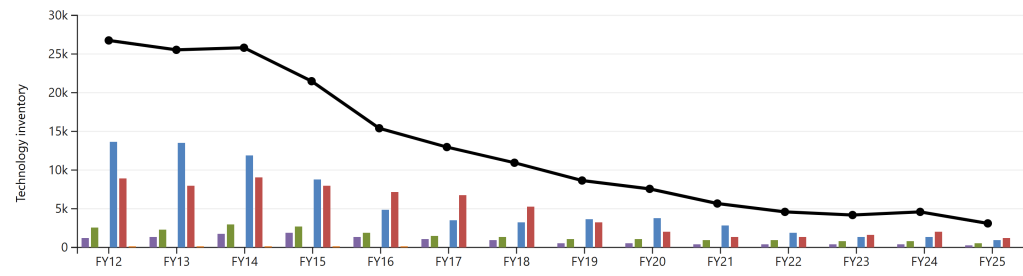
PTA Keeps Score: Patent Term Adjustment as a Measure of the USPTO Backlog

Patent Term Adjustment data reveals the USPTO's examination backlog has nearly returned to 2015 levels after years of improvement, with average PTA climbing from 120 days in 2021 to 296 days by December 2025.
Intellectual property law
fromPatently-O
3 weeks ago

The Expanding Patent Document: Fewer Claims, More Words, and a Trend That Predates Alice

Patent specifications have nearly doubled in length over twenty years to over 13,000 words, but claim counts have declined since 2005, contradicting expectations that Alice Corp. v. CLS Bank would cause a structural break in 2014-2015.
Intellectual property law
fromPatently-O
4 weeks ago

Twenty and Done: The Fee-Driven Collapse of Claim Count Diversity

Patent fee structures have created a hard threshold at 20 claims, causing 28% of 2025 utility patents to issue with exactly 20 claims compared to 6% in 2005.
#uspto-allowance-rates
Intellectual property law
fromPatently-O
1 month ago

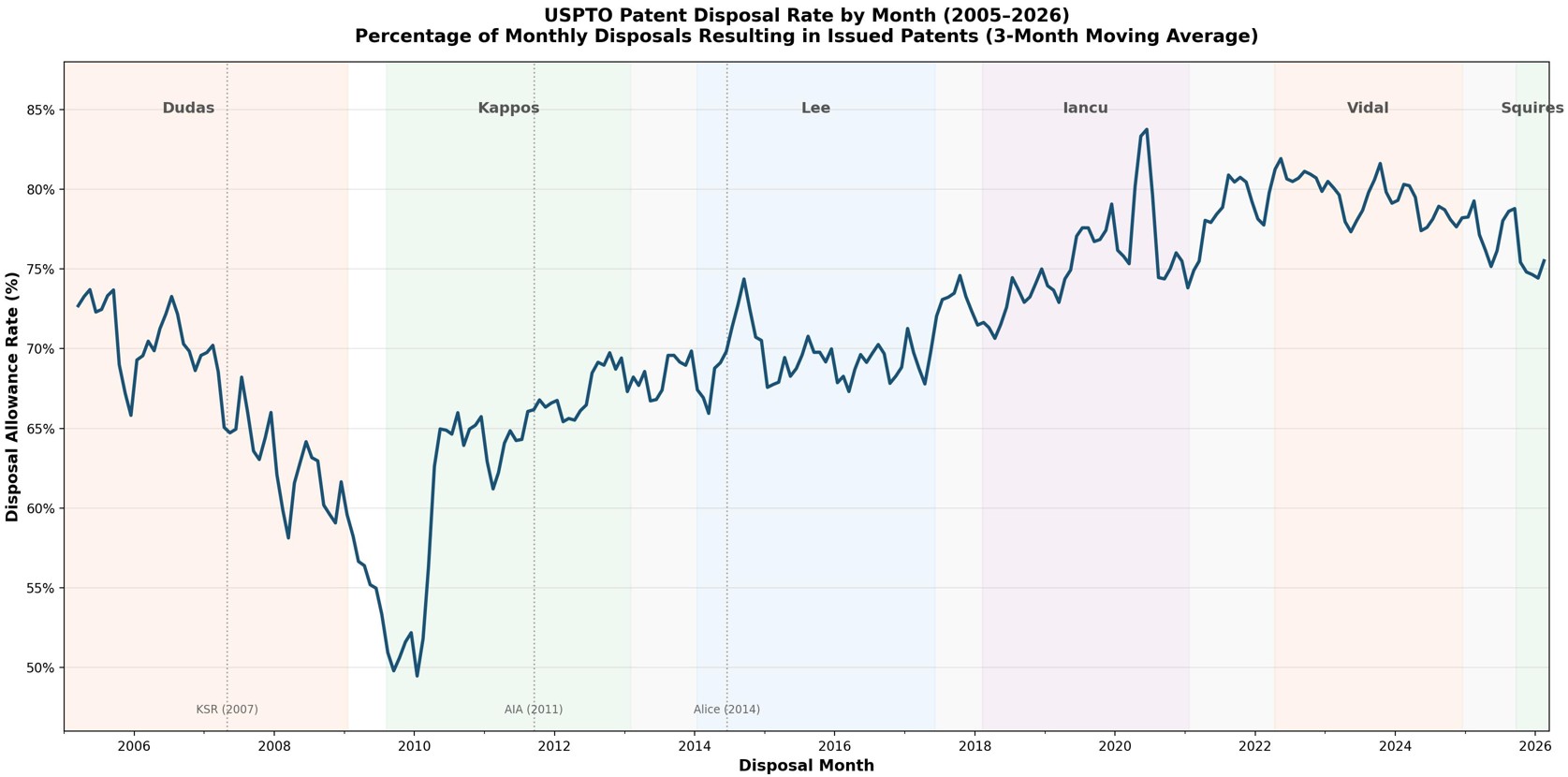
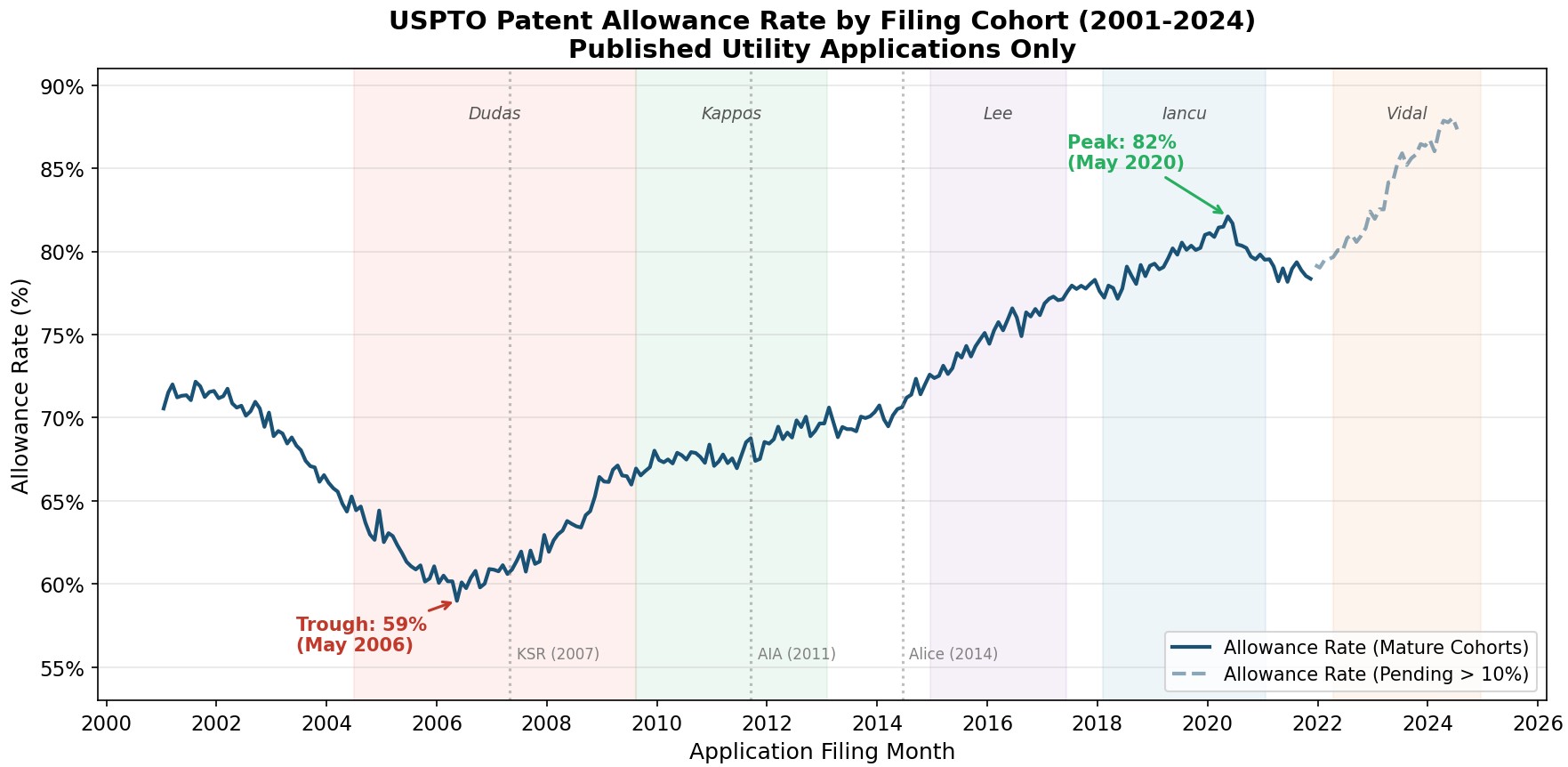
The Third Way: Examiner Action Dates and the Allowance Rate Curve

Examining USPTO allowance rates by anchoring outcomes to examiner mail dates provides the most direct measure of examination policy by capturing the moment examiners make final decisions.
Intellectual property law
fromPatently-O
1 month ago

The Third Way: Examiner Action Dates and the Allowance Rate Curve

Examining USPTO allowance rates by anchoring outcomes to examiner mail dates provides the most direct measure of examination policy by capturing the moment examiners make final decisions.
#patent-reform
Intellectual property law
fromPatently-O
1 month ago

Extolling the Virtues: 'Space-Efficient' Preamble Fails to Limit

The Federal Circuit reversed an indefiniteness ruling while affirming dismissal of breach-of-contract claims in NimbeLink Corp. v. Digi International Inc., with the patent issue centering on whether claim preambles impose substantive limitations.
#patent-allowance-rates
Intellectual property law
fromPatently-O
1 month ago

Patent Examiner Pays $500K for Financial Conflicts - But the Real Story may be Systemic

A USPTO patent examiner settled allegations of examining patent applications from companies where she held substantial undisclosed stock positions, paying $500,000 in penalties for ethics violations.
Intellectual property law
fromPatently-O
1 month ago

Cleaning House: Director Squires Responds to Examiner Conflict-of-Interest Scandal

USPTO Director John Squires mandated that patent examiners must recuse themselves from examining applications where they hold any stock or bonds in the applicant company, following a $500,000 settlement with examiner Daxin Wu for undisclosed financial conflicts.
fromIPWatchdog.com | Patents & Intellectual Property Law
1 month ago

Harrity & Harrity is Seeking a Patent Attorney / Patent Agent - Electrical & Mechanical Innovations

Harrity & Harrity is looking for experienced patent attorneys and agents who want a smarter way to practice law. Our practice is built around streamlined workflows, custom AI and automation tools, and a data-driven approach that keeps the focus where it belongs: on quality, strategy, and client service-not busywork or billable-hour math. You'll work on high-value patent portfolios for top-tier technology companies while enjoying true flexibility, strong support, and meaningful autonomy.
Intellectual property law
fromPatently-O
2 months ago

Patently-O Operations Contact

Patently-O added an operations manager and a dedicated contact (discover@patentlyo.com) for subscription, login, billing, and administrative inquiries to improve response times.
fromIPWatchdog.com | Patents & Intellectual Property Law
2 years ago

Since 2020, Patent Errors Have Decreased by 11.24%

In an ideal world, issued patents would not contain errors. In reality, patent drafting is tedious and time-consuming work and perfection is not an attainable goal. The patent industry seems to be steadily getting better, though. In a recent study, we uncovered an 11.24% decrease in errors per patent over the past four years. We observed this decrease by reviewing every patent issued by the U.S. Patent and Trademark Office (USPTO) since 2020 - nearly 1.4 million patents.
Intellectual property law

fromPatently-O
1 month ago

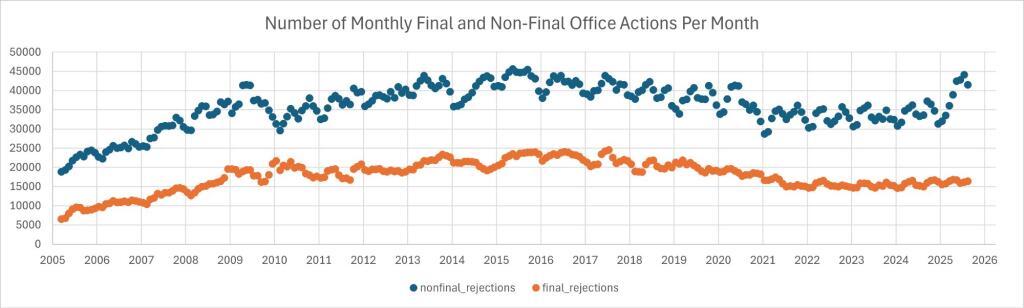
An Old Trick in the Patent Book: Targeted Drafting from 1876 to 2026

Patent applicants strategically draft filings to steer USPTO art‑unit assignment and increase claim allowance odds, a practice known as targeted drafting.
fromIntellectual Property Law Blog
2 months ago

PTAB Overly Relied on Statements of Doubt in Determining Conception and Reduction to Practice in Interference Proceedings

Regents of the University of California ("Regents") and Broad Institute were engaged in a patent interference proceeding involving the adaptation of CRISPR systems to edit eukaryotic DNA. Both parties were engaged in extensive testing related to editing eukaryotic DNA during the time of the invention, and both filed multiple patent applications that became the subjects of the patent interference proceedings.
Intellectual property law

fromPatently-O
1 month ago

Privity Without Duty: When Patent Inventors Are Bound but Not Represented

University-employed inventors often lose control and compensation decisions when universities and licensees litigate patents without including inventors.
#federal-circuit
fromPatently-O
1 month ago
Intellectual property law
The Director Unbound: Federal Circuit Holds NHK-Fintiv Exempt from APA Rulemaking

fromPatently-O
1 month ago
Intellectual property law
The Director Unbound: Federal Circuit Holds NHK-Fintiv Exempt from APA Rulemaking

fromIPWatchdog.com | Patents & Intellectual Property Law
1 month ago

Inside the PTAB Reset: Practical Fixes for a Reengineered PTAB | IPWatchdog Unleashed

Johnson and I discuss obviousness determinations built on excessive combinations of prior art, warning that such analyses blur the line between legitimate hindsight reconstruction and genuine innovation assessment. We also highlight a systemic blind spot: nuisance "ankle-biter" assertions that exploit litigation economics while largely evading PTAB scrutiny. These cases have driven much of the political backlash against patents while remaining functionally untouched by the post-grant review process.
Intellectual property law

#ipr-institution-rates
Intellectual property law
fromPatently-O
1 month ago

When Obviousness Rejections Pile On: Rethinking Multi-Reference Combinations

Combining numerous prior art references to reject a patent claim often reflects hindsight and risks improper obviousness findings; doctrinal tests already address this.
Intellectual property law
fromPatently-O
2 months ago

A Dog's Breakfast: The Doctrinal Mess Surrounding "Configured To" Claim Language

"Configured to" and "configured for" mean "capable of" performing the recited function absent specification language suggesting a narrower construction.
fromIPWatchdog.com | Patents & Intellectual Property Law
1 month ago

PTAB Whiplash: Predictability, Policy and the PTAB Pendulum

This week on IPWatchdog Unleashed, I speak with Todd Walters, who is Chair of the Patent Office Litigation practice group at Buchanan. We explore the current state of Patent Trial and Appeal Board (PTAB) practice and the growing tension among stakeholders as policy changes continue to reshape post-grant proceedings. We reflect on the intensity of opinion from patent owners and petitioners and discuss the high financial stakes and strategic importance of America Invents Act (AIA) proceedings.
Intellectual property law
fromIPWatchdog.com | Patents & Intellectual Property Law
2 months ago

Squires Issues Precedential Decision Holding Parallel Petitions on Same Patent Claims Should Be Rare

The Board's Trial Practice Guide explains that 'one petition should be sufficient to challenge the claims of a patent in most situations' and 'multiple petitions by a petitioner are not necessary in the vast majority of cases.'
Intellectual property law
fromPatently-O
1 month ago

The 'Narrow' Question That Appears in Half of PTAB Obviousness Decisions

The case centers on the "Martin" reference, a patent application covering LED technology that was filed on April 16, 2003 and published on October 21, 2004. Martin was later abandoned and never became a patent. Lynk Labs' '400 patent claims a priority date of February 25, 2004, placing it squarely in the gap between Martin's filing and publication dates. Samsung successfully used Martin to challenge claims of the '400 patent as obvious in IPR.
Intellectual property law
[ Load more ]