#api-transition
#api-transition
[ follow ]
#ai #ai-integration #security #cloud-computing #automation #software-development #kubernetes #devops #microservices






fromInfoQ
1 day agoModule Federation 2.0 Reaches Stable Release with Wider Support Outside of Webpack
The dynamic type hints feature in Module Federation 2.0 dramatically streamlines the development process by automatically generating and loading types from remote modules, eliminating the need for shared type packages.
Angular
fromInfoWorld
1 month agoThe right way to architect modern web applications
Modern web applications are no longer just "sites." They are long-lived, highly interactive systems that span multiple runtimes, global content delivery networks, edge caches, background workers, and increasingly complex data pipelines. They are expected to load instantly, remain responsive under poor network conditions, and degrade gracefully when something goes wrong.
Web frameworks
#event-driven-architecture
DevOps
fromInfoQ
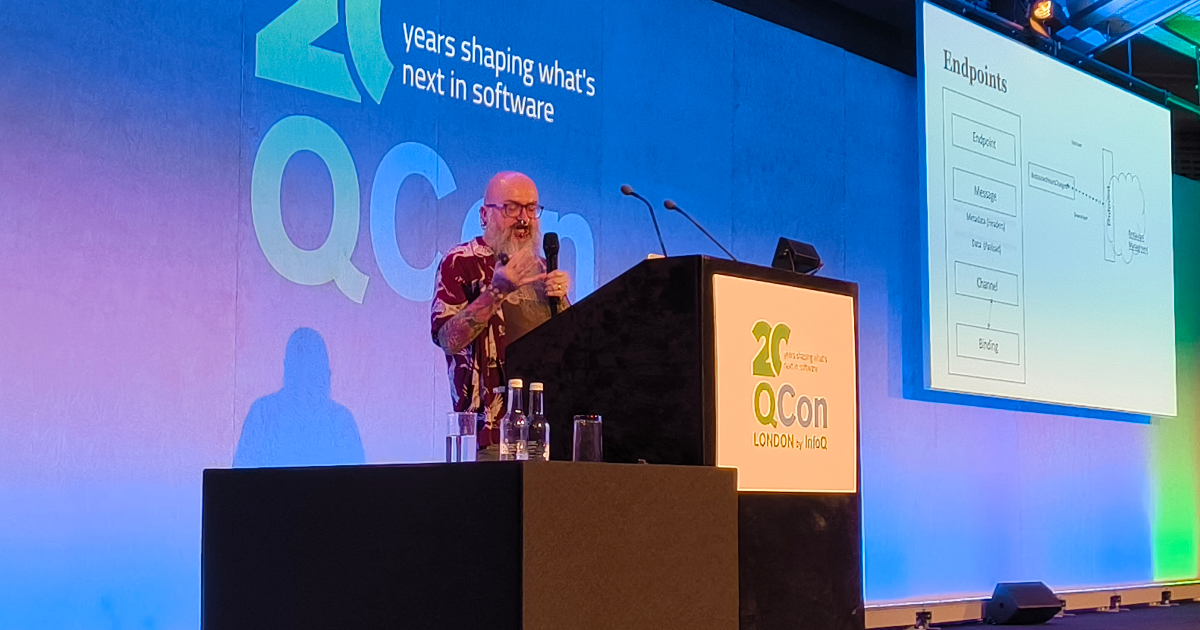
2 weeks agoQCon London 2026: Managing Asynchronous APIs at Scale
Event-driven architectures require explicit specifications, governance, and provisioning practices to scale beyond informal ad-hoc approaches, using tools like AsyncAPI to enable discovery, schema consistency, and automated infrastructure deployment.
fromInfoQ
1 month agoPlatforms for Secure API Connectivity With Architecture as Code
Building APIs is so simple. Caveat, it's not. Actually, working with tools with no security, you've got a consumer and an API service, you can pretty much get that up and running on your laptop in two or three minutes with some modern frameworks. Then, authentication and authorization comes in. You need a way to model this.
Web frameworks
fromDevOps.com
3 weeks agoZero Downtime Multicloud Migrations for Observability Control Planes - DevOps.com
An observability control plane isn't just a dashboard. It's the operational authority system. It defines alert rules, routing, ownership, escalation policy, and notification endpoints. When that layer is wrong, the impact is immediate. The wrong team gets paged. The right team never hears about the incident. Your service level indicators look clean while production burns.
DevOps
fromInfoQ
1 month agoDevOps Modernization: AI Agents, Intelligent Observability and Automation
Just a couple of words about today's topic. Of course, nothing surprising here, AI is changing DevOps and is changing the way teams are moving beyond reactive monitoring towards predictive automated delivery and operations. What does that mean? How can teams actually implement predictive incident detection, intelligent rollout, and AI-driven remediation? Also, how can we accelerate delivery? Those are all topics that today's panelists hopefully are going to cover.
Software development
fromthenewstack.io
2 months agoWhy Most APIs Fail in AI Systems and How To Fix It
Over the past few years, I've reviewed thousands of APIs across startups, enterprises and global platforms. Almost all shipped OpenAPI documents. On paper, they should be well-defined and interoperable. In practice, most fail when consumed predictably by AI systems. They were designed for human readers, not machines that need to reason, plan and safely execute actions. When APIs are ambiguous, inconsistent or structurally unreliable, AI systems struggle or fail outright.
Software development
fromMedium
1 year agoModern Web Architectures: Composability with Harmony
Over the past decade, software development has undergone a massive transformation due to continuous innovations in tools, processors and novel architectures. In the past, most applications were monoliths and then shifted to microservices, and now we find ourselves embracing composability - a paradigm that prioritizes modular, reusable, and flexible software design. Instead of writing separate, tightly coupled applications, developers now compose software using reusable business capabilities that can be plugged into multiple projects. This enables greater scalability, maintainability, and collaboration across teams and organizations. At the heart of this movement is Bit Harmony, a framework designed to make composability a first-class citizen in modern web development.
Software development
fromEntrepreneur
1 month agoBuild Enterprise-Grade Applications for Just $50
Developers spend more than 60% of their time debugging and maintaining code rather than building new features, Stack Overflow's Developer Survey reports. If you're running a software development team or building applications for your business, you can use Microsoft Visual Studio Pro to streamline coding workflows with an AI-enhanced development environment that reduces debugging time and accelerates deployment cycles. Best of all, Microsoft Visual Studio Professional 2026 is currently available for only $49.99 (reg. $499.99).
Software development
DevOps
fromInfoWorld
2 months agoFrom distributed monolith to composable architecture on AWS: A modern approach to scalable software
Migrating distributed monoliths to a composable AWS architecture yields loosely coupled, autonomous services that improve scalability, resilience, deployment velocity, and team autonomy.
DevOps
fromAmazon Web Services
1 month agoBuilding a scalable code modernization solution with AWS Transform custom | Amazon Web Services
An open-source infrastructure enables enterprise-scale, parallel AWS Transform custom code modernizations using AWS Batch, Fargate, REST APIs, and CloudWatch monitoring.
[ Load more ]