#art-rock
#art-rock
[ follow ]
#david-bowie #music #electronic-music #album-release #collaboration #talking-heads #music-history #electronic
fromPitchfork
4 days agoWatch David Byrne Perform "When We Are Singing" on Colbert
"I licensed some ICE footage to show at the very, very end of that song. If we showed it for the whole song, it would be kind of sad, depressing, but we show it at the very end and we start off with some footage that I saw of what looked like a delivery guy on a bike being chased by the ICE guys, and he gets away! It was in Chicago."
London music

Berlin music
fromOregon ArtsWatch * Arts & Culture News
1 week agoClusters of harmony: Fear No Music's "Looking Inward, Spacing Out" * Oregon ArtsWatch
Fear No Music's concert 'Looking Inward, Spacing Out' featured innovative seating and a performance of Nystedt's 'Immortal Bach' by Reed College Choirs.



Arts
fromHyperallergic
3 weeks agoBrian Eno and 200+ Artists Urge British Museum to "Stop Erasing Palestine"
Over 200 artists and cultural groups signed an open letter criticizing the British Museum for altering Middle East gallery displays after pressure from a pro-Israel advocacy group, alleging systematic erasure of Palestine from museum labels and historical context.
fromThe Nation
2 weeks agoThe Intermediate States of Eliane Radigue
Her slowly shifting synthesizer compositions and quiet, meditative pieces for acoustic instruments continue to inspire a deep immersion in their audiences, and her recordings and writings have influenced multiple generations of musicians worldwide.
Berlin music
#adrian-belew
Music production
fromMetro Silicon Valley | Silicon Valley's Leading Weekly
1 week agoAdrian Belew Brings Remain In Light Show to Menlo Park | Metro Silicon Valley | Silicon Valley's Leading Weekly
Adrian Belew is revisiting key collaborations, including a tour with Jerry Harrison and an extensive European tour with his band Beat.

Music production
fromMetro Silicon Valley | Silicon Valley's Leading Weekly
1 week agoAdrian Belew Brings Remain In Light Show to Menlo Park | Metro Silicon Valley | Silicon Valley's Leading Weekly
Adrian Belew is revisiting key collaborations, including a tour with Jerry Harrison and an extensive European tour with his band Beat.
Music
fromwww.theguardian.com
3 weeks agoAdd to playlist: the dadaist cubist racket of Angine de Poitrine and the week's best new tracks
Angine de Poitrine is a Quebec duo creating absurdist mantra-rock dada music that blends metal shredding with microtonal guitar, world music influences, and hypnotic grooves while performing in elaborate papier-mache costumes.
NYC music
fromwww.theguardian.com
1 month agoThe bathrooms were rank, but we didn't care': how the grimy-but-great CBGB changed rock for ever
CBGB, a New York dive bar opened in 1973, became the birthplace of punk, new wave, and multiple rock subgenres that transformed modern music's sound and aesthetic.
SF music
fromSFGATE
1 month agoHis band defined 1990s indie rock. In SF, he reclaims a singular voice.
Stephen Malkmus, a founding member of Pavement, continues to define alternative rock as a solo artist and bandleader while maintaining relevance across three decades through evolving musical projects.




fromwww.theguardian.com
2 weeks agoWe did Disneyland on mind-altering substances': Primus frontman Les Claypool on being rock's great joker and why Metallica rejected him
I was too embarrassed to sing in my apartment, he says on a video call. But my roommate at the time was dating the preacher's daughter, and had keys to the church across the street. In the dead of night, the madcap bassist and singer took his recording equipment to the empty church, set up on the podium, and first sang his anti-war song Too Many Puppies.
Music production


fromVulture
1 month ago'The Man With the Interesting Sounds'
Laurie Anderson, the performance artist, told Paul Simon about me and said, 'You should get Adrian to play on your record. He always comes up with interesting sounds that I'm sure you could use.' That's me, the man with the interesting sounds.
Music production
Music
fromOregon ArtsWatch * Arts & Culture News
1 month agoUnintentional synchronicity: Third Angle New Music, Steve Reich, "Hopscotch Counterpoints" * Oregon ArtsWatch
Third Angle New Music performed Steve Reich's four Counterpoints at Hopscotch to celebrate the composer's ninetieth birthday, featuring works composed over twenty-one years for different solo instruments with pre-recorded accompaniment.
fromThe Verge
1 month agoYou need to listen to Laurie Spiegel's masterpiece of early ambient music
I recently had the pleasure of interviewing Laurie Spiegel for the site. As preparation for the interview, I spent a lot of time over the last couple of weeks revisiting Spiegel's records, most notably The Expanding Universe, her 1980 masterpiece that blends synth experimentalism with early examples of what would eventually be called ambient music, and algorithmic composition techniques. It's a marvel that sounds both nostalgic and cutting-edge at the same time.
Music
fromPitchfork
1 month agoOrgan Tapes: (Yi Bao Yan)
Tim Zha is looking for the soul in the machine. While some might hear Auto-Tune as masking a singer's humanity, the London-based artist filters his vocals to highlight technology's inseparability with our notions of self. This is ground well-trodden by Afrofuturist techno pioneers, Atlanta trappers, and PC Music hyperpoppers; for Zha, Auto-Tune represents what he calls the "coincidence of human subjectivity and the networked machine system."
London music
from48 hills
1 month agoPhil Manzanera shares his life's sounds, from a Cuban Revolution childhood to Roxy Music - 48 hills
Revolución to Roxy begins long before glam, synthesizers, or LP covers became cultural landmarks. Manzanera's earliest memories are shaped by upheaval: childhood in Cuba during the revolution, displacement, and an upbringing that crossed Venezuela, Colombia, England, and beyond. That instability, he says, produced something lasting-understanding. "If you grow up speaking two languages, you are scientifically proven to be more compassionate," Manzanera says. "You have this kind of duality, and one of those is the power to be empathetic. For a musician, that is such a helpful tool."
Music
fromPitchfork
1 month agoVisible Cloaks Return With New Album Paradessence
Paradessence draws its title from a portmanteau of "paradoxical" and "essence," coined by author Alex Shakar. Per Visible Cloaks, the word embodies the oppositional-but-coexisting concepts they're trying to explore with the new album. "Instead of creating pieces that function horizontally as environments, we wanted to conceptualize them as living material changing in space, continually in flux," Doran shared in a press statement.
Music
Music
fromwww.theguardian.com
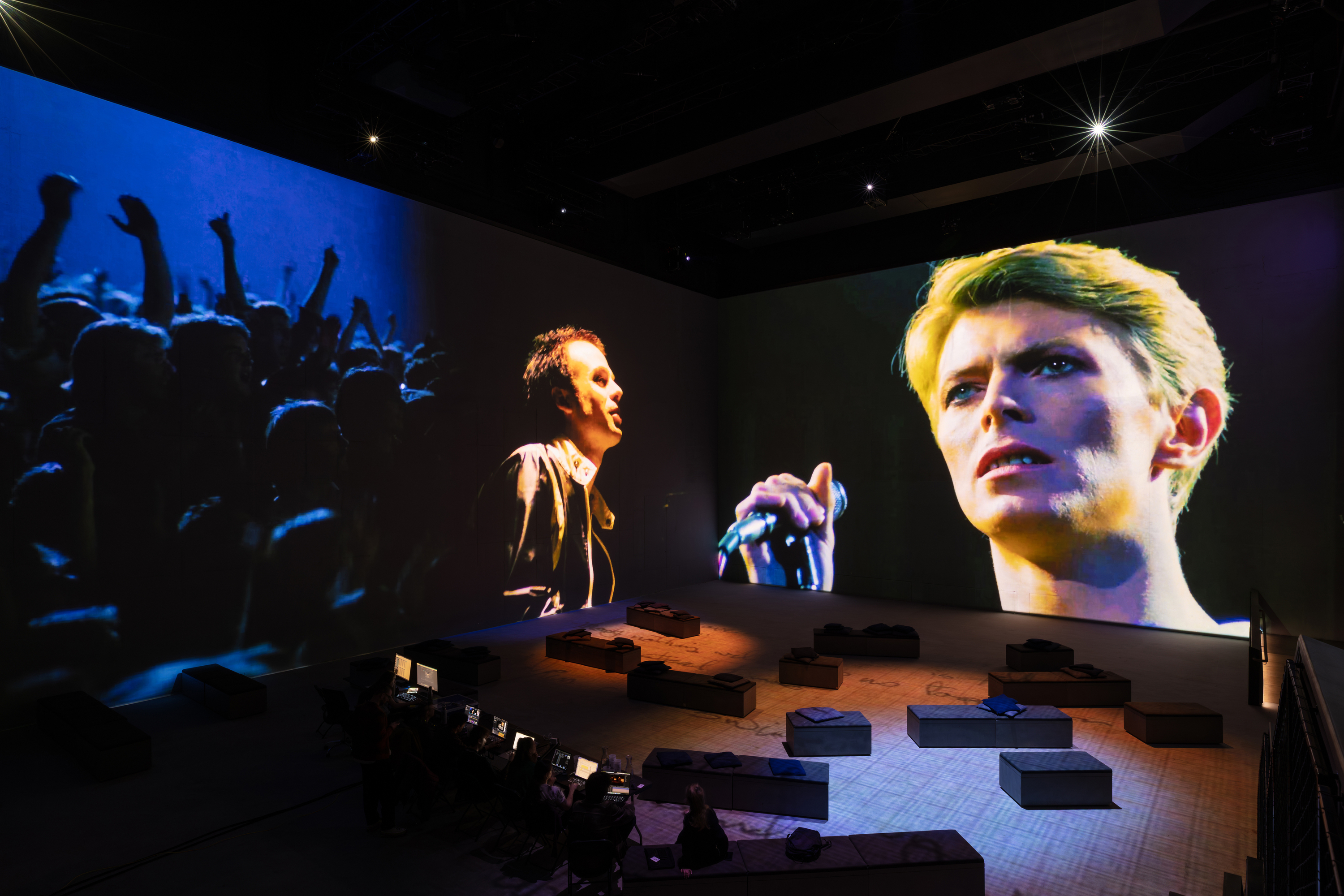
2 months agoTen years after his death, is David Bowie's musical legacy at risk of fading from view?
David Bowie has underperformed posthumously in earnings and streaming compared with other major artists, influenced by a publishing-rights sale and limited estate-driven audience engagement.


fromVulture
1 month agoWhen Is a Band Not the Same Band Anymore?
"When I read the fine print, it was 'an experience with REO Speedwagon's music.' It's none of the original members," Fletcher recalls. "I don't want to promote the show unless it's the real thing. I don't know why you would want to see that. It's just a cover band. To me, that's a little bit strange." He adds, with a sigh, "If there are no original members, who cares?"
Music
fromPitchfork
2 months agoAgriculture: The Spiritual Sound
Take the title of The Spiritual Sound as a kind of syllabus, and you'll find a heady list of musical reference points that Agriculture aim to exalt. The jarring intros of black metal songs that make you feel like a portal to Hell has opened inside your headphones. The sound design on later Scott Walker arrangements meant to conjure a Biblical plague. The slow, majestic build of post-rock epics that hold back their climax for maximum transcendence.
Music
fromAnOther
2 months agoThe Second Coming of Alan Vega, the Charismatic Frontman of Suicide
One such person who was finding his singular creative spark amidst the volatility was Lamere's partner, the late Alan Vega, one half of the pioneering electronic-punk outfit Suicide. After the group's 1977 self-titled album - a raw record filled with grinding drum machines, haunting organ, feral screams and ghostly atmospherics - but before their more polished follow-up in 1980, Vega wanted to do some solo stuff.
Music
fromSPIN
1 month agoRagger Take Ragtime to the Warp Zone - SPIN
"Many found the music offensive, the dancing objectionable, and the popularity of both with young people verging on a mental health crisis." So writes music historian Susan C. Cook about ragtime, the heavily syncopated ancestor of jazz that arose in the late 1800s. Like all things, ragtime's subversiveness faded over time, and, a century later, the works of Scott Joplin and other practitioners had been relegated to carnivals and fairs, their jaunty piano melodies now evoking quaint notions of old-timey fun.
Music
Music
fromKALTBLUT Magazine
1 month agoChoosing the Artificial Over the Real in Dash Hammerstein's "Noise Machine" - KALTBLUT Magazine
Dash Hammerstein blends Americana songwriting and filmmaking to create intimate, melody-driven songs and film scores that mix folk-pop sensibility with subtle production flourishes.
Music
fromPinkNews | Latest lesbian, gay, bi and trans news | LGBTQ+ news
2 months ago10 albums we're seriously looking forward to in 2026, including Sexistential
Notable indie, pop, and folk artists release albums in early 2026 that blend evolved sounds, personal lyricism, theatrical pop, and relationship-focused songwriting.
fromenglish.elpais.com
2 months agoThe birth year of punk rock
Don't say you were not warned: stories, both in print and broadcast, are already being prepared about the 50th anniversary of punk rock. Indeed, 1976 saw the release of debut albums by the Sex Pistols, the Ramones, the Damned, and the first version of Blank Generation, Richard Hell's anthem. Of course, there are also nitpicky arguments for rejecting 1976 as the annus mirabilis.
Music
fromOpen Culture
2 months agoBrazilian Musician Seu Jorge Performs 15 Iconic Bowie Songs in Portuguese to Mark the 10th Anniversary of Bowie's Passing
In 2004, the Brazilian musician Seu Jorge recorded a series of Portuguese covers of David Bowie songs for Wes Anderson's film The Life Aquatic with Steve Zissou. The next year, he released a full album of 13 Bowie classics, and in 2016-2017, he even took the songs on tour. Now, in 2026, to mark the 10th anniversary of Bowie's passing, Jorge returns with the performance above.
Music
[ Load more ]