#decoupled-architecture
#decoupled-architecture
[ follow ]
#microservices #kubernetes #security #software-architecture #ai #devops #software-development #cloud-computing


fromInfoQ
1 day agoModule Federation 2.0 Reaches Stable Release with Wider Support Outside of Webpack
The dynamic type hints feature in Module Federation 2.0 dramatically streamlines the development process by automatically generating and loading types from remote modules, eliminating the need for shared type packages.
Angular





fromInfoWorld
2 weeks agoWe mistook event handling for architecture
Events are essential inputs to modern front-end systems. But when we mistake reactions for architecture, complexity quietly multiplies. Over time, many front-end architectures have come to resemble chains of reactions rather than models of structure. The result is systems that are expressive, but increasingly difficult to reason about.
React
fromInfoWorld
1 month agoThe right way to architect modern web applications
Modern web applications are no longer just "sites." They are long-lived, highly interactive systems that span multiple runtimes, global content delivery networks, edge caches, background workers, and increasingly complex data pipelines. They are expected to load instantly, remain responsive under poor network conditions, and degrade gracefully when something goes wrong.
Web frameworks
#event-driven-architecture
DevOps
fromInfoQ
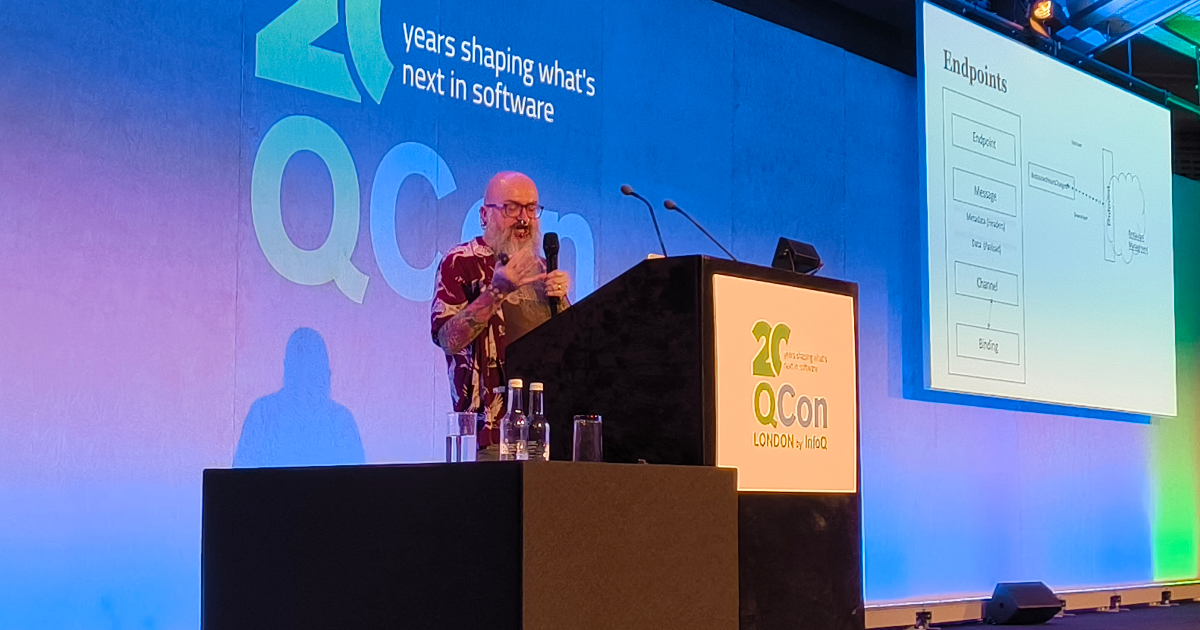
2 weeks agoQCon London 2026: Managing Asynchronous APIs at Scale
Event-driven architectures require explicit specifications, governance, and provisioning practices to scale beyond informal ad-hoc approaches, using tools like AsyncAPI to enable discovery, schema consistency, and automated infrastructure deployment.
fromInfoQ
1 month agoPlatforms for Secure API Connectivity With Architecture as Code
Building APIs is so simple. Caveat, it's not. Actually, working with tools with no security, you've got a consumer and an API service, you can pretty much get that up and running on your laptop in two or three minutes with some modern frameworks. Then, authentication and authorization comes in. You need a way to model this.
Web frameworks
fromTechzine Global
2 months agoDevelopers struggle with container security
Almost a quarter of those surveyed said they had experienced a container-related security incident in the past year. The bottleneck is rarely in detecting vulnerabilities, but mainly in what happens next. Weeks or months can pass between the discovery of a problem and the actual implementation of a solution. During that period, applications continued to run with known risks, making organizations vulnerable, reports The Register.
Information security
fromdzone.com
2 months agoIntegrating AI-Enhanced Microservices in SAFe 5.0 Framework
The integration of AI-enhanced microservices within the SAFe 5.0 framework presents a novel approach to achieving scalability in enterprise solutions. This article explores how AI can serve as a lean portfolio ally to enhance value stream performance, reduce noise, and automate tasks such as financial forecasting and risk management. The cross-industry application of AI, from automotive predictive maintenance to healthcare, demonstrates its potential to redefine processes and improve outcomes.
Agile
fromInfoQ
1 month agoDevOps Modernization: AI Agents, Intelligent Observability and Automation
Just a couple of words about today's topic. Of course, nothing surprising here, AI is changing DevOps and is changing the way teams are moving beyond reactive monitoring towards predictive automated delivery and operations. What does that mean? How can teams actually implement predictive incident detection, intelligent rollout, and AI-driven remediation? Also, how can we accelerate delivery? Those are all topics that today's panelists hopefully are going to cover.
Software development
fromDevOps.com
3 weeks agoZero Downtime Multicloud Migrations for Observability Control Planes - DevOps.com
An observability control plane isn't just a dashboard. It's the operational authority system. It defines alert rules, routing, ownership, escalation policy, and notification endpoints. When that layer is wrong, the impact is immediate. The wrong team gets paged. The right team never hears about the incident. Your service level indicators look clean while production burns.
DevOps
fromMedium
1 year agoModern Web Architectures: Composability with Harmony
Over the past decade, software development has undergone a massive transformation due to continuous innovations in tools, processors and novel architectures. In the past, most applications were monoliths and then shifted to microservices, and now we find ourselves embracing composability - a paradigm that prioritizes modular, reusable, and flexible software design. Instead of writing separate, tightly coupled applications, developers now compose software using reusable business capabilities that can be plugged into multiple projects. This enables greater scalability, maintainability, and collaboration across teams and organizations. At the heart of this movement is Bit Harmony, a framework designed to make composability a first-class citizen in modern web development.
Software development
fromMedium
4 months agoCI/CD and Gitops with Microservices: Open Ecosystem vs AWS Native
While building apps I learned that writing code is only half the journey - getting it deployed, updated, and running reliably is also just as important if not more. When I started deploying my apps to the cloud, I realized how many manual steps it took to get the app running. That's when I discovered CI/CD and GitOps tools that automate everything from testing to deployment, so developers can focus on writing code instead of wasting time on manually deploying each time.
Software development
fromDevOps.com
1 month agoHarness Readies Resilience Testing Platform to Make Applications More Robust - DevOps.com
The Harness Resilience Testing platform extends the scope of the tests provided to include application load and disaster recovery (DR) testing tools that will enable DevOps teams to further streamline workflows.
DevOps
fromDevOps.com
1 month agoBot-Driven Development: Redefining DevOps Workflow - DevOps.com
Industry professionals are realizing what's coming next, and it's well captured in a recent LinkedIn thread that says AI is moving on from being just a helper to a full-fledged co-developer - generating code, automating testing, managing whole workflows and even taking charge of every part of the CI/CD pipeline. Put simply, AI is transforming DevOps into a living ecosystem, one driven by close collaboration between human judgment and machine intelligence.
Software development

fromEntrepreneur
1 month agoBuild Enterprise-Grade Applications for Just $50
Developers spend more than 60% of their time debugging and maintaining code rather than building new features, Stack Overflow's Developer Survey reports. If you're running a software development team or building applications for your business, you can use Microsoft Visual Studio Pro to streamline coding workflows with an AI-enhanced development environment that reduces debugging time and accelerates deployment cycles. Best of all, Microsoft Visual Studio Professional 2026 is currently available for only $49.99 (reg. $499.99).
Software development
DevOps
fromInfoWorld
2 months agoFrom distributed monolith to composable architecture on AWS: A modern approach to scalable software
Migrating distributed monoliths to a composable AWS architecture yields loosely coupled, autonomous services that improve scalability, resilience, deployment velocity, and team autonomy.
DevOps
fromAmazon Web Services
1 month agoBuilding a scalable code modernization solution with AWS Transform custom | Amazon Web Services
An open-source infrastructure enables enterprise-scale, parallel AWS Transform custom code modernizations using AWS Batch, Fargate, REST APIs, and CloudWatch monitoring.
fromInfoWorld
1 month agoThe 'Super Bowl' standard: Architecting distributed systems for massive concurrency
When I manage infrastructure for major events (whether it is the Olympics, a Premier League match or a season finale) I am dealing with a "thundering herd" problem that few systems ever face. Millions of users log in, browse and hit "play" within the same three-minute window. But this challenge isn't unique to media. It is the same nightmare that keeps e-commerce CTOs awake before Black Friday or financial systems architects up during a market crash. The fundamental problem is always the same: How do you survive when demand exceeds capacity by an order of magnitude?
DevOps

fromAmazon Web Services
1 month agoChoosing between Amazon ECS Blue/Green Native or AWS CodeDeploy in AWS CDK | Amazon Web Services
Blue/green deployments on Amazon Elastic Container Service (Amazon ECS) have long been a go-to pattern for shipping zero-downtime deployments. Historically, the recommended approach in the AWS Cloud Development Kit (AWS CDK) was to wire ECS to AWS CodeDeploy for traffic shifting, lifecycle hooks, and tight integration with AWS CodePipeline. In July 2025, Amazon ECS launched built-in blue/green deployments. This allows you to operate directly within the ECS service, without requiring the use of Amazon CodeDeploy.
DevOps
[ Load more ]