#earthquake-dynamics
#earthquake-dynamics
[ follow ]
#earthquake #usgs #seismic-activity #earthquake-swarm #san-ramon #bay-area #aftershocks #calaveras-fault #shakealert



France news
fromMail Online
2 weeks agoThe Mediterranean is overdue a TSUNAMI, scientists warn
Scientists predict a 100% certainty of a tsunami hitting the French Riviera within 30 years, potentially arriving in 10 minutes, with current alert systems unable to detect local triggers like underwater landslides.
Miami food
fromABC7 Los Angeles
3 weeks agoKilauea volcano in Hawaii erupts, launching football-sized debris into the air, officials report
Kilauea volcano in Hawaii erupted Tuesday morning, ejecting large volcanic particles and prompting concerns about ash reaching nearby homes during an incoming storm.
fromABC7 Los Angeles
1 week agoPreliminary magnitude 7.6 earthquake strikes near Tonga in the South Pacific Ocean, USGS says
The United States Geological Survey reported that the earthquake struck early Tuesday evening local time at a depth of about 237 km, which is significant as shallower earthquakes are felt more strongly at the surface.
World news


fromSFGATE
2 weeks agoSouth Bay wakes up to magnitude 3.4 quake
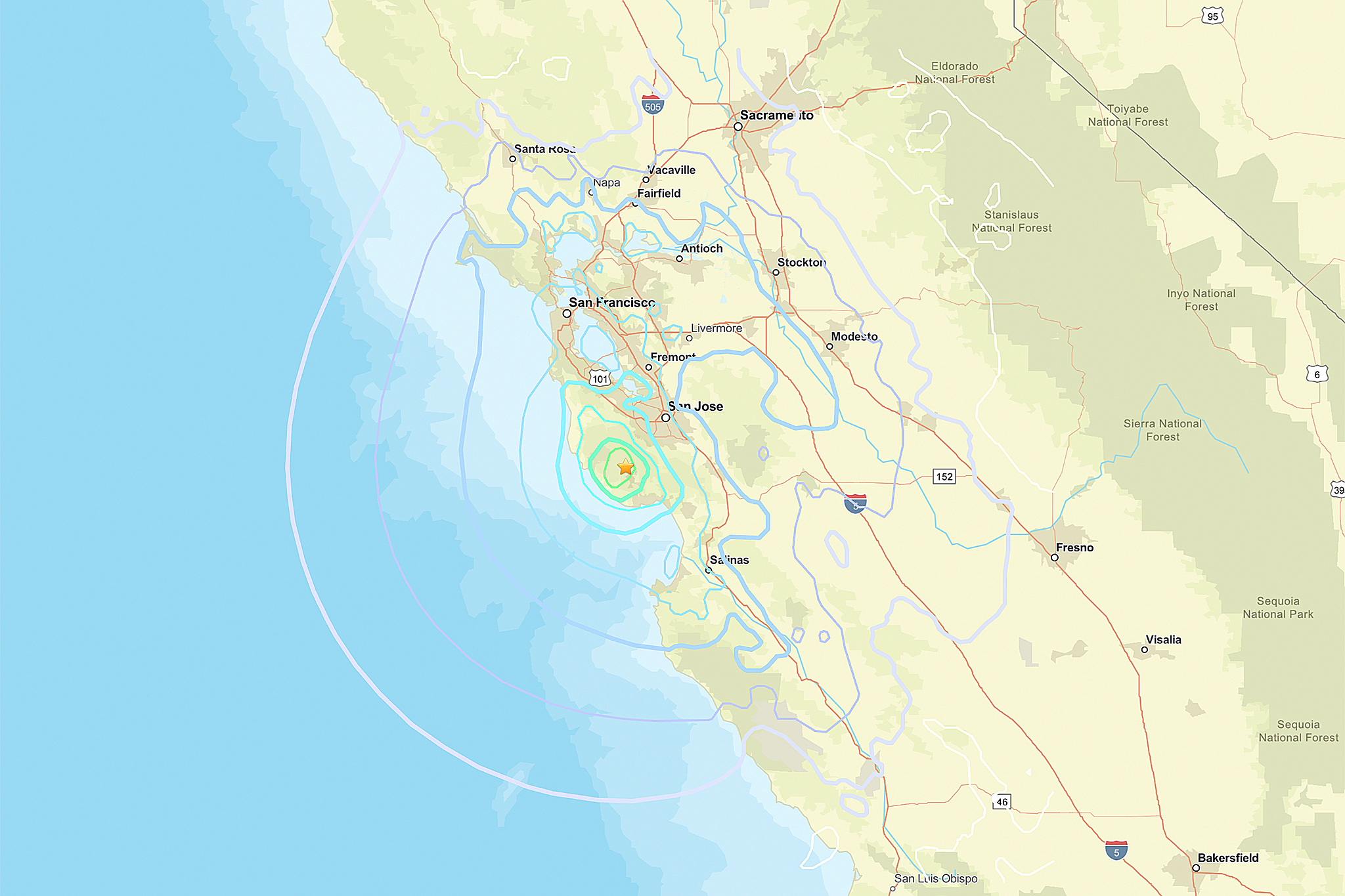
A magnitude 3.4 earthquake rumbled in the South Bay on Tuesday morning, according to the U.S. Geological Survey. The temblor struck at 6:48 a.m. and its epicenter was approximately 15 miles south of San Jose and 5 miles east-northeast of Gilroy. At least two small aftershocks were reported in the area shortly after the initial shaker; those shocks measured magnitude 1.3 and magnitude 1.0 respectively.
East Bay (California)
fromFast Company
1 month agoThis Berkeley building can snap back into place after a major earthquake
The rods are the central element of a novel seismic-responsive structural system that is designed to help the building snap back to its original shape in the event of a major earthquake. Their trick is an embedded cluster of taut cables made from a highly flexible compound called a shape-memory alloy that's capable of bending under tension-like the lateral shaking in a California earthquake-and then straightening out.
Science
fromMail Online
1 month agoEarthquake strikes America's Heartland above ancient volcanoes
Although Kansas has no active volcanoes, the region marks the southern reach of the Midcontinent Rift System, a massive tectonic event that nearly split North America apart in Earth's distant past. When magma forced its way through the crust during that period, it left behind hardened igneous rock and deep fractures that remain buried thousands of feet underground.
Science
fromSFGATE
1 month agoMagnitude 4.3 temblor felt in North Bay
An earthquake measuring at a preliminary magnitude of 4.3 shook Sonoma County on Saturday morning around 9:22 a.m., according to the U.S. Geological Survey. The temblor struck about 3.7 miles north-northwest of the Geysers, close to Healdsburg in the North Bay. Originally the quake was measured at a preliminary magnitude of 3.9 but that was revised to a preliminary 4.3 later in the morning by the USGS.
US news
fromwww.mercurynews.com
2 months agoBracing for the next big earthquake, San Jose plans to test out seismic retrofit financing program
The city passed legislation nearly 18 months ago requiring property owners to retrofit their multi-story, wooden-frame buildings with at least three units constructed before 1990. It delayed implementation, however, when the federal government rolled back significant funding to facilitate the repairs. But after a court-granted injunction required the release of some of those federal funds, the city approved a $1.6 million pilot financing program in hopes of rolling out a larger critical life-safety initiative in the future.
Real estate
fromwww.mercurynews.com
2 months agoWhy earthquake swarms happen and what they mean for California
Earthquakes usually strike without warning. But sometimes they come in clusters dozens or even hundreds of small quakes concentrated in one area over days or weeks. Geologists call these clusters earthquake swarms, and while they can be unsettling, scientists say they rarely signal that a major quake is imminent. Unlike the familiar pattern of a single large earthquake followed by aftershocks, swarms consist of many small quakes without a clear mainshock.
Science
fromwww.dw.com
2 months ago6.2-magnitude earthquake jolts western Japan DW 01/06/2026
A magnitude 6.2 earthquake hit western Japan on Tuesday, the country's meteorological agency said. The quake was relatively shallow, the meteorological service said, and struck around 10:18 a.m. local time (0118 GMT). There was no tsunami threat, the agency added. The US Geological Survey measured the quake at magnitude 5.7. The quake occurred in Shimane prefecture in northwestern Japan, impacting the cities of Matsue and Yasugi and nearby areas in Tottori prefecture.
World news
fromSFGATE
2 months agoHundreds of mini earthquakes rattle Joshua Tree National Park in 24 hours
The flurry of quakes rattled close to a relatively unknown fault called Blue Cut, according to Kate Scharer, a research geologist for the U.S. Geological Survey's Earthquake Hazards Program in Pasadena. "This happened in Joshua Tree National Park, a beautiful part of the world where many people have actually probably been and unknowingly traversed near this fault," Scharer told SFGATE. "This is a good reminder that there are many other faults besides the San Andreas in California that can give us a little jolt."
US news
[ Load more ]