Online learning
fromeLearning Industry
3 hours agoLeveraging Failure And Feedback For Rapid Adaptive Learning Growth
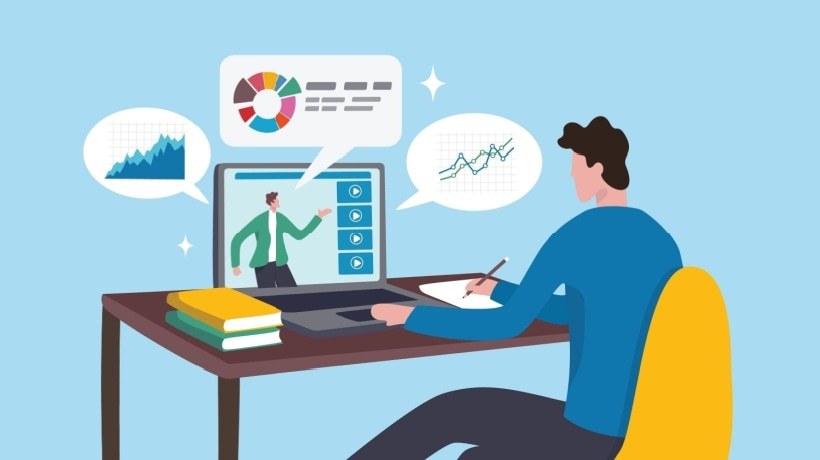
Learning from failure leads to faster skill acquisition and better retention in corporate training.
James Coltella had instructed students at Tonbridge School to sing sections of the song Marvin Gaye' by Charlie Puth, with lyrics including king size to ourselves and it's a Karma Sutra show and tell. In a witness statement, one of the pupils said that Mr Coltella would walk up and down the line, searching for eye contact.
Research has shown there is a reading for pleasure crisis among children in the UK, where enjoyment of books has fallen to its lowest level in two decades. Not so here at Christ Church primary, a tiny Church of England school tucked behind the maze of HS2 construction works in Camden, north London, where children fizz with excitement about books.
The most popular courses taken online were those required to graduate or electives typically used for university applications, raising concerns about the e-learning system.
This is a striking decision at a moment when public confidence in higher education is eroding. It is also puzzling because rigorous research and evaluation have demonstrated, over and over, the value of the work of centers for teaching and learning, including positive impacts on student learning outcomes, institutional effectiveness and faculty development.
Ministers have asked the exams watchdog, Ofqual, to extend current arrangements, providing GCSE maths, physics, and combined science students with formula sheets. Ofqual is consulting on extending this until current GCSEs are reformed following a curriculum review. The government will then consider if memorisation is required for new qualifications.
This idea was based on the parallel between the pluck and elan that are characteristic of both the early-college students I worked with and that of America's hardest-working founding father. Five years after I wrote the book, I had the opportunity to revisit the field for a revised edition, making it appropriate to ask, after Thomas Jefferson's song in the second act of Hamilton, "What'd I Miss": How has early college/dual enrollment changed over the past half decade?
You will notice the announcer of the following highlight reel continually returns to one word to describe Learner Tien's performance against Alexander Shevchenko in the second round of the Australian Open: control. The 20-year-old American tidily dispatched Shevchenko in two quick hours, half of which the Kazakh spent in apparent physical agony and the entirety of which Tien spent in command.
The most exciting moments for a teacher come when students stumble onto something unexpected-when they run to my office to tell me about a new twist in their thinking about birds in Sula or the discovery of yet another biblical reflection in Housekeeping. Those revelations come only when they survey the text as it is, not as they assume it to be.
One of my favorite movies is Good Will Hunting. Will Hunting (played by Matt Damon) is a 20-year-old janitor at the Massachusetts Institute of Technology. Although he works a blue-collar job, he is secretly a self-taught genius with an extraordinary gift for mathematics and an exceptional memory. One day, he anonymously solves a complex math problem left on a chalkboard by Professor Gerald Lambeau, astonishing the faculty.
Gathering training feedback is crucial because it shows whether your L&D initiatives are actually making a difference. While attendance metrics and completion rates give you surface-level insights, authentic feedback reveals how learners felt, what they understood, and which areas they struggled with. Feedback also identifies gaps between desired outcomes and real-world results.
Collective learning is how a group or system creates, improves, and keeps knowledge. This knowledge lasts beyond any one person or cohort. That is the most practical collective learning definition, because it shifts the focus away from individuals and toward the learning system itself.
Choosing the right training content isn't about how much training content you offer. It's about how well that content fits the job it needs to do. The real training challenge is not content. It's fit We often hear that teams need more training. But when we dig deeper, the problem is rarely a lack of courses. It's a lack of focus. Training often fails because different needs get lumped together into one giant learning initiative. For instance, it's impossible to use the same approach for teaching introduction to Python as for harassment prevention.
A German lesson is starting in a public-school classroom in the Philippines, and it opens with a greeting: "Guten Morgen," the teacher says. Students respond carefully, shaping unfamiliar sounds before moving on to short dialogues about directions, food, family, and eventually, culture. German has a reputation of being a difficult language to learn, but this also makes it a valuable assetImage: Stanley Gajete/DW In a Philippine public school, that routine still feels unusual.
The effort to get a snapshot of kindergarten readiness is part of the National Survey of Children's Health, which collected information from thousands of parents and guardians about their child in five areas - early learning, motor skills, social-emotional development, self-regulation and health. The goal was to answer an overall question: Is your child ready for school? Readiness in California is on par with the nation's average, which also puts kindergarten readiness at two-thirds of 3- to 5-year-olds.
Education is compulsory in France for children aged between three and 16 years of age. Schools can be public or private and, under certain circumstances, there is the possibility of home-schooling. Some parents moving to France may choose an international school for their children or teenagers, with lessons taught partly in English, sometimes following a UK or American curriculum. We moved to France with children aged 14 and 11 in 2018.
Scaling learning should be a sign of success. More employees. More roles. More regions. More skills to build. On the surface, these are the markers of a growing, forward-moving organization. But for many Learning and Development (L&D) teams, scaling learning feels less like progress and more like pressure. Every new hire cohort, geographic expansion, or capability initiative introduces friction. What once worked well for a few hundred employees begins to strain-and eventually break-when applied to thousands.
In today's digital learning environment, creating engaging and effective e-learning content requires more than just visually appealing graphics. It demands thoughtful structure, purposeful interactive design, and a deep understanding of how learners process information. Interactive experiences are not merely add-ons; they are powerful tools that can transform passive consumption into active learning. This article explores evidence-based strategies for designing interactive e-learning that delivers real learning impact.