#general-relativity

[ follow ]
Philosophy
fromBig Think
2 days ago

The flimsy case for evolving dark energy

Theoretical physicists risk falling into motivated reasoning by overly believing speculative ideas without sufficient supporting evidence.
#black-holes
Science
fromwww.scientificamerican.com
1 month ago

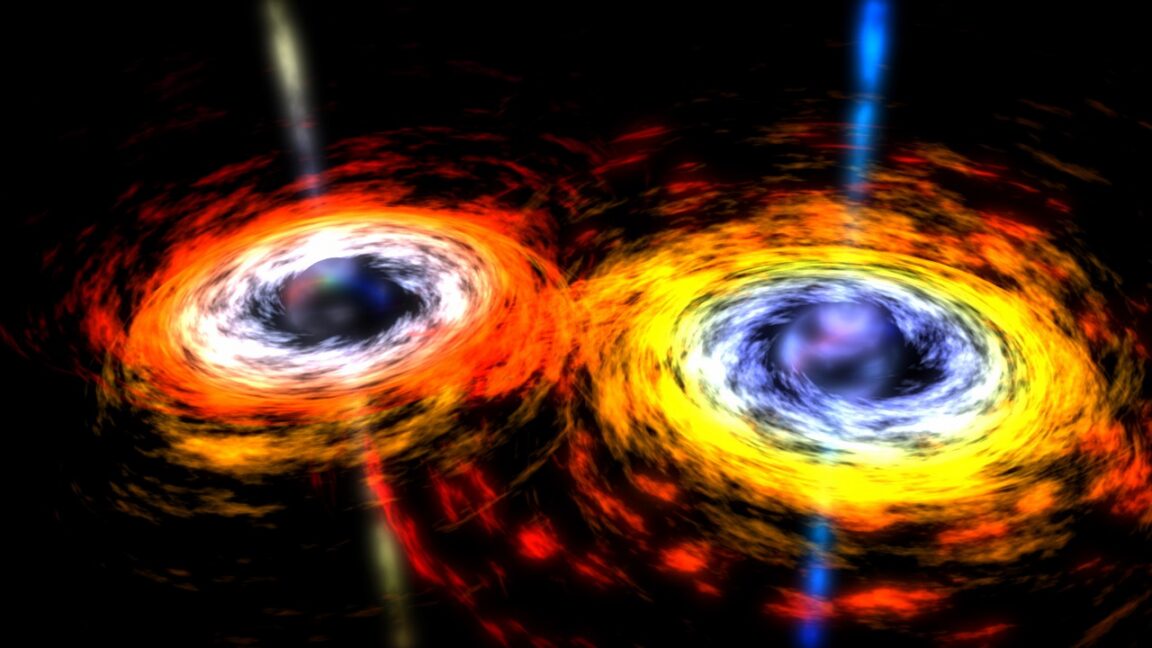
How much energy is released when supermassive black holes collide?

Binary black hole mergers release enormous energy and involve complex interactions near event horizons; many pairs are too distant to merge within the universe's age.
Science
fromBig Think
2 months ago

It's time to stop teaching the biggest lie about Hawking radiation

Hawking radiation arises from quantum-field effects near horizons; the popular particle–antiparticle pair popping explanation is incorrect and misleading.
OMG science
fromFuturism
2 weeks ago

Scientists Say Something Bizarre Is Hiding Inside Black Holes

Mathematicians and physicists propose that prime numbers could describe black hole interiors, offering a novel mathematical framework for understanding these cosmic mysteries.
#quantum-mechanics
Science
fromArs Technica
6 days ago

Getting formal about quantum mechanics' lack of causality

Superposition of temporal order is a fundamental feature of quantum mechanics, despite existing loopholes in current experiments.
Philosophy
fromwww.scientificamerican.com
2 weeks ago

A 100-year-old theory might explain what's wrong with quantum mechanics

Pilot wave theory, developed by Louis de Broglie a century ago, potentially resolves quantum mechanics' paradoxes by describing particles guided by attendant waves rather than existing in superposition.
#universe
OMG science
fromBig Think
3 days ago

The Universe has changed by the time you finish this sentence

The Universe undergoes profound changes over time, despite appearing static on human timescales.
OMG science
fromBig Think
1 week ago

Ask Ethan: Does dark energy curve the Universe over time?

The fate of the Universe is determined by the total energy present and its relation to the initial expansion rate.
Philosophy
fromThe Conversation
4 days ago

Are multiverses real? An astrophysicist explains why it depends on how you define 'real'

The existence of the multiverse remains hypothetical, with no direct sensory evidence but potential indirect effects.
Philosophy
fromBig Think
2 weeks ago

Einstein showed space can curve, but data reveals a flat Universe

The Universe has a flat spatial geometry, confirmed through cosmic microwave background observations, rather than the curved or spherical shape many physicists theoretically preferred.
Science
fromBig Think
3 weeks ago

A quirk of relativity is the closest thing to achieving immortality

While immortality is impossible due to thermodynamic laws, relativity reveals physical scenarios that maximize lifespan relative to the universe by manipulating spacetime through motion and gravity.
OMG science
fromwww.scientificamerican.com
1 week ago

We thought we knew the shape of the universe. We were wrong

The shape of the universe remains unknown, with three possible geometries and the cosmic microwave background as a key to understanding its topology.
Science
fromwww.scientificamerican.com
3 weeks ago

Have astronomers found a runaway monster black hole or just a very weird galaxy?

Astronomers discovered RBH-1, a potentially runaway supermassive black hole traveling at over three million kilometers per hour, though ambiguous data makes its true nature uncertain.
fromBig Think
1 week ago

Gravity and quantum physics are fundamentally incompatible

General Relativity has yet to let us down. Its success rate is 100%, from tabletop experiments to gravitational lensing and the formation of the great cosmic web.
OMG science
#superluminous-supernovae
Science
fromArs Technica
3 weeks ago

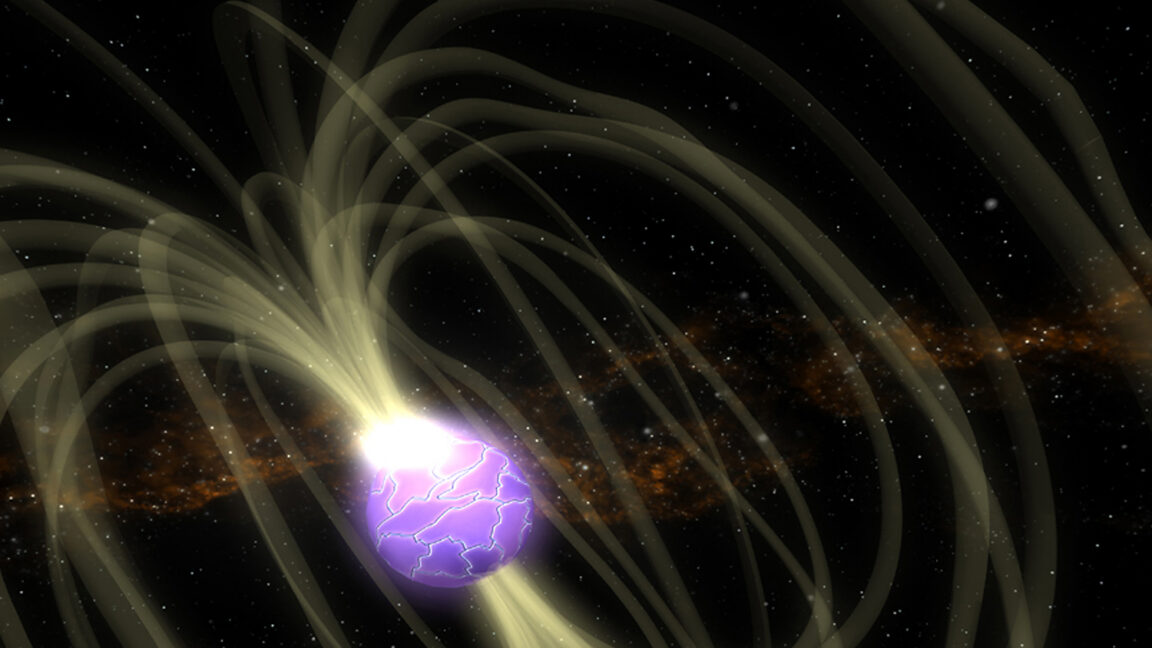
Magnetars drag spacetime to power superluminous supernovae

Frame-dragging from rapidly spinning magnetars explains the irregular light patterns observed in superluminous supernovae, resolving a long-standing discrepancy between theory and observations.
OMG science
fromBig Think
2 weeks ago

The case for and against a 5th fundamental force of nature

Current physics theories cannot explain fundamental cosmic mysteries like matter-antimatter asymmetry, dark matter, dark energy, and cosmic inflation, suggesting undiscovered forces or phenomena remain.
#gravitational-waves
fromwww.scientificamerican.com
2 weeks ago
OMG science

A boom in gravitational waves leaves scientists with more questions than answers

A global network of gravitational-wave observatories has detected 218 candidate events, revealing complex structures in cosmic mergers and providing unprecedented insights into the universe.
fromwww.scientificamerican.com
4 weeks ago
OMG science

Newly discovered ripples in spacetime put Einstein's general relativity to the test

A global network of gravitational wave observatories has more than doubled detections of cosmic collisions, revealing a universe filled with black holes, neutron stars, and their mergers with unprecedented variety and characteristics.
OMG science
fromwww.scientificamerican.com
2 weeks ago

A boom in gravitational waves leaves scientists with more questions than answers

A global network of gravitational-wave observatories has detected 218 candidate events, revealing complex structures in cosmic mergers and providing unprecedented insights into the universe.
OMG science
fromwww.scientificamerican.com
4 weeks ago

Newly discovered ripples in spacetime put Einstein's general relativity to the test

A global network of gravitational wave observatories has more than doubled detections of cosmic collisions, revealing a universe filled with black holes, neutron stars, and their mergers with unprecedented variety and characteristics.
OMG science
fromBig Think
2 weeks ago

Why "CPT" is the Universe's most unbreakable symmetry

CPT symmetry is a fundamental, unbreakable symmetry that applies universally to all physical laws and phenomena in the Universe.
fromBig Think
2 weeks ago

OJ 287 has the most supermassive pair of black holes ever

The closest supermassive black hole pair, in NGC 7727, was discovered in 2021. Just 89 million light-years away, these 154,000,000- and 6,300,000-solar-mass black holes are just 1,600 light-years apart. Approximately 0.1% of young quasars are expected to be doubles, with typical separations of ~10,000 light-years.
OMG science
fromBig Think
1 month ago

Ask Ethan: Can quantum entanglement survive a black hole?

According to Einstein's General Relativity, for every black hole that exists within the Universe, there are only three properties that go into it that matter in any way: the black hole's total mass, the black hole's net electric charge, and the black hole's intrinsic angular momentum, and that's it. It doesn't matter what type of matter went into the black hole in order to form it; all that matters is its mass, charge, and angular momentum.
Science
OMG science
fromBig Think
3 weeks ago

Ask Ethan: How dark will the Universe become?

The Universe will eventually become dark and sparse as stars exhaust their fuel and die, with approximately 95% of all stars already formed, allowing estimation of future cosmic dimming.
OMG science
fromMail Online
3 weeks ago

Astronomers watch the birth of a magnetar for the first time

Astronomers observed the birth of a magnetar, an extremely dense neutron star with the universe's most powerful magnetic fields, through a superluminous supernova's unusual flickering light pattern over 200 days.
fromBig Think
1 month ago

How Einstein revolutionized the meaning of "where" and "when"

We now recognize that even ideas like "when" and "where" are subject to the laws of Einstein's relativity, and that in relativity, space and time are not absolute quantities, but rather are relative to each and every unique observer.
Science
#dark-matter
fromFuturism
1 month ago
Science

The Object at the Core of the Milky Way Might Not Be a Black Hole at All, Scientists Say

OMG science
fromFuturism
4 weeks ago

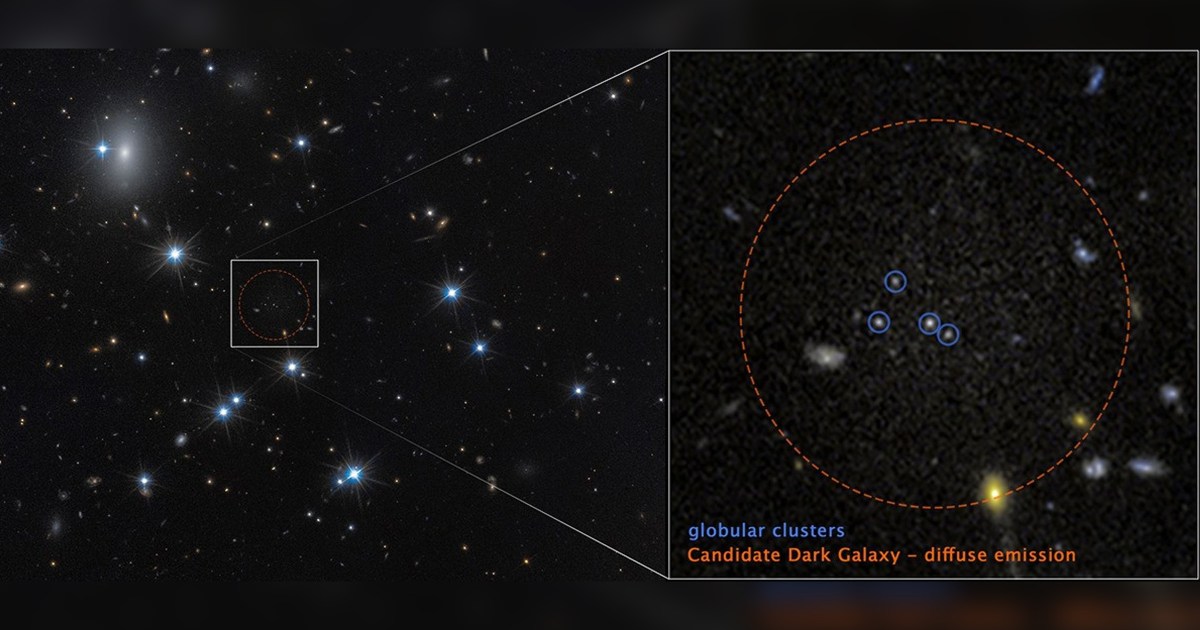
Hubble Spots Bizarre Galaxy That Appears to Be 99.9 Percent Dark Matter

Astronomers discovered galaxy CDG-2, composed of at least 99.9 percent dark matter, representing one of the most dark matter-dominated galaxies ever found and a candidate for theoretical dark galaxies.
OMG science
fromBig Think
1 month ago

Did Hubble's new "dark galaxy" kill modified gravity?

Dark matter, an undetected particle form distinct from Standard Model particles, dominates the Universe's matter content and is essential for explaining cosmic structures, though recent discoveries like CDG-2 present new puzzles about satellite galaxy formation and dark matter's nature.
fromFuturism
1 month ago
Science

The Object at the Core of the Milky Way Might Not Be a Black Hole at All, Scientists Say

Science
fromNature
1 month ago

Runaway black hole leaves a trail of stars

A supermassive black hole was ejected from a nearby galaxy and is traveling through the intergalactic medium, creating a trail of newly formed stars.
fromBig Think
1 month ago

Ask Ethan: Will anything persist when the Universe dies?

Star-formation will eventually end, and then the last shining stars will burn out. Galaxies will dissociate due to gravitational interactions, ejecting all masses and leaving only supermassive black holes behind. And then those black holes will decay via Hawking radiation, leaving only cold, stable, isolated bodies, from which no further energy can be extracted, all accelerating away from us within our dark energy-dominated Universe.
Science
fromFuturism
1 month ago

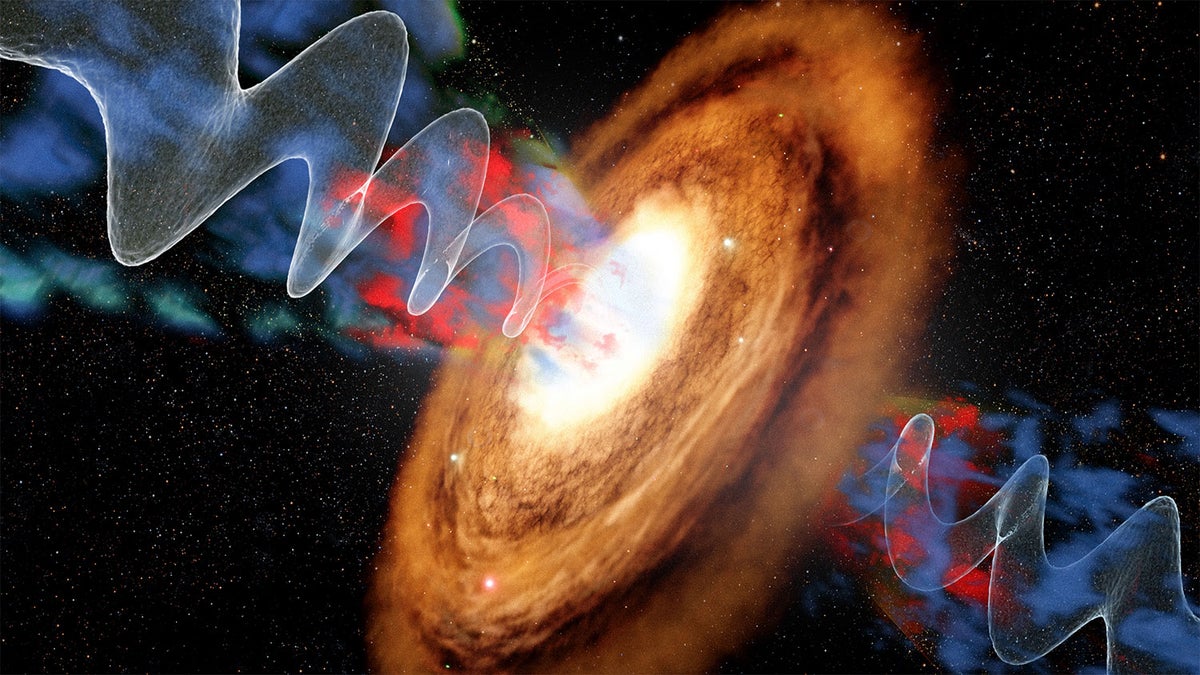
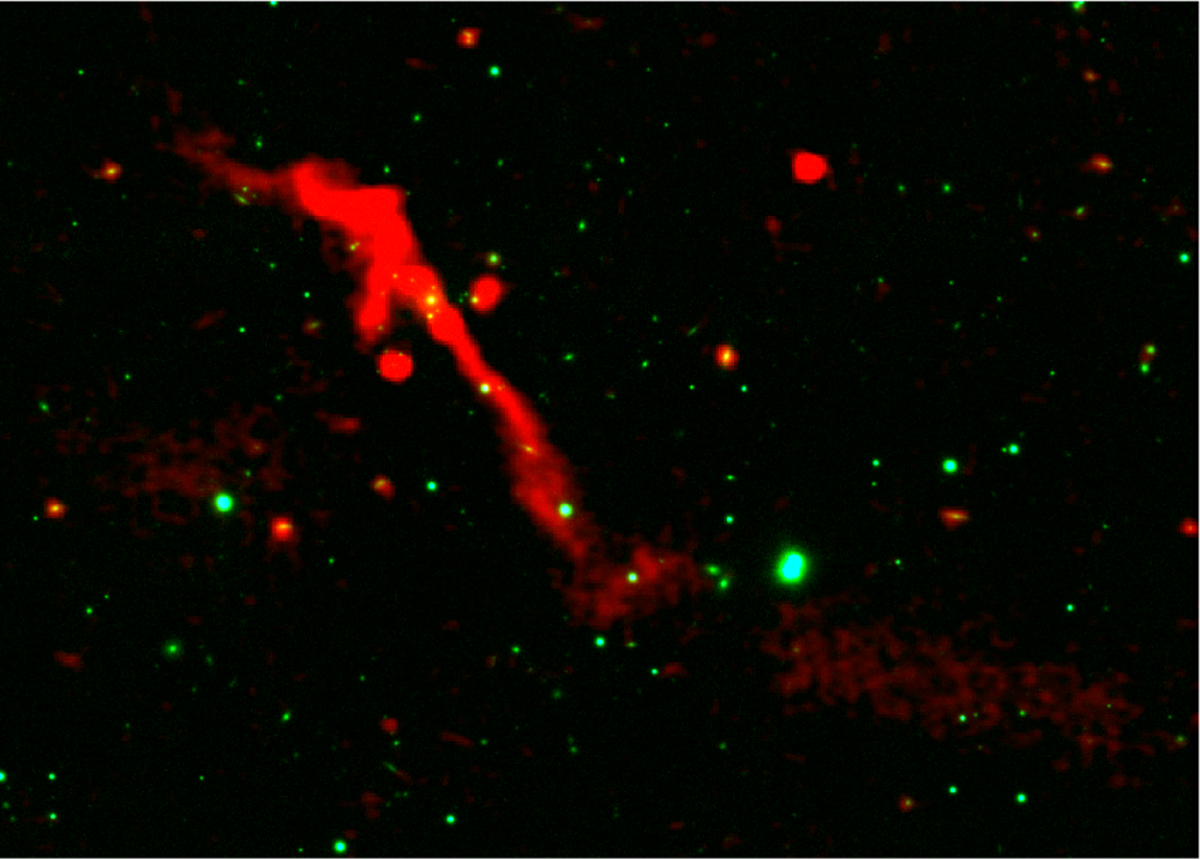
Astronomers Spot Huge Microwave Laser Blasting Into Space

This system is truly extraordinary. We're seeing the radio equivalent of a laser halfway across the universe. Fundamentally, masers and lasers are focused beams of light in the same frequency. In the realm of astrophysics, these can arise from clouds of dust being excited into a higher energy state from the light emitted by other sources, like stars and black holes.
OMG science
#big-bang
#time
fromAeon
1 month ago
Philosophy

Time is real - if you view it through the lens of heat | Aeon Videos

fromAeon
1 month ago
Philosophy

Time is real - if you view it through the lens of heat | Aeon Videos

Science
fromBig Think
2 months ago

Ask Ethan: What does "gravitationally bound" mean in the expanding Universe?

Gravitationally bound systems remain together when mutual gravity overcomes cosmic expansion; only stronger expansion or external influences can separate bound components.
Science
fromFuturism
1 month ago

Physicists Think They Saw a Black Hole Explode

Primordial black holes can evaporate via Hawking radiation and may explosively release particles, potentially explaining a powerful 2023 neutrino detection.
fromwww.scientificamerican.com
1 month ago

Astronomers spot one of the largest spinning structures in the universe

The first time that University of Oxford astronomer Lyla Jung saw the cosmic configuration on her monitor, she almost didn't believe it was real. But it wasand Jung and her colleagues went on to identify one of the largest rotating structures ever found in space: a chain of galaxies embedded in a spinning cosmic filament 400 million light-years from Earth. The finding, published in Monthly Notices of the Royal Astronomical Society, may give astronomers new insights into galaxies' formation, evolution and diversity, Jung says.
Science
fromFuturism
2 months ago

Astronomers Intrigued By Impossible Structure Around Dead Star

A dead star 730 light years away appears to be forming a powerful structure around itself - and despite their best efforts, astronomers aren't sure how. The cosmic corpse, designated RXJ0528+2838, is an incredibly dense stellar remnant known as a white dwarf, with a Sun-like star orbiting around it. This binary arrangement isn't uncommon throughout the universe, but what is strange is the structure surrounding the former body: a highly energetic and luminescent cloud known as a nebula,
Science
#tidal-disruption-event
#supermassive-black-hole
Science
fromBig Think
2 months ago

The most underappreciated achievement in theoretical physics

Modern physics explains luminous matter, black holes, gravity, cosmic expansion, and particle interactions through the Standard Model, quantum field theory, and General Relativity.
Science
fromwww.scientificamerican.com
2 months ago

3,000-light-year-long jet offers new clues to first black hole ever imaged

Probable base of M87*'s 3,000-light-year jet identified on the black hole's glowing ring using Event Horizon Telescope observations.
Science
fromwww.scientificamerican.com
1 month ago

Physicists trace particles back to the quantum vacuum

RHIC experiments traced virtual particle pairs evolving into real, spin-aligned particle pairs, indicating vacuum fluctuations can produce correlated spin descendants.
fromwww.scientificamerican.com
2 months ago

The biggest explosions in the universe, ranked

The universe is exploding. Or parts of it are. The night sky may seem calm, even serene, but that masks events of a catastrophic and nearly unimaginable scale. Across the galaxy and even the cosmos itself, immense outbursts of energy occur that could easily vaporize our planet. Happily, space is vast, and the terrible distance between these events and us diminishes what we see to a faint glowusually.
OMG science
fromwww.npr.org
1 month ago

Have astronomers witnessed the birth of a black hole?

A bright star in a nearby galaxy has essentially vanished. Astronomers believe that it died and collapsed in on itself, transforming into the eerie cosmic phenomenon known as a black hole. "It used to be one of the brightest stars in the Andromeda galaxy," says Kishalay De, an astronomer with Columbia University and the Flatiron Institute. "Today, it is nowhere to be seen, even with the most sensitive telescopes."
Science
Science
fromFuturism
2 months ago

Outer Space Is a Viscous Fluid, New Paper Claims

Outer space behaves like a viscous, stretchy fluid with "spatial phonons" that resist dark energy, producing nonuniform cosmic expansion and explaining ΛCDM discrepancies.
Science
fromwww.theguardian.com
2 months ago

Astronomers aim to take revolutionary' moving image of black hole

Astronomers will use the Event Horizon Telescope to record the first movie of the M87 supermassive black hole to study its rotation and jet-launching mechanisms.
Science
fromBig Think
1 month ago

Ask Ethan: Can we see the expanding Universe changing?

Cosmic expansion stretches photon wavelengths and alters observability, producing extremely small real-time effects detectable only via precise, long-term redshift drift measurements.
Science
fromFuturism
1 month ago

Scientists Intrigued as Prominent Star Suddenly Winks Out of Existence

A massive Andromeda star (M31-2014-DS1) brightened, faded, and vanished, consistent with a failed supernova leading to direct collapse into a stellar-mass black hole.
fromwww.scientificamerican.com
2 months ago

The Milky Way's Central Black Hole May Have Appeared Shockingly Different Just a Few Hundred Years Ago

Supermassive black holes are mysterious bodies. Scientists aren't entirely sure how these beating hearts at the centers of most large galaxies formed. That includes Sagittarius A* (Sgr A*), the supermassive black hole at the center of our own Milky Way galaxy. Now a new preprint study is shedding light on Sagittarius A* by studying what happens as material falls toward the black hole.
Science
fromEngadget
2 months ago

Astronomers share new insights about the early universe via the Webb Space Telescope

With Webb, we are able to see farther than humans ever have before, and it looks nothing like what we predicted, which is both challenging and exciting,
Science
fromwww.scientificamerican.com
1 month ago

How can galaxies ever collide in an ever-expanding universe?

Okay, first thing first: the universe is in fact expanding. We've known this for more than a century now, and it's the basis for modern cosmology. This idea is called the big bang modelwhich is an unfortunate name because it brings to mind a cosmos expanding like an explosion, with galaxies moving away from each other through space like shrapnel. But in fact space itself is expanding, and that's different.
Science
Science
fromwww.scientificamerican.com
1 month ago

Scientists may have discovered a pulsar at the Milky Way's hearta result that could reveal new physics

A pulsar near Sagittarius A* would enable more precise measurements of spacetime and gravitational effects around the Milky Way's central supermassive black hole.
Science
fromwww.scientificamerican.com
2 months ago

Stunningly Hot Galaxy Cluster Puts New Spin on How These Cosmic Behemoths Evolved

Galaxy cluster SPT2349-56 contained gas at least five times hotter than predicted when the universe was 1.4 billion years old.
[ Load more ]