#hgp-write

[ follow ]
#cloning
fromFuturism
4 days ago
Science

A Startup Has Been Quietly Pitching Cloned Human Bodies to Transfer Your Brain Into

fromFuturism
1 week ago
OMG science

Scientists Cloned a Mouse, Then Cloned the Clone, Et Cetera. The Results Were Horrific

fromNature
1 week ago
OMG science

Can a mouse be cloned indefinitely? Decades-long experiment has answers

Science
fromFuturism
4 days ago

A Startup Has Been Quietly Pitching Cloned Human Bodies to Transfer Your Brain Into

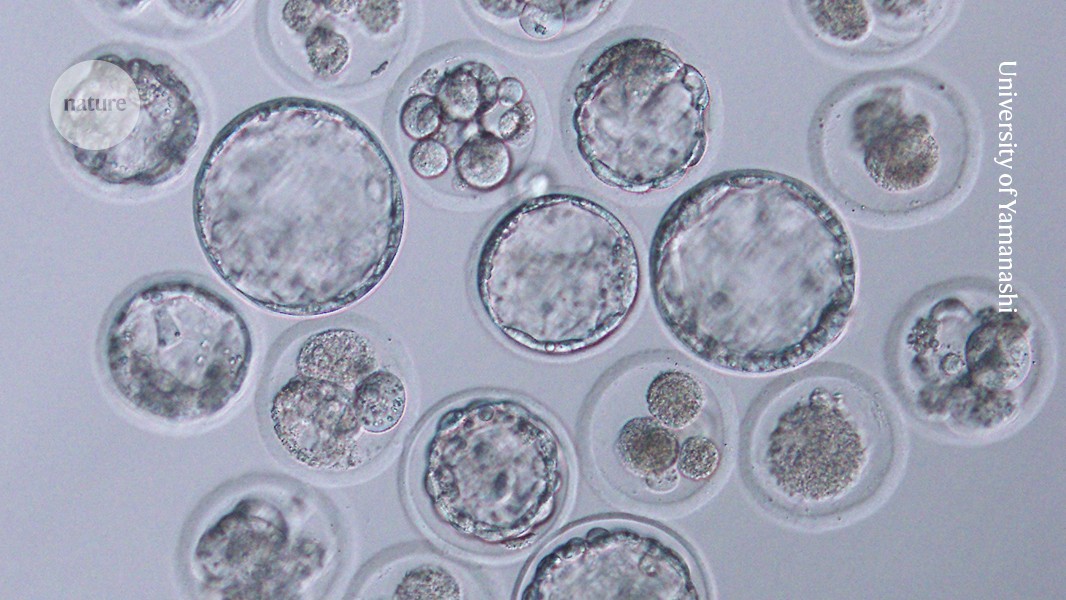
Cloning efforts have evolved from animals to controversial human embryo models, with ambitions for brainless human clones for organ transplants.
OMG science
fromFuturism
1 week ago

Scientists Cloned a Mouse, Then Cloned the Clone, Et Cetera. The Results Were Horrific

Cloning mice for 58 generations led to immediate death of offspring, revealing limits to mammalian cloning.
OMG science
fromNature
1 week ago

Can a mouse be cloned indefinitely? Decades-long experiment has answers

Asexual reproduction in mice is unsustainable due to accumulating mutations, limiting the potential for successful cloning.
#crispr
Artificial intelligence
fromFortune
2 weeks ago

Could data from 100 million species help cure disease? One startup is betting on it | Fortune

Basecamp Research launches the Trillion Gene Atlas to map genetic diversity across 100 million species, aiming to expand biological knowledge 100-fold through AI-powered genomic data collection.
Science
fromNature
1 week ago

Zombieland: Genome transplant brings 'dead' bacteria back to life

Researchers have revived 'dead' bacterial cells by replacing their DNA with a working genome from another species, advancing genome engineering.
fromNature
2 weeks ago

In vivo site-specific engineering to reprogram T cells - Nature

Using CRISPR-Cas9 and adeno-associated virus (AAV)-mediated homology-directed repair, we targeted CAR integration into the endogenous human TCR alpha locus (TRAC). TRAC-CAR T cells display dynamic CAR expression that delays exhaustion and improves tumour control in xenograft and immunocompetent models. This work has been critical for the development of allogeneic CAR T cell therapy, as it disrupts the TCR after transgene insertion—a necessary step to limit graft-versus-host disease.
Cancer
Medicine
fromThe Atlantic
2 weeks ago

Everyone Is a Biohacker Now

Vyleesi, a prescription female libido drug, is being purchased off-label by men through online retailers exploiting 'research use only' disclaimers to circumvent prescription requirements.
Data science
fromwww.scientificamerican.com
3 weeks ago

OpenAI and Ginkgo Bioworks show how AI can accelerate scientific discovery

OpenAI's GPT successfully designed and iterated on biology experiments autonomously, demonstrating AI capability in scientific hypothesis generation, experimental design, and result interpretation beyond summarization tasks.
Cancer
fromThe Verge
2 weeks ago

ChatGPT did not cure a dog's cancer

An Australian entrepreneur used ChatGPT and AI tools to help develop a personalized mRNA vaccine for his dog's cancer, but the actual scientific process was far more complex than the viral narrative suggested.
Medicine
fromBusiness Matters
2 weeks ago

UK biotech Ternary raises 3.6m to scale AI platform for next-generation drugs

Ternary Therapeutics secured £3.6 million in seed funding to develop an AI-driven platform for engineering molecular glues, a new class of medicines that bring proteins together to destroy disease-causing targets.
Science
fromNature
2 weeks ago

Synthetic circuits for cell ratio control - Nature

Synthetic biology enables artificial cell differentiation and division of labor by engineering genetic and epigenetic circuits that mimic natural stem cell asymmetric division processes.
Artificial intelligence
fromwww.npr.org
3 weeks ago

ChatGPT might give you bad medical advice, studies warn

AI chatbots provide medical information to millions daily but often mislead users because people lack training in effectively communicating symptoms to these systems.
Silicon Valley
fromKqed
1 month ago

How South San Francisco Became the Birthplace of Biotechnology | KQED

South San Francisco transformed from an industrial meatpacking and steel manufacturing hub into the world's biotechnology capital, hosting over 250 biotech companies including Genentech.
Science
fromScienceDaily
3 weeks ago

A lab mistake at Cambridge reveals a powerful new way to modify drug molecules

Cambridge researchers developed an LED-powered photochemical technique that enables late-stage modification of complex drug molecules without toxic chemicals or metal catalysts, accelerating drug development.
Left-wing politics
fromTruthout
1 month ago

Reproductive Tech That Promises Smart Babies Is Peddling Soft Eugenics

Reproductive tech companies now offer embryo genetic screening for intelligence and disease, raising concerns about eugenics, disability discrimination, and wealth-based genetic enhancement.
Healthcare
fromwww.theguardian.com
1 month ago

Unbelievably dangerous': experts sound alarm after ChatGPT Health fails to recognise medical emergencies

ChatGPT Health fails to recognize medical emergencies in over half of cases, potentially endangering users by recommending home care instead of emergency department visits.
Science
fromArs Technica
1 month ago

Large genome model: Open source AI trained on trillions of bases

Evo 2, an AI system trained on trillions of base pairs from all life domains, can identify genes, regulatory sequences, and splice sites in complex genomes including humans.
fromwww.nature.com
1 month ago

Genetically encoded assembly recorder temporally resolves cellular history

GEMINI leverages a computationally designed protein assembly as an intracellular memory device to record the history of individual cells. GEMINI grows predictably within live cells, capturing cellular events as tree-ring-like fluorescent patterns for imaging-based retrospective readout. Absolute chronological information of activity histories is attainable with hour-level accuracy.
US news
fromwww.npr.org
2 months ago

'ChatGPT saved my life.' How patients, and doctors, are using AI to make a diagnosis

AI chatbots like ChatGPT can provide timely medical triage, influence urgent care decisions, and are increasingly integrated into patient-facing healthcare tools.
fromNature
1 month ago

AI tools can design genomes. Will they upend how life evolves?

Biology is undergoing a transformation. After centuries of studying life as it evolves naturally, researchers are now using a combination of computation and genome engineering to intervene, generating new proteins and even whole bacteria from scratch. The use of artificial-intelligence tools to design biological components, an approach known as generative biology, is set to turbocharge this area of research. Just last year, scientists used AI-assisted design to produce artificial genes that can be expressed in mammalian cells.
Science
Public health
fromZDNET
2 months ago

40 million people globally are using ChatGPT for healthcare - but is it safe?

Over 40 million people use ChatGPT daily for medical advice, creating safety concerns because chatbots can give dangerously inaccurate healthcare information.
fromArs Technica
1 month ago

Have we leapt into commercial genetic testing without understanding it?

Martschenko's argument is largely that genetic research and data have almost always been used thus far as a justification to further entrench extant social inequalities. But we know the solutions to many of the injustices in our world-trying to lift people out of poverty, for example-and we certainly don't need more genetic research to implement them. Trejo's point is largely that more information is generally better than less.
Science
OMG science
fromNature
1 month ago

Regulatory grammar in human promoters uncovered by MPRA-based deep learning - Nature

Massively parallel reporter assays provide cell-type-specific causal training data enabling more direct inference of DNA sequence effects on promoter activity than epigenomic maps.
Medicine
fromThe Washington Post
1 month ago

David Liu unlocks the power of gene editing to treat rare genetic diseases

Base and prime gene-editing technologies can precisely correct genetic mutations, enabling personalized therapies that can cure life-threatening inherited diseases.
Artificial intelligence
fromNew Relic
2 months ago

Observability for ChatGPT Apps in the Age of Agentic AI

Implement robust observability and telemetry to detect AI-rendered UI failures, hallucinations, and performance issues and ensure reliable, business-worthy AI content.
fromThe Verge
1 month ago

ChatGPT's deep research tool adds a built-in document viewer so you can read its reports

OpenAI is updating ChatGPT's deep research tool with a full-screen viewer that you can use to scroll through and navigate to specific areas of its AI-generated reports. As shown in a video shared by OpenAI, the built-in viewer allows you to open ChatGPT's reports in a window separate from your chat, while showing a table of contents on the left side of the screen, and a list of sources on the right.
Artificial intelligence
Medicine
fromNature
1 month ago

China's biotech boom: why the nation must collaborate to stay ahead

China leads in drug manufacturing and biotech innovation, but geopolitical scrutiny and moves toward a closed biotech ecosystem threaten scientific collaboration and global medicine access.
fromwww.nature.com
2 months ago

Collective intelligence for AI-assisted chemical synthesis

The exponential growth of scientific literature presents an increasingly acute challenge across disciplines. Hundreds of thousands of new chemical reactions are reported annually, yet translating them into actionable experiments becomes an obstacle1,2. Recent applications of large language models (LLMs) have shown promise3,4,5,6, but systems that reliably work for diverse transformations across de novo compounds have remained elusive. Here we introduce MOSAIC (Multiple Optimized Specialists for AI-assisted Chemical Prediction), a computational framework that enables chemists to harness the collective knowledge of millions of reaction protocols.
Medicine
fromArs Technica
2 months ago

ChatGPT Health lets you connect medical records to an AI that makes things up

ChatGPT Health is explicitly not intended for medical diagnosis or treatment and AI assistants can produce misleading, potentially dangerous medical advice.
Science
fromNature
2 months ago

Construction of complex and diverse DNA sequences using DNA three-way junctions - Nature

DNA writing remains limited by short oligo synthesis and two-way junction assembly methods, hindering affordable, scalable construction of large, complex synthetic DNA.
Science
fromWIRED
2 months ago

He Went to Prison for Gene-Editing Babies. Now He's Planning to Do It Again

He Jiankui created the first gene-edited babies, was jailed and banned, and now seeks to resume controversial genetic research despite widespread germline-editing prohibitions.
Science
fromMail Online
2 months ago

Scientists use AI to create a virus never seen before

Scientists used AI and gene-assembly tools to create Evo-Φ2147, a novel 11-gene virus designed to kill pathogenic E. coli.
Science
fromwww.scientificamerican.com
2 months ago

Google DeepMind unleashes new AI to investigate DNA's dark matter'

AlphaGenome predicts functional effects of mutations in long noncoding DNA sequences up to one million base pairs, helping interpret genomic variants for disease research.
Science
fromwww.nature.com
2 months ago

Scalable and multiplexed recorders of gene regulation dynamics across weeks

CytoTape enables multiplexed, genetically encoded, spatiotemporally scalable recording of gene regulation dynamics in single cells for up to three weeks with minute-scale resolution.
Science
fromwww.theguardian.com
2 months ago

Google DeepMind launches AI tool to help identify genetic drivers of disease

AlphaGenome predicts how mutations alter gene regulation to identify disease-driving variants, map tissue-specific functional elements, and guide gene-therapy design.
Science
fromNature
2 months ago

'Remote controlled' proteins illuminate living cells

Engineered magnetically sensitive fluorescent proteins enable remote modulation of brightness in cells and animals, offering quantum-based control for biosensors and potential therapies.
Science
fromwww.theguardian.com
1 month ago

On the Future of Species by Adrian Woolfson review are we on the verge of creating synthetic life?

Humans are on the verge of creating synthetic species that will coexist with natural life, offering major benefits while posing significant ecological and ethical risks.
fromFortune
2 months ago

AI drug startup Insilico Medicine launches an AI 'gym' to help models like GPT and Qwen be good at science | Fortune

Generalist models "fail miserably" at the benchmarks used to measure how AI performs scientific tasks, Alex Zhavoronkov, Insilico's founder and CEO, told Fortune. " You test it five times at the same task, and you can see that it's so far from state of the art...It's basically worse than random. It's complete garbage." Far better are specialist AI models that are trained directly on chemistry or biology data.
Science
[ Load more ]