UX design
fromMedium
4 hours agoYou're not supposed to get it right
Design challenges for UX writers can be intimidating due to the pressure of making quick, impactful decisions and the emphasis on visual elements.
Santa Cruz de Tenerife is one of the most idyllic cities in the Canary Islands. At its heart stands the jewel - the Auditorio. It's a place where talent from both worlds, New and Old, comes together. A theatre, opera, dance, and music heaven.
The convenience of sourcing online is fraught with more pitfalls than most of us want to admit. Try finding adequate photos of a vintage piece's condition-close-ups of the fabric, video of damaged areas, any images of a piece's rear or underside!
For decades in SAAS, products reduced ambiguity. Users supplied constrained inputs, and the system handled the output. It's never been Minority Report cinematic, but it was predictable. By providing predictable environments for manipulating data, users learned by moving things, adjusting variables - and the outcome emerged through interaction.
Instructions I created. Instructions I am continuing to hone - instructions that required me to study my own old essays, identifying what I do when I write. The sentence rhythms. The way I move between timescales. The zooming in and out from concept to detail. The instructions tell Claude how I would like ideas composed. I pull together concepts and experiences from my lived expertise to formulate a point of view - in this case, on this new AI technology.
The normative form for interacting with what we think of as "AI" is something like this: there's a chat you type a question you wait for a few seconds you start seeing an answer. you start reading it you read or scan some more tens of seconds longer, while the rest of the response appears you maybe study the response in more detail you respond the loop continues
Today we are at the cusp of revolutions in artificial intelligence, autonomous vehicles, renewable energy, and biotechnology. Each brings extraordinary promise, but each introduces more complexity, more interdependence, and more latent pathways to failure. This elevates prudence to be critical. Good design recognizes what cannot be foreseen. It acknowledges the limits of prediction and control. It builds not merely for performance, but for recovery.
The question dropped into the Slack channel before the user research summary. Before the problem was clearly defined. Before anyone asked if users actually needed this feature. Your product manager already generated three interface options in ChatGPT. Now they're asking which one to build. Not whether to build. Not why to build. Which. And when you slow the conversation down to ask those questions, you're about to discover that strategic thinking now reads as bottleneck behavior.
Your junior designer spins up a prototype in Lovable before lunch. Your PM shows you a "working" MVP built entirely with Cursor within a day. And your CEO forwards you a LinkedIn post about how AI will replace 80% of UI work by 2026. And it seems like anyone can now make an app to solve a specific problem. Has the graphical interface really died, as Jakob Nielsen provocatively suggests?
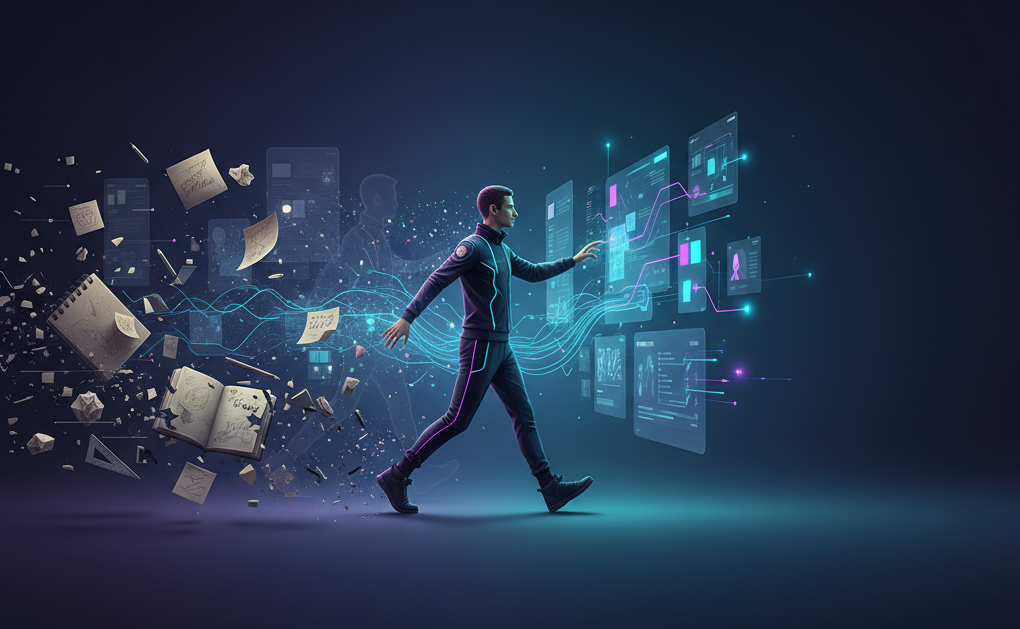
AI is disrupting more than the software industry, and is doing so at a breakneck speed. Not long ago, designers were deep in Figma variables and pixel-perfect mockups. Now, tools like v0, Lovable, and Cursor are enabling instant, vibe-based prototyping that makes old methods feel almost quaint. What's coming into sharper focus isn't fidelity, it's foresight. Part of the work of Product Design today is conceptual: sensing trends, building future-proof systems, and thinking years ahead.
Something's been slowly shifting in the design zeitgeist. I've been watching my feed on X and the vibe has changed. More and more, I see designers sharing finished experiments or prototypes they coded themselves, rather than static Figma files. Moving from working on a canvas to talking to an LLM. The conversation isn't "here's a design I made" anymore... it's "here's something I shipped this afternoon."