#kotlinconf-2025
#kotlinconf-2025
[ follow ]
#ai #kotlin #open-source #ai-agents #developer-tools #ai-assisted-development #android #java #developer-productivity


Software development
fromThe NodeSource Blog - Node.js Tutorials, Guides, and Updates
2 weeks agoJavaScript Is Evolving Faster Than Ever - And JSConf Spain Made It Impossible to Ignore
JavaScript is evolving into a platform for intelligence, infrastructure, and decision-making systems, transforming how developers build and think.



Data science
fromScalac - Software Development Company - Akka, Kafka, Spark, ZIO
2 weeks agoScalendar April 2026
April 2026 features major tech conferences including Applied Machine Learning Conference, Google Cloud Next, ACM CHI, and JPoint, covering ML systems, data platforms, human-AI interaction, and JVM performance.
fromTechzine Global
1 week agoOpenTelemetry accepts Kotlin SDK for mobile observability
The SDK provides observability support for Kotlin Multiplatform (KMP) projects on Android, iOS, and JavaScript via a single standardized API, giving the cloud-native community a vendor-neutral Kotlin implementation.
Java
fromSubstack
3 weeks agoFriday Links #36: JavaScript, AI Tools, and Ecosystem Updates
The TypeScript team released an early preview of TypeScript 6. This release is mainly about internal changes preparing for the future Go-based compiler planned for TypeScript 7. Large monorepos could see dramatic speed improvements once the Go compiler lands.
JavaScript


DevOps
fromInfoQ
2 weeks agoQCon London 2026: Managing Asynchronous APIs at Scale
Event-driven architectures require explicit specifications, governance, and provisioning practices to scale beyond informal ad-hoc approaches, using tools like AsyncAPI to enable discovery, schema consistency, and automated infrastructure deployment.
Software development
fromInfoQ
2 weeks agoQCon London 2026: Rewriting All of Spotify's Code Base, All the Time
Spotify uses Honk, an AI-powered coding agent, to perform large-scale code migrations across its codebase, achieving 1,000 merged pull requests every 10 days by handling edge cases that deterministic scripts cannot resolve.
Software development
fromInfoQ
2 weeks agoQCon London 2026: From Prompt to Production: How Spotify Builds Internal Tools in Days with AI
Spotify accelerates internal tool development by combining its Portal Studio platform with AI assistance, solving the problem of small tools being too important to ignore yet too resource-intensive to justify dedicated engineering teams.
fromInfoWorld
3 weeks agoJetBrains unveils AI tracing library for Kotlin and Java
Tracy is compatible with Kotlin from version 2.0.0 and Java from version 17. Integrations can be made with SDKs from OpenAI, Anthropic, and Gemini. The library also works with common Kotlin/LLM stacks including OkHttp and Ktor clients, as well as OpenAI, Anthropic, and Gemini ones.
Java
Software development
fromDevOps.com
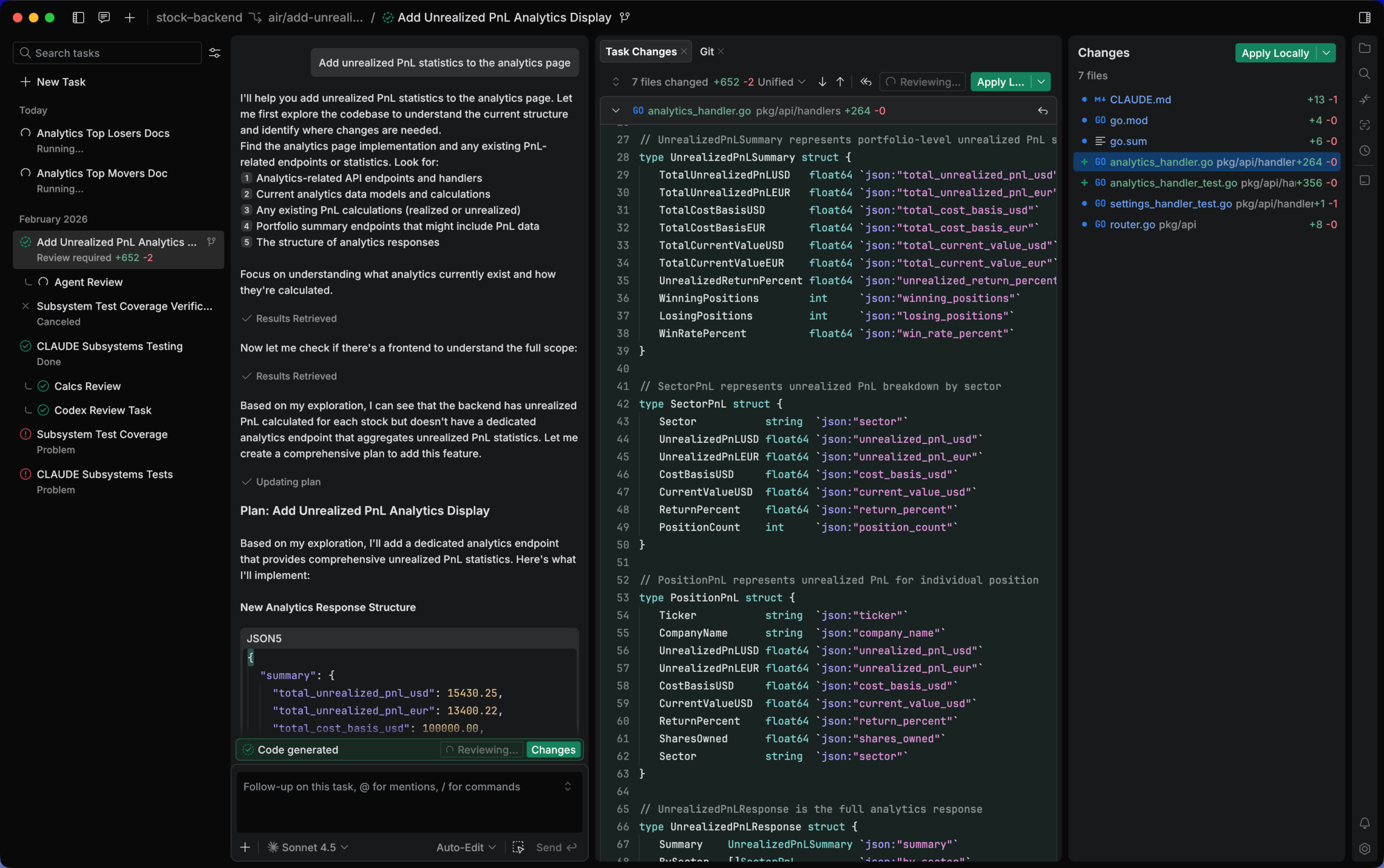
3 weeks agoJetBrains Launches Air and Junie CLI to Blend Traditional IDE with AI Agents - DevOps.com
JetBrains launched Air, an agentic development environment, and Junie CLI, an LLM-agnostic coding agent, to enable developers to delegate tasks to multiple concurrent AI agents within a unified workspace.
Artificial intelligence
fromTechzine Global
1 month agoRemote Control extends Claude Code to the mobile app
Anthropic's Remote Control for Claude Code enables developers to continue local coding sessions across phones, tablets, and browsers while maintaining all processing on their local machine with automatic synchronization.

fromCSS-Tricks
2 months agoPostcard From Web Directions Dev Summit, 2025 | CSS-Tricks
When I was a kid, there used to be a Museum railway station in Melbourne, Australia. In 1995, it changed its name to match the shopping center above it - a microcosm of how the mentality of my home city has shifted - but Sydney still has a Museum station. The aesthetics of Sydney's Museum Station evoke London Underground vibes as my train from Sydney Airport stops under Hyde Park, the oldest public park in Australia and the first to be named after its more
Web development
Gadgets
fromYanko Design - Modern Industrial Design News
2 months agoThis Phone Runs Android, Linux, and Windows to Replace 3 Computers - Yanko Design
NexPhone is a rugged, high-spec Android handset that can multi-boot Android, Debian Linux, and optionally Windows 11 on Arm to serve as phone and desktop.
fromInfoWorld
2 months agoCompose Multiplatform brings auto-resizing to interop views
Also in version 1.10.0, Compose Multiplatform now uses the Web Cache API to cache successful responses for static assets and string resources. This avoids the delays associated with the browser's default cache, which validates stored content through repeated HTTP requests and can be slow on low-bandwidth connections. The cache is cleared on every app launch or page refresh to ensure resources remain consistent with the application's current state. This capability is an experimental feature.
Mobile UX
fromThe JetBrains Blog
1 month agoPython Unplugged on PyTV - A Free Online Python Conference for Everyone | The PyCharm Blog
Join us on March 4th 2026, for an unforgettable, non-stop event, streamed from our studio in Amsterdam. We'll be joined live by 15 well-known and beloved speakers from Python communities around the globe, including Carol Willing, Deb Nicholson, Sheena O'Connell, Paul Everitt, Marlene Mhangami, and Carlton Gibson. They'll be speaking about topics such as core Python, AI, community, web development and data science.
Python
fromMedium
2 months agoFrom Scala to Kotlin: A Frustrated Engineer's Honest Take
Over the past months, I've watched two clients move from Scala (Play, Slick, Akka, Akka Http ... ) to Kotlin (Spring, JPA/Hibernate). In my current role, an engineering decision was made to move away from Scala. The decision was driven less by Scala's shortcomings and more by long-term career risk management: leaders understandably favor stacks (Java/Kotlin) that maximize hiring flexibility in a volatile market.
Scala
fromEngadget
1 month agoGoogle I/O 2026 is set for May 19 and 20
As has been the case for several years, Google revealed the conference's dates for 2026 after enough folks completed a puzzle on the I/O website. This year's puzzle has multiple "builds" to play through, all of which use Gemini. They start with a mini-golf game in which a virtual caddy that's powered by Gemini offers some of the most anodyne advice imaginable.
Artificial intelligence


fromRealpython
1 month agoWhy You Should Attend a Python Conference - Real Python
Prerequisites This guide is for all Python users who want to grow their Python knowledge, get involved with the Python community, or explore new professional opportunities. Your level of experience with Python doesn't matter, and neither does whether you use Python professionally or as a hobbyist-regularly or only from time to time. If you use Python, you're a Python developer, and Python conferences are for Python developers!
Python
fromArs Technica
1 month agoXcode 26.3 adds support for Claude, Codex, and other agentic tools via MCP
This is achieved via Model Context Protocol (MCP), an open protocol that lets AI agents work with external tools and structured resources. Xcode acts as an MCP endpoint that exposes a bunch of machine-invocable interfaces and gives AI tools like Codex or Claude Agent access to a wide range of IDE primitives like file graph, docs search, project settings, and so on.
Apple
Mobile UX
fromTechCrunch
2 months agoConsumers spent more on mobile apps than games in 2025, driven by AI app adoption | TechCrunch
In 2025, global consumer spending on non-game mobile apps exceeded spending on games for the first time, driven largely by rapid generative AI adoption and revenue growth.
fromInfoWorld
2 months agoWhich development platforms and tools should you learn now?
Software development used to be simpler, with fewer choices about which platforms and languages to learn. You were either a Java, .NET, or LAMP developer. You focused on AWS, Azure, or Google Cloud. Full-stack developers learned the intricacies of selected JavaScript frameworks, relational databases, and CI/CD tools. In the best of times, developers advanced their technology skills with their employer's funding and time to experiment. They attended conferences, took courses, and learned the low-code development platforms their employers invested in.
Software development
[ Load more ]