#learning-names
#learning-names
[ follow ]
#language-learning #ai #multilingualism #cognitive-neuroscience #communication #word-learning #anendophasia

#language-learning
Online learning
fromwww.theguardian.com
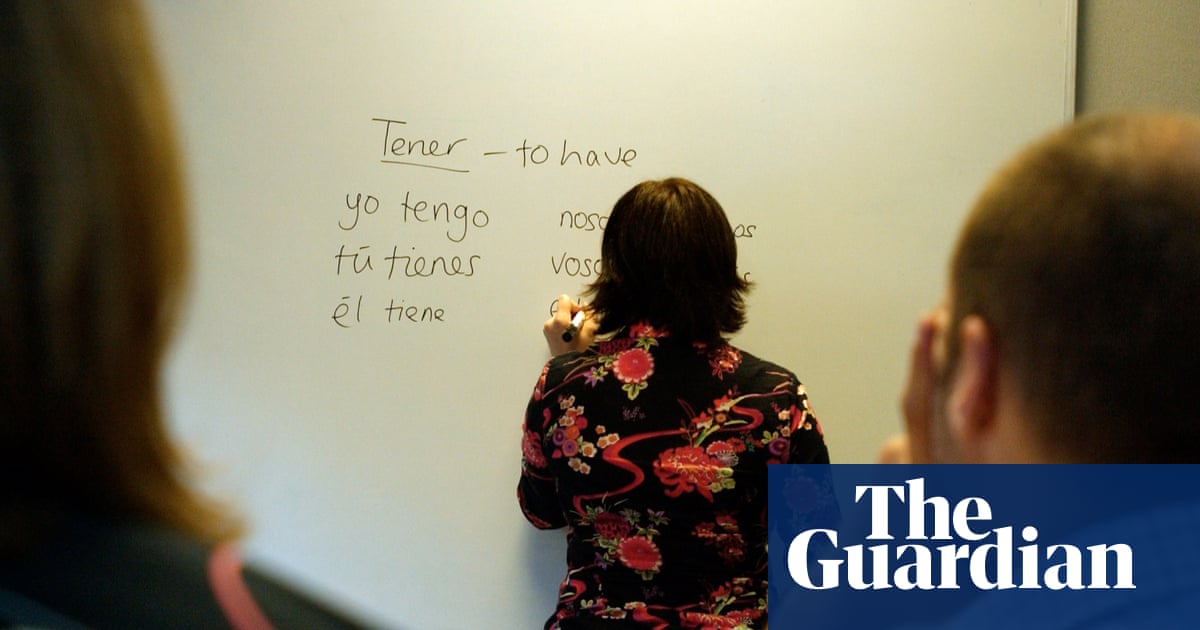
5 days agoDon't stop at Duolingo, set realistic goals, balance skills: how to start learning a new language
Being multilingual enhances sophistication, cultural understanding, and cognitive abilities, making language learning beneficial for personal and social growth.
Online learning
fromwww.theguardian.com
5 days agoDon't stop at Duolingo, set realistic goals, balance skills: how to start learning a new language
Being multilingual enhances sophistication, cultural understanding, and cognitive abilities, making language learning beneficial for personal and social growth.
fromPsychology Today
1 week agoWhat Reading Fluency Has to Do With Leadership: Nothing
The assumption that difficulty with reading or writing signals lower intelligence or diminished leadership ability is not supported by evidence. Decades of research show little to no correlation between dyslexia and lower general intelligence.
Education
Psychology
fromSilicon Canals
1 week ago9 cognitive habits people develop when they grew up bilingual that have nothing to do with language and everything to do with how their brain learned to hold two realities at once - Silicon Canals
Bilingualism can delay Alzheimer's onset by five years and reshapes cognitive processes beyond language.
fromwww.scientificamerican.com
2 weeks agoCan you solve these language puzzles? Test your skills with these problems from North America's biggest linguistics competition
Computational linguistics is a two-way street: You're either using a computer to do things with human language or communicate or translate or teach a foreign language, or you're using computational techniques to learn something about human languages. Her work documenting and preserving endangered languages uses a little bit of both.
Education
fromwww.theguardian.com
3 weeks agoIt's like a giant book club': how schools are getting children excited about reading again
Research has shown there is a reading for pleasure crisis among children in the UK, where enjoyment of books has fallen to its lowest level in two decades. Not so here at Christ Church primary, a tiny Church of England school tucked behind the maze of HS2 construction works in Camden, north London, where children fizz with excitement about books.
Books
fromMail Online
2 weeks agoNursery rhymes should be confined to HISTORY lessons, woke expert says
'We absolutely should challenge stereotypes about ageing. Children do build their understanding of the world from these tiny repeated narratives. If old always equals useless or confused then that's going to shape their perception.'
Psychology
OMG science
fromMail Online
3 weeks agoScientists recreate the lost languages of ancient humans
Scientists reconstructed ancient human species languages by analyzing fossilized skeletal imprints of soft tissues like the larynx, tongue, and brain, revealing that Neanderthals likely spoke languages understandable to early Homo sapiens.
Online learning
fromOpen Culture
2 weeks agoLearn Ancient Greek in 118 Free Lessons: A Free Online Course from Brandeis & Harvard
Leonard Muellner and Belisi Gillespie have created 118 YouTube videos covering two semesters of college-level Introduction to Ancient Greek, aligned with the textbook Greek: An Intensive Course.
France news
fromThe Local France
1 month agoAsk the expert: When is the best time to start learning French?
Learning French before moving to France is essential because immersion after arrival is significantly more difficult than expected, as the nervous system enters survival mode while managing multiple life changes simultaneously.
Artificial intelligence
fromPsychology Today
4 weeks agoAnti-Intelligence: When Language Operates Without a Mind
AI generates language through a fundamentally different structural architecture than human cognition, not through inferior intelligence but through inverted processes detached from lived experience and stakes.
Higher education
fromNews Center
1 month agoAI Model Predicts Language Development in Children with Hearing Loss - News Center
Advanced machine learning models predict spoken language outcomes in children with cochlear implants more accurately than traditional approaches, enabling identification of at-risk patients for targeted interventions.
Psychology
fromSilicon Canals
2 weeks agoPsychology says people who remember the exact location of every item in their childhood home - which drawer, which shelf, which cupboard - aren't sentimental, their brain mapped that house the way a body maps a minefield, and the precision that looks like nostalgia is actually surveillance that never turned off - Silicon Canals
Detailed childhood home memories reflect survival-based hypervigilance rather than nostalgia, with brains mapping familiar spaces like tactical terrain to navigate unpredictable or chaotic environments.
fromThe Nation
1 month agoCan the Dictionary Keep Up?
The Merriam-Webster editor Peter Sokolowski introduced the crowd of assembled nerds to the idea that a dictionary is not a static document but a living object, constantly updated and remade in response to how people write and speak. In a talk titled "The Dictionary as Data," Sokolowski emphasized that the editors at Merriam-Webster look to how the general public uses language to guide their work.
Typography
Education
fromSilicon Canals
3 weeks agoPsychology says people who educated themselves through reading and curiosity instead of formal degrees solve problems in a fundamentally different way - and these 8 cognitive patterns explain why classrooms can't replicate it - Silicon Canals
Self-taught learners achieve innovative solutions by connecting learning directly to problems they want to solve, rather than learning subjects first and seeking applications later.
Psychology
fromSilicon Canals
3 weeks agoI used to think I had a terrible memory until I realized I can recall every tone shift in every argument my parents ever had but not what I ate yesterday. My memory works fine. It was just trained on threat detection instead of daily life. - Silicon Canals
People from unpredictable environments develop heightened memory for threat signals and emotional cues as a survival mechanism, not a memory deficiency.
Education
fromPsychology Today
1 month agoFluent at Home, Silent at Work: Growing Up Bilingual
Heritage speakers lack formal language instruction in their native language, creating gaps in professional and academic domains that they internalize as personal failure rather than systemic educational gaps.
France news
fromThe Local France
1 month agoEndless rain, Montpellier, and growing up bilingual: 6 essential articles for life in France
France faces prolonged rain; Paris and Montpellier attract Americans; bilingual upbringing requires balance; 2026 mutuelle hikes can be challenged; selling property incurs hidden costs.
fromHarvard Gazette
1 month agoAudiobooks don't really count as reading? Think again. - Harvard Gazette
The neural networks that process written and oral language are deeply intertwined and largely overlap when reading print books or listening to audiobooks. There isn't much of a difference between the brain network for reading and the brain network for language comprehension. The brain area we call the 'letter box,' which processes print, is not as engaged when you listen, but it has been shown that when some people listen to words, they visualize them, so the letter box gets activated as well.
Education
fromBuzzFeed
2 months agoI Hate To Break It To You, But There's A Huge Chance You've Been Saying Extremely Common Words And Phrases Wrong Your Entire Life
1. Tongue in cheek 2. Old wives' tales 3. Statute of limitations 4. To be specific 5. Nipped in the bud 6. Get down to brass tacks 7. Deep-seated hatred 8. All intents and purposes 9. Wheelbarrow 10. Champing at the bit 11. Jury-rigged 12. Ulterior motive 13. Bald-faced lie 14. Dog eat dog world 15. Chump change 16. Dime a dozen 17. Duct tape 18. Can't see the forest for the trees 19. Quote unquote 20. Could have 21. Chalk it up 22. Iced tea 23. Take for granted 24. Blessing in disguise 25. Bated breath
Writing
fromPsychology Today
2 months agoIs It Better to Learn a Second Language as a Child or Adult?
Parents often hear the warning: "If your child doesn't learn a second language early, they'll never be fluent." Adults, meanwhile, are told: "It's just too late for you to learn now." These claims are familiar and tidy, but misleading. Are they actually true? Is it better to learn a second language as a child or as an adult? The short answer is that it depends on what we mean by "better."
OMG science
fromwww.theguardian.com
1 month agoReading and writing can lower dementia risk by almost 40%, study finds
US researchers found that engaging in intellectually stimulating activities throughout life, such as reading, writing or learning a new language, was associated with a lower risk of Alzheimer's disease, the most common form of dementia, and slower cognitive decline. The study author Andrea Zammit, of Rush University Medical Center in Chicago, said the discovery suggested cognitive health in later life was strongly influenced by lifelong exposure to intellectually stimulating environments.
Public health
Silicon Valley
fromSilicon Canals
1 month agoPsychology says people who still use complete sentences in text messages share 7 cognitive traits that are becoming increasingly rare - Silicon Canals
Maintaining full sentences and proper punctuation in digital messages correlates with stronger impulse control and deeper information processing, reflecting healthier cognitive habits.
fromSilicon Canals
1 month ago7 phrases you should always avoid if you want to sound intelligent, according to psychology - Silicon Canals
You know that sinking feeling when you realize you've been using a phrase that makes you sound less intelligent than you actually are? I had one of those moments a few years back during a pitch meeting for my startup. I was presenting to potential investors, and I kept saying "I think" before every point I made. "I think our user acquisition strategy will work."
Startup companies
fromThe Atlantic
2 months agoAI's Memorization Crisis
In fact, when prompted strategically by researchers, Claude delivered the near-complete text of Harry Potter and the Sorcerer's Stone, The Great Gatsby, 1984, and Frankenstein, in addition to thousands of words from books including The Hunger Games and The Catcher in the Rye. Varying amounts of these books were also reproduced by the other three models. Thirteen books were tested.
Intellectual property law
fromwww.theguardian.com
2 months agoGifted learner dogs' can learn words by eavesdropping, study says
Scientists have discovered canines with the unusual ability to learn the names of myriad objects can pick up such labels by eavesdropping on conversations. The team say such abilities are thought to rely on a host of social cognitive skills, from identifying the relevant word within a conversation to using cues from people's gaze, gestures, and voices to understand what the word refers to.
Pets
fromPsychology Today
2 months agoDon't Get Lost in Translation
Led Zeppelin warned us about the perils of misunderstood communications in relationships. Failing to translate what we are trying to say or do so that someone else gets it is the root of so many problems. But translation is a fantastic find when it goes right. Here are some things I've learned about translating meaning from a lifetime of speaking numerous languages, practicing a wide array of martial arts, and communicating science.
Philosophy


fromPsychology Today
1 month agoAre There Linguistic Conspiracy Theories?
The term "conspiracy theory" calls to mind a variety of dubious claims and controversies, like rumors about Area 51, claims that the Earth is flat, and the movement known as QAnon. At first blush, these phenomena would seem to have little in common with bogus word origins. But there are a variety of false etymologies that spread virally and refuse to go away, in much the same way that stories about chemtrails, black helicopters, and UFOs refuse to die.
Writing
fromThe Atlantic
1 month agoWords Without Consequence
For the first time, speech has been decoupled from consequence. We now live alongside AI systems that converse knowledgeably and persuasively-deploying claims about the world, explanations, advice, encouragement, apologies, and promises-while bearing no vulnerability for what they say. Millions of people already rely on chatbots powered by large language models, and have integrated these synthetic interlocutors into their personal and professional lives. An LLM's words shape our beliefs, decisions, and actions, yet no speaker stands behind them.
Philosophy
fromPsychology Today
1 month agoAI Can Help Solve the Reading Achievement Gap
During this Black History Month, let us attend for a moment to the reading achievement gap, as it affects all of us regardless of race. Here's why. Lack of literacy is linked to some of the biggest and costliest problems in society: spiralling special education spending, school dropouts, juvenile delinquency, incarceration, poverty, and mental health (NSBA, 2019; Vacca, 2008; Vacca, 2004; Nelson & Gregg, 2012). We all pay for these problems, at the very least in taxes.
Education
Education
fromSilicon Canals
1 month ago7 words highly intelligent people use in conversation that average people mispronounce - Silicon Canals
Correct pronunciation of commonly mispronounced words often reflects extensive reading, attention to language, and habitual auditory correction rather than showing off.
Psychology
fromwww.theguardian.com
2 months agoI see sounds as shapes. Synaesthesia has given me an extraordinary ability for languages
Auditory-visual synaesthesia produces vivid visual imagery from sound, facilitating exceptional language learning but complicating everyday tasks like driving with loud music.
fromPsychology Today
2 months agoTech Tools for Spelling May Stunt Children's Literacy Growth
Rather than using the visual word form area in the reading brain, where images of correct spellings are stored in long-term memory for automatic proficient reading and composing, kids use technology tools, eliminating human thinking and making the machine do the work. These tools can circumvent cognitive processes, hindering elementary students from developing a large bank of correctly spelled words essential for automatic reading and literacy.
Education
fromOpen Culture
1 month agoWhy Some People Think in Words, While Others Think in Pictures & Feelings
Take the sur­prise some have expressed in recent years upon find­ing out that the expres­sion to "pic­ture" some­thing in one's head isn't just a fig­ure of speech. You mean that peo­ple "pic­tur­ing an apple," say, haven't been just think­ing about an apple, but actu­al­ly see­ing one in their heads? The inabil­i­ty to do that has a name: aphan­ta­sia, from the Greek word phan­ta­sia, "image," and prefix - a, "with­out."
Psychology
fromwww.theguardian.com
2 months agoI see time as a grid in my mind. I remember the birthdays of friends I haven't seen for 65 years
Did someone with spatial-sequence synaesthesia design the calendar app on mobile phones? Because that's how time and dates look in my brain. If you say a date to me, that day appears in a grid diagram in my head, and it shows if that box is already imprinted with a holiday, event or someone's birthday. Public holidays and special events like Christmas and Easter are already imprinted for the year, and the diagram goes backwards to about 100,000BC
Psychology
Psychology
fromSilicon Canals
1 month agoPsychology says people who grew up without digital reminders often maintain these 9 internal memory systems - Silicon Canals
Adults who matured before smartphones developed internal cognitive systems—spatial mental maps and narrative memory chains—that shape how they process, retain, and organize information.
Education
fromFuturism
2 months agoNew Study Finds AI in Schools Is Undermining Kids' Social and Intellectual Development
Generative AI in schools currently poses greater risks than benefits, undermining children's cognitive development, learning engagement, memory retention, and social skill formation.
[ Load more ]