#luminiscence
#luminiscence
[ follow ]
#animal-behavior #quantum-computing #magnetars #neutron-stars #superluminous-supernovae #bioluminescence

Psychology
fromwww.scientificamerican.com
2 weeks agoThese fish can tell when you're staring
Fish can perceive when they or their offspring are being watched and respond with increased aggression, demonstrating attention attribution abilities previously documented mainly in primates, birds, and domestic animals.
OMG science
fromwww.theguardian.com
2 weeks agoButterflies crossing oceans, moths navigating by the stars: unravelling the mysteries of insect migrations
Insects, including butterflies and dragonflies, undertake massive long-distance migrations across continents and oceans, with trillions traveling annually over previously unknown routes.
fromArs Technica
2 weeks agoThe science of how fireflies stay in sync
The fireflies were most likely to change their own flashing rhythm in response when the LED blinked almost, but not quite, at the same time as the fireflies. The males would speed up their next flash if the LED blinked just before and waited a bit longer for their next flash when the LED blinked right after.
Science
fromMail Online
2 weeks agoHumanity receives mysterious 'mega-laser' signal from unknown source
This system is truly extraordinary. We are seeing the radio equivalent of a laser halfway across the universe. This galaxy acts as a lens, the way a water droplet on a window pane would, because its mass curves the local space-time. So we have a radio laser passing through a cosmic telescope before being detected by the powerful MeerKAT radio telescope.
Science
OMG science
fromMail Online
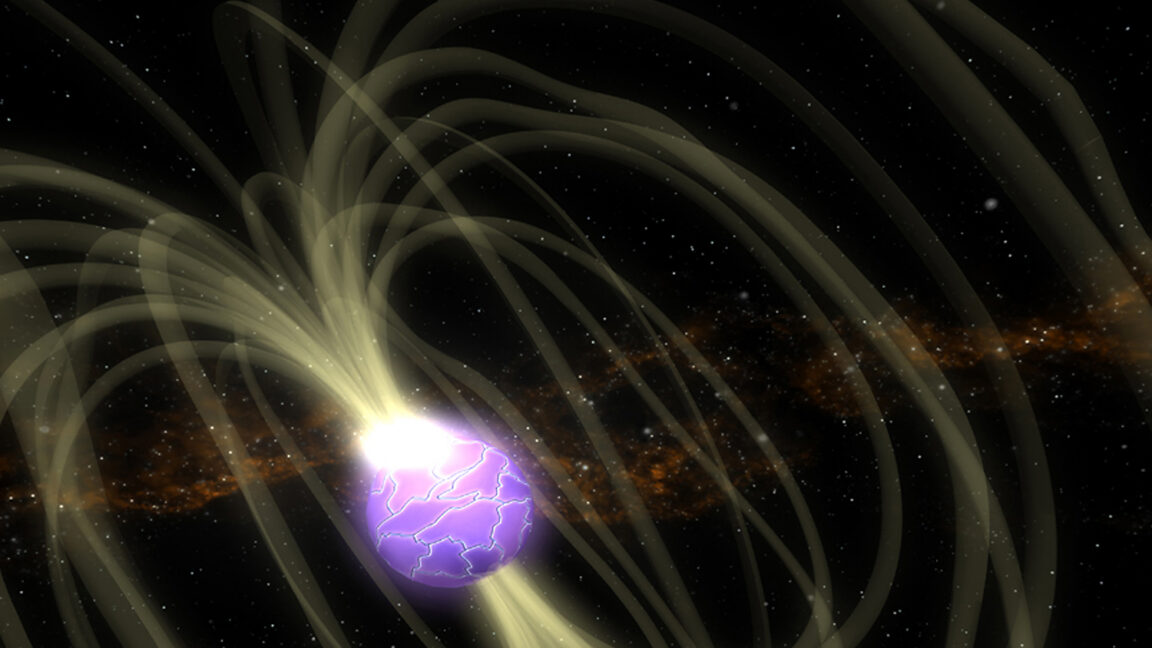
3 weeks agoAstronomers watch the birth of a magnetar for the first time
Astronomers observed the birth of a magnetar, an extremely dense neutron star with the universe's most powerful magnetic fields, through a superluminous supernova's unusual flickering light pattern over 200 days.


Environment
fromABC7 San Francisco
1 month agoTracking fisherman to track fish: The new technological approach to better understand ocean life
Global Fishing Watch uses AIS transponder data and artificial intelligence to track fishing vessels worldwide, providing unprecedented visibility into global fishing fleet movements and activities.
Science
fromNature
3 weeks agoMultimodal electron microscopy of halide perovskite interfacial dynamics - Nature
Halide perovskite LEDs suffer rapid operational degradation due to ion migration and interfacial electrochemical reactions, requiring atomic-scale in situ imaging to understand degradation mechanisms and improve device stability.
fromSecurityWeek
1 month agoNIST's Quantum Breakthrough: Single Photons Produced on a Chip
NIST has developed a chip that reliably emits a single photon on demand. This ability will improve the efficiency of QKD (quantum key distribution) as we prepare for the arrival of quantum computers. Quantum computers will upend current cryptology by using Shor's algorithm to rapidly negate the current public/private key secure encryption methods. This has largely been solved by NIST's post quantum cryptology (PQC) algorithms.
Information security
Science
fromMail Online
3 weeks agoScientists to launch 50,000 MIRRORS into space for sunlight on demand
Reflect Orbital plans to launch 50,000 mirrors into space to beam sunlight to Earth for 24-hour solar power generation, disaster relief lighting, and street lighting, though scientists warn of significant environmental and biological impacts.
fromFuturism
1 month agoAstronomers Spot Huge Microwave Laser Blasting Into Space
This system is truly extraordinary. We're seeing the radio equivalent of a laser halfway across the universe. Fundamentally, masers and lasers are focused beams of light in the same frequency. In the realm of astrophysics, these can arise from clouds of dust being excited into a higher energy state from the light emitted by other sources, like stars and black holes.
OMG science
Arts
fromdesignboom | architecture & design magazine
1 month agocolorful crystals show how they naturally grow within a garden of glass petri dishes
Crystal Garden: Seasons displays colorful crystals growing in glass Petri dishes, forming seasonally themed mineral landscapes through controlled setup and natural crystallization.
fromAeon
2 months agoOur Universe has light not by chance but by necessity | Aeon Videos
Light is one aspect of the Universe that, for most people, holds a deep and noticeable value in everyday life, helping them to navigate, learn from, and connect with the world around them. Yet it's not particularly difficult to imagine life without it. After all, many nonhuman animals live in lightless environments. However, as Gideon Koekoek, an associate professor of physics in the research group Gravitational Waves and Fundamental Physics
Philosophy
Artificial intelligence
fromwww.scientificamerican.com
2 months agoCracking DNA's dark matter with AI, surviving two days without lungs, and uncovering a botanical mystery
AlphaGenome, an AI model, predicts DNA segment functions to expand understanding of genetic code and its links to proteins and disease.
Environment
fromState of the Planet
1 month agoHarnessing AI, Scientists Discover a Rise in Floating Algae Across the Global Ocean
Floating algae blooms have increased globally since about 2008–2010, driven by warming oceans, changing currents, and nutrient pollution, with coastal ecological and economic harms.
fromAeon
1 month agoTime is real - if you view it through the lens of heat | Aeon Videos
The way most people think about time is wrong. The notion that we share a 'common time' moving in a single direction is a useful illusion but, as physicists have understood since the discoveries of Albert Einstein, it doesn't comport with our understanding of the Universe. However, as the Italian theoretical physicist and writer Carlo Rovelli argues in this short documentary from Quanta Magazine, this doesn't mean we should abandon the concept of time altogether.
Philosophy
fromwww.scientificamerican.com
1 month agoHow do deep-sea fish see in dark water? This new study could hold the clue
Some deep-sea fish may be able to see light in a different way from most other vertebrates, according to a new study. The fish, found in the Red Sea, have what the scientists behind the new study describe as hybrid photoreceptorslight-sensing cells in the retina that combine elements of two distinct kinds of photoreceptors, cones and rods. In human retinas, cone cells enable us to see in bright environments, detecting color and fine detail,
Science
Science
fromenglish.elpais.com
2 months agoThe technology that reveals what happens in 0.00000000000000000000001 second
Attosecond-scale light pulses reveal ultrafast electron dynamics, enabling new studies of materials, quantum processes, and biological structures, and have earned major scientific awards.
fromwww.scientificamerican.com
1 month agoThe science behind why some auroras have such stunning wave patterns
Auroras are nature's most special light show: when charged particles from the sun hit our atmosphere, they can generate bright colors that dance across the night sky near the Earth's poles. Auroras can come in various forms, including bands, rays, patches and more. But why auroras form these patterns is less clear. Now, researchers say they've identified the battery that powers at least one kind of auroraaurora arcs.
Science
fromNature
2 months agoJellyfish sleep like humans - even though they don't have brains
Neither jellyfish nor sea anemones have brains. But these animals sleep in ways strikingly similar to humans, according to a study published today in Nature Communications. The findings bolster a theory that sleep evolved, at least in part, to protect the DNA in individual nerve cells, helping to repair damage that builds up while animals are awake.
Science
fromNature
2 months agoLarge-scale analogue quantum simulation using atom dot arrays - Nature
Analogue quantum simulations are a useful tool for investigating these systems, particularly in regimes in which the applicability of numerical techniques is limited. For different simulator platforms, figures of merit include the electron bandwidth and interaction strength, temperature and the number of simulated lattice sites. Their use is further underscored by the ability to realize distinct lattice geometries, on-site degrees of freedom and by the physical observables that are accessible to experimental measurement.
Science
fromNature
2 months agoLong-lived remote ion-ion entanglement for scalable quantum repeaters - Nature
Hefei National Research Center for Physical Sciences at the Microscale and School of Physical Sciences, University of Science and Technology of China, Hefei, Anhui, China Wen-Zhao Liu, Ya-Bin Zhou, Jiu-Peng Chen, Ao Teng, Xiao-Wen Han, Guang-Cheng Liu, Zhi-Jiong Zhang, Yi Yang, Feng-Guang Liu, Chao-Hui Xue, Bo-Wen Yang, Jin Yang, Chao Zeng, Yi-Zheng Zhen, Feihu Xu, Ye Wang, Yong Wan, Qiang Zhang & Jian-Wei Pan
fromwww.scientificamerican.com
2 months agoScientists Catch Jellyfish and Sea Anemones Behaving in Surprisingly Human Ways
The animals do, however, have neuronsnerve cells that appear interconnected throughout their body. And now a new study shows that how these animals sleep is surprisingly similar to humans, suggesting that sleep may have evolved before even the most primitive brains. The findings, published on Tuesday in Nature Communications, also help answer one of science's prevailing mysteries: Why do animals sleep?
Science
fromNature
2 months agoConstraints on axion dark matter by distributed intercity quantum sensors - Nature
Y.W. designed the experimental protocols, performed experiments, analysed the data and wrote the manuscript. Y.H., X.K., D.C., J.X.X. and W.Z. performed experiments and edited the manuscript. Y.C. and S.P. edited the manuscript. M.J., X.P. and J.D. proposed the experimental concept, designed experimental protocols and proofread and edited the manuscript. All authors contributed with discussions and checking the manuscript. Corresponding authors Correspondence to Min Jiang or Xinhua Peng.
Science
fromNextgov.com
2 months agoQuantum cameras could remake space-based intelligence
Can quantum physics enable better, cheaper, faster satellite photos? In a month or two, a startup will test a "quantum camera" for space-based imaging. If it works, it could slash the cost of missile defenses and give smaller NATO allies and partners spy-satellite capabilities that were once exclusive to major powers.
Science
fromArs Technica
1 month agoNew critique debunks claim that trees can sense a solar eclipse
"Granted, "[p]lants have extensive and well established mechanisms of communication, with that of volatiles being the most well studied and understood," he added. "There is also growing recognition that root exudates play a role in plant-plant interactions, though this is only now being deeply investigated. Nothing else, communication through mychorriza, has withstood independent investigation."
Science
fromwww.mercurynews.com
2 months agoFrom fuzzy flowers to see-through sea slugs, here are some of the new species discovered last year by California scientists
But as he swept his flashlight through the dark waters, something unexpected emerged. Inching through the beam of light, an alien creature crawled across the surface of the sand, resembling an inch-long cluster of ghostly leaves fringed with silvery filigree and capped with a pair of antennae-like stalks. It immediately caught my eye, said Gosliner, Invertebrate Zoology Curator for the California Academy of Sciences. I've been diving there for 30 years and this one immediately struck me as different.
Science
fromwww.scientificamerican.com
2 months agoA bright light in the dark
The week leading up to the awards is stacked with lectures, concerts, exhibitions and discussions, and Stockholm is decorated with light displays and video shows. The whole thing feels like the Oscars. People line up on the street to catch a glimpse of celebrities as they leave the Stockholm Concert Hall. National public television dedicates more than five hours to a live broadcast of the ceremony and subsequent banquet.
Science
fromwww.scientificamerican.com
2 months agoThe sun just unleashed its most powerful solar flare in years
The sun is putting on a show. On Sunday the star unleashed several strong and bright solar flares, including one of the most powerful eruptions seen in decades. Far from the steadily glowing orb we sometimes picture, the sun's surface is made up of roiling plasma thrown about by twisting magnetic fields. When these fields snap, they can throw out huge bursts of energy and charged particles into spacea solar flare.
Science
[ Load more ]