#modular-controllers
#modular-controllers
[ follow ]
#robotics #humanoid-robots #automation #ai #ai-integration #home-automation #smart-home #model-context-protocol




#humanoid-robots





Artificial intelligence
fromTechRepublic
2 weeks agoHumanoid Robots Are Getting Cheaper - But Enterprise Costs Are Just Getting Started
Falling hardware costs and AI advancements are enabling real-world deployments of humanoid robots, shifting focus to operational infrastructure and software differentiation.
Artificial intelligence
fromFuturism
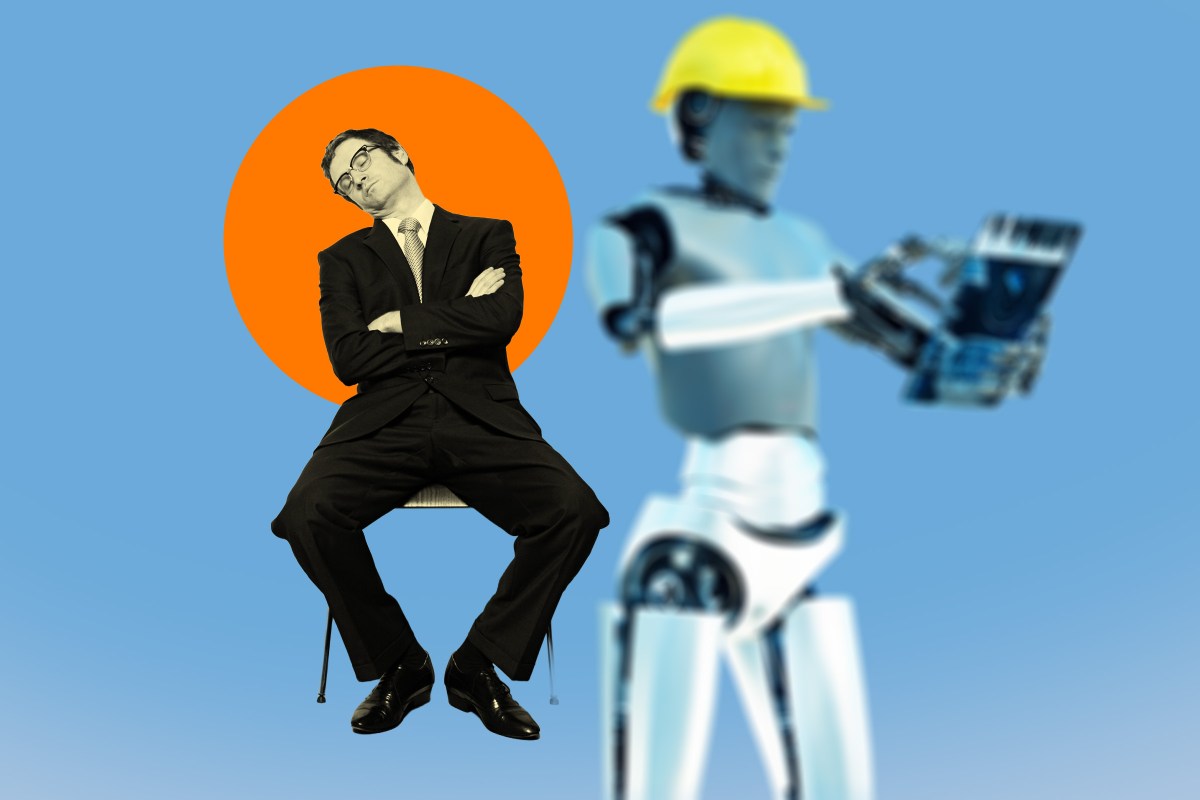
2 weeks agoFactory Paying Human Worker to Watch Robot Worker All Day
Humanoid robots like Digit are being deployed in factories with human supervisors, with costs expected to drop from $10-$25 per hour to $2-$3 per hour, potentially displacing workers earning $20 per hour.
Roam Research
fromTheregister
2 weeks agoWater company spins out homegrown AI after LLMs failed it
Large language models provided confidently incorrect information about materials science, causing a water desalination startup to waste four months and $200,000 validating a material choice that ultimately proved inferior.

fromTNW | Deep-Tech
2 weeks agoUniversal Robots and Scale AI launch the UR AI Trainer
Our customers, ranging from large enterprises to AI research labs, are no longer just asking for AI features. They need a way to collect high-fidelity, synchronized robot and vision data to train AI models on the same robots they intend to deploy. Our AI Trainer is the industry's first direct lab-to-factory solution for AI model training.
Data science
Information security
fromSecurityWeek
3 weeks agoICS Patch Tuesday: Vulnerabilities Fixed by Siemens, Schneider, Moxa, Mitsubishi Electric
Industrial control system manufacturers Siemens, Schneider Electric, Mitsubishi Electric, and Moxa released multiple security advisories addressing critical and high-severity vulnerabilities in their ICS products.
Miscellaneous
fromComputerWeekly.com
3 weeks agoRender Networks unveils synchronised agentic critical infrastructure architecture | Computer Weekly
Render Networks expands ClearWay platform to automate critical infrastructure deployment, reducing capital risk through real-time field verification and audit-grade accountability across complex multi-asset projects.
fromLondon Business News | Londonlovesbusiness.com
3 weeks agoWhy long range communication is useful for industrial monitoring - London Business News | Londonlovesbusiness.com
Long-range radio waves can pass through obstacles more easily, which makes them perfect for monitoring expansive factories or outdoor infrastructure. A recent report by Fabrity highlighted that these systems use very little power. This allows sensors to operate for 5 to 10 years on a single battery. Using such tech means you do not have to install expensive wiring across your entire site.
Roam Research

Artificial intelligence
fromMedium
2 weeks agoFrom Dumb Devices to Digital Teammates: How Agentic AI is Revolutionizing the Internet of Things
Agentic AI transforms IoT from obedient automation into intelligent systems that anticipate needs, reason through problems, and take initiative rather than simply following programmed commands.
Artificial intelligence
fromComputerWeekly.com
2 weeks agoLab for autonomous agents to drive boost in manufacturing in India | Computer Weekly
IBM Research launches Emergence India Labs to develop autonomous systems for manufacturing, logistics, and infrastructure, positioning India as a frontier AI research hub beyond traditional IT services.
fromComputerworld
1 month agoAnthropic targets core business systems with new Claude plug-ins
Anthropic is expanding its push into the enterprise market with a new set of "coworker" plug-ins designed to embed its Claude AI directly into tools used by investment bankers, HR teams, and engineers, signaling a shift from standalone assistants toward AI agents that operate inside core business workflows.
Tech industry
Gadgets
fromEngadget
1 month agoThe Lenovo Modular AI PC concept is a remixed dual-screen laptop with hot swappable ports
Lenovo's Modular AI PC concept features a detachable keyboard and secondary display with hot-swappable components, enabling flexible configuration for different workloads and environments.
Startup companies
fromBusiness Insider
1 month agoHow robotics could upend the US manufacturing industry
Machina Labs promotes distributed, flexible, portable robotics-enabled manufacturing to leapfrog centralized factories and accelerate U.S. reindustrialization in defense, aerospace, and automotive sectors.
Gadgets
fromComputerWeekly.com
1 month agoConnectivity, AI drive fleet safety, productivity and decision-making | Computer Weekly
AI, connected data, and safety-focused services are transforming fleet operations, with GPS tracking adoption at record highs and AI delivering measurable safety improvements and cost reductions.
Gadgets
fromYanko Design - Modern Industrial Design News
1 month agoArduino's $61 Matter Bundle Lets You Build Smart Home Devices That Work With Apple, Google, and Amazon - Yanko Design
Arduino's Matter Discovery Bundle enables DIY smart home device creation at $61.04, solving platform fragmentation by providing universal connectivity to Apple HomeKit, Google Home, Amazon Alexa, and Home Assistant.
fromInfoQ
1 month agoGoogle Publishes Scaling Principles for Agentic Architectures
The scaling model relies on several predictive factors of the system, including the underlying LLM's intelligence index; the baseline performance of a single agent; the number of agents; number of tools; and coordination metrics. The researchers found there were three dominant effects in the model: tool-coordination trade-off, where tasks requiring many tools perform worse with multi-agent overhead; capability saturation, where adding agents yields diminishing returns when the single-agent baseline performance exceeds a certain threshold; and topology-dependent error amplification, where centralized orchestration reduces error amplification.
Artificial intelligence



fromdzone.com
2 months agoManaging Changing Hardware/Peripherals in a Robust POS
Retail point-of-sale systems today offer a wide range of options for peripherals and hardware. Their technical specifications play a major role in selection, and big retailers often choose multiple vendors to reduce a single point of failure. This gives them an advantage to negotiate price or support as well. Technically, these peripherals also require updating with new models and may have new feature sets. This necessitates the redevelopment of point-of-sale applications, increasing development costs.
Information security
Real estate
fromLondon Business News | Londonlovesbusiness.com
1 month agoThree common myths about modular construction (debunked) - London Business News | Londonlovesbusiness.com
Modern panelised off-site construction delivers permanent, energy-efficient, high-performance buildings that rival or exceed traditional construction.
fromSecurityWeek
1 month agoICS Patch Tuesday: Vulnerabilities Addressed by Siemens, Schneider, Aveva, Phoenix Contact
Siemens has published eight new advisories. The company has released patches and mitigations for high-severity issues in Desigo CC, Sentron Powermanager, Simcenter Femap and Nastran, NX, Sinec NMS, Solid Edge, and Polarion products. A medium-severity flaw has been found in Siveillance Video Management Servers. Exploitation of the vulnerabilities can lead to unauthorized access, XSS, DoS, code execution, and privilege escalation.
Information security
fromDevOps.com
1 month agoHow AI Is Expanding Who Gets to Build Infrastructure - DevOps.com
Baron traces the origin story back to his time building high-scale systems at Instana (which exited to IBM in 2020), where the reality of "always-on" platforms made one thing obvious: the tooling we rely on is often too low-level, too rigid, and too disconnected from real-world use cases. That gap has only widened as environments have exploded in complexity-more cloud providers, more managed services, more hybrid setups, more internal APIs, and "gillions" of tools stitched together into brittle workflows.
Software development
fromArmin Ronacher's Thoughts and Writings
1 month agoA Language For Agents
Last year I first started thinking about what the future of programming languages might look like now that agentic engineering is a growing thing. Initially I felt that the enormous corpus of pre-existing code would cement existing languages in place but now I'm starting to think the opposite is true. Here I want to outline my thinking on why we are going to see more new programming languages and why there is quite a bit of space for interesting innovation.
Software development
fromMedium
2 months agoCreating a smart home automation with Home Assistant and Scala fs2.
After some investigation, I found that Home Assistant has an integration with Node-RED - a graphical tool for manipulating data and event streams. It could probably satisfy most of my needs. But from time to time I remember that I'm a professional software developer, working with event streams for many years, and for this kind of problem there's nothing better than math (and Scala's type system, which supports it very well).
Software development


Gadgets
fromYanko Design - Modern Industrial Design News
1 month agoThis Modular Console Changes Layout With Magnetic Snap-In Controls - Yanko Design
A single modular magnetic control surface reconfigures with snap-in modules and app-driven layouts to replace multiple fixed controllers across streaming, editing, and design workflows.
fromApp Developer Magazine
1 year agoThe Rise of Agentic Orchestration
According to Tamas Cser, Founder and CEO of Functionize, the industry is on the verge of a structural shift. By 2026, development teams will transition from AI copilots to agentic fleets: coordinated groups of specialized AI agents operating semi-autonomously across the entire software lifecycle. In this new paradigm, engineering excellence is measured less by syntactic mastery and more by the ability to orchestrate intelligent systems-delegating, validating, and refining work continuously, at machine speed.
Software development
fromThe Atlantic
1 month agoSmart Homes Are Terrible
All of the appliances and systems are brand-new: the HVAC, the lighting, the entertainment. Touch screens of various shapes and sizes control this, that, and the other. Rows of programmable buttons sit where traditional light switches would normally be. The kitchen even has outlets designed to rise up from the countertop when you need them, and slide away when you don't.
Gadgets
fromMedium
1 month agoBuilding a Smart Home Automation with Home Assistant and Scala FS2-Part 2: Service Lifecycle and...
PF4J expects that your plugin code has a class that extends org.pf4j.Plugin interface. And for running and stopping the plugin, methods start() and stop() of this interface will be called. But our service is expected to have completely pure logic - without any side effects - we need to bring these two worlds together - Java impure plugins start/stop and Scala pure logic.
Software development
fromZDNET
2 months agoNo Matter? No problem! Imagine one smart home app to control all your devices
Matter, the smart home connectivity protocol that revolutionized the IoT world, has done wonders to bridge the interoperability gaps between brands. For various reasons, however, Matter hasn't completely solved the problem of incompatibility in the smart home. IoT company Copilot.cx aims to change that by giving users access to different brands' devices with a single mobile app. Copilot.cx has introduced Copilot Star, a platform that enables manufacturers to builda branded app based on a single framework, connecting smart home devices running on different platforms.
Gadgets
Gadgets
fromYanko Design - Modern Industrial Design News
2 months agoThis 55-Inch Smart Calendar Has Wheels and Runs Your Entire Home - Yanko Design
A 55-inch 4K wheeled touchscreen combines a family calendar, smart-home command center, and TV, offering a highly visible, mobile hub for household coordination.
Gadgets
fromYanko Design - Modern Industrial Design News
2 months agoSwitchBot's New Onero H1 Robot Finally Does Your Chores - Yanko Design
SwitchBot's Onero H1 is an AI-capable, full-sized humanoid household robot with 22 degrees of freedom, onboard perception, and manipulators to perform chores without cloud connectivity.
fromWIRED
1 month agoWhat Is Thread? We Explain the Smart Home Network Protocol
Originally developed by Nest (before the Google acquisition), Thread has existed since 2011. Devised as a power-efficient mesh networking technology for internet-of-things (IoT) products, Thread gathered pace after the 2014 formation of the Thread Group, which develops the technology and drives its adoption as an industry standard. Founding members like ARM, Samsung, Google, and Qualcomm have been joined by Apple, Amazon, and many other big companies over the years.
Gadgets
Gadgets
fromComputerWeekly.com
1 month agoDirect-to-device connectivity set to underpin next generation of industrial IoT | Computer Weekly
Ubiquitous satellite direct-to-device (D2D) connectivity will drive rapid, near-term mass adoption in industrial IoT across agriculture, mining, energy, transport and utilities.
[ Load more ]