#parchment-and-ink-analysis
#parchment-and-ink-analysis
[ follow ]
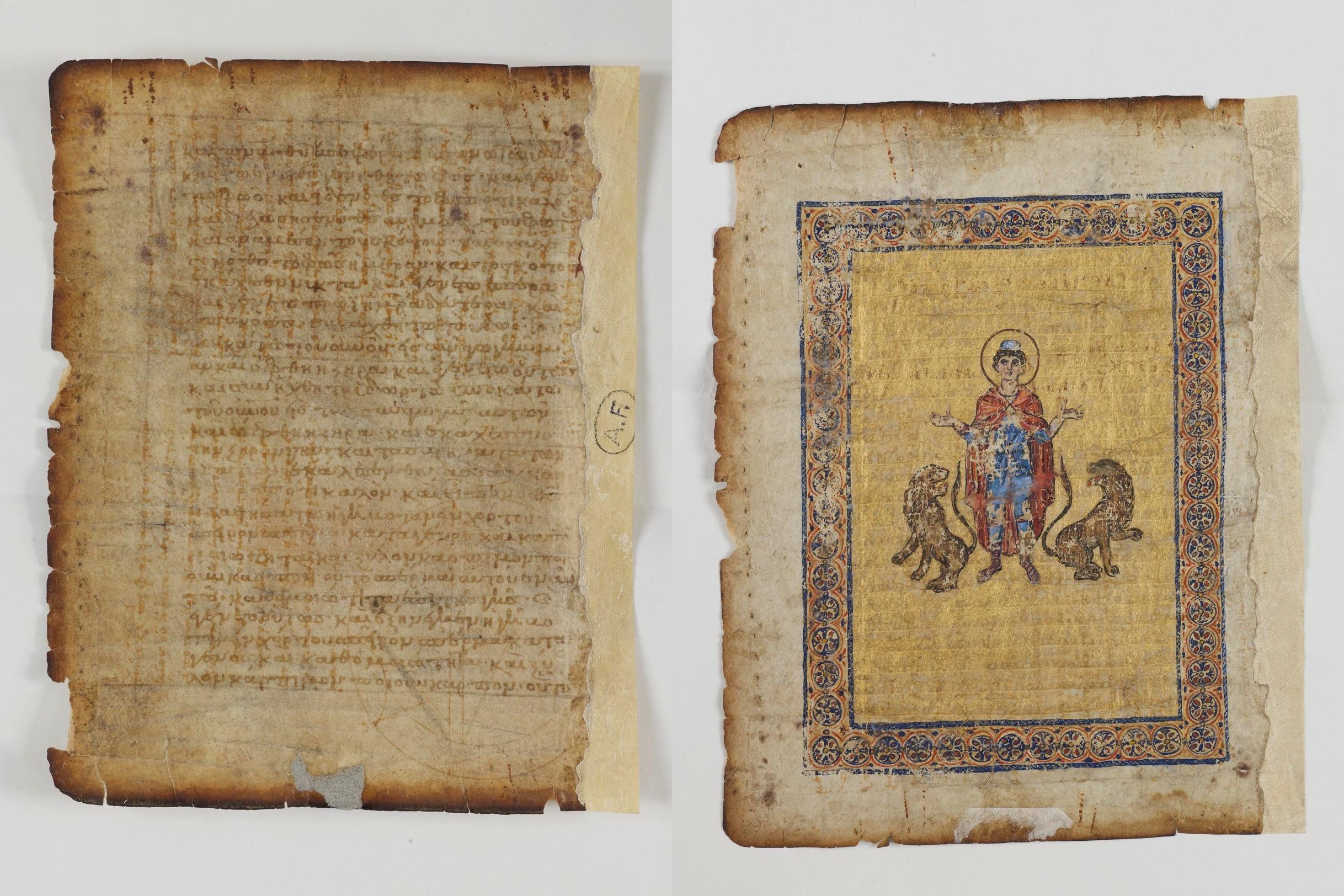
#medieval-manuscripts #archimedes-palimpsest #medieval-history #material-culture #renaissance-painting
fromMedievalists.net
6 days agoWho Lies in Winchester's Medieval Mortuary Chests? - Medievalists.net
This project demonstrates the combined power of science, the study of human remains and historical research to discover new information about the six mortuary chests and their occupants which would not have been available to us a generation ago.
History
Berlin music
fromGothamist
2 weeks agoMozart's childhood violin and original manuscripts come to the Morgan Library
Mozart's personal belongings, including the clavichord used to compose 'The Magic Flute' and his childhood violin, are exhibited at the Morgan Library & Museum in Manhattan for the first time in the United States.
Higher education
fromHarvard Gazette
3 weeks agoLike seeing art of Roman chapels in technicolor for first time - Harvard Gazette
Students learned centuries-old stucco sculpting techniques through hands-on practice, gaining deeper understanding of Renaissance and Baroque artists' material choices and creative processes.
fromArtnet News
2 weeks agoJust How Much Did Pompeii's Prized Blue Paint Cost? | Artnet News
In the Roman Empire, Egyptian blue was typically traded in the form of small pellets, which were ground into a useable powder, and researchers estimate between six and 10 pounds were used to coat the Blue Room. Using prices quoted by Pliny the Elder (who died in nearby Stabiae during the eruption), the researchers estimate this much paint would have cost 93 to 168 denarii, perhaps equivalent more than 1,000 loaves of bread or 90 percent of a soldier's annual salary.
Arts


OMG science
fromNature
1 month agoDaily briefing: Galileo's notes discovered in the margins of an ancient book
Tectonic plates moved 3.3 billion years ago with higher oxygen levels; Galileo's annotations discovered in 400-year-old Ptolemy text; rotator cuff degeneration common in older adults regardless of symptoms.
Medicine
fromArs Technica
1 month agoWhat we can learn from scientific analysis of Renaissance recipes
16th-century people used scientific experimentation to create personalized home remedies, leaving protein traces on medical manuals that researchers now analyze to understand Renaissance knowledge construction.
fromMedievalists.net
3 weeks agoNew Medieval Books: Approaching Records of the Household and Wardrobe - Medievalists.net
The Household and Wardrobe Accounts are English records that document the daily needs of the king and his family. This book serves as a guide to these sources, showing how they can be used and what valuable insights they offer into medieval government.
History
Books
fromianVisits
1 month agoNew exhibition explores how early printing developed into readable books
William Caxton revolutionized English book printing in the late 15th century, transforming books from elite luxury items into affordable, widely accessible products through rapid technological advancement.
History
fromMedievalists.net
3 weeks agoNew Medieval Books: Widow City - Medievalists.net
Late medieval Italian widows mourned their spouses and navigated their lives through religious or secular paths, evolving from allegorical subjects to prominent authors who reshaped public discourse on widowed identity.
Arts
fromColossal
3 weeks agoYou'll Need a Magnifying Glass to Read Some of the World's Smallest Books at the V&A
Queen Mary's Dolls' House at Windsor Castle contains nearly 600 miniature books designed by leading craftspeople, representing a remarkable collection of scaled literary works from the early 20th century.

Arts
fromThe Art Newspaper - International art news and events
3 weeks ago'It has nothing to do with Michelangelo': expert wades in on painting newly attributed to Renaissance master
Belgian art historian Michel Draguet claims to have discovered a Michelangelo painting from the 1540s, but leading Renaissance experts dispute the attribution based on artistic style analysis.

History
fromMedievalists.net
1 month agoDreaming of Owning a Medieval Artefact? Here's Your Chance - Medievalists.net
TimeLine Auctions' March 3 online sale features hundreds of medieval historical objects including a 13th-century Limoges cross, 1224 Chinese armor, Viking silver mount, and Anglo-Saxon brooch.
fromwww.scientificamerican.com
2 months agoThe search for Leonardo da Vinci's DNAhow modern forensic science is trying to crack a 500-year-old puzzle
About ten years ago researchers across a wide range of disciplines, from forensic science and genetics to art history, got together with the goal of finding the Renaissance artist's DNA. Da Vinci had no children, and his remains were disturbed during the French Revolution. The hope is that uncovering his DNA could open the door to a number of discoveries, including new tools for authenticating artwork and potential clues about da Vinci's uncanny way of seeing the world.
Science
History
fromMedievalists.net
1 month agoJoshua O'Driscoll Named Head of Medieval and Renaissance Manuscripts at the Morgan - Medievalists.net
Dr. Joshua O'Driscoll appointed as Melvin R. Seiden Curator and Department Head of Medieval and Renaissance Manuscripts at the Morgan Library & Museum, overseeing one of the world's most significant illuminated manuscript collections.
fromOpen Culture
1 month agoThe Rohonc Codex: Hungary's Mysterious Manuscript That No One Can Read
Image by Klaus Schmeh, via Wiki­me­dia Com­mons Mag­yar, which is spo­ken and writ­ten in Hun­gary, ranks among the hard­est Euro­pean lan­guages to learn. (The U.S. For­eign Ser­vice Insti­tute puts it in the sec­ond-to-high­est lev­el, accom­pa­nied by the dread­ed aster­isk label­ing it as "usu­al­ly more dif­fi­cult than oth­er lan­guages in the same cat­e­go­ry.") But once you mas­ter its vow­el har­mo­ny sys­tem, its def­i­nite and indef­i­nite con­ju­ga­tion, and its eigh­teen gram­mat­i­cal cas­es, among oth­er noto­ri­ous fea­tures, you can final­ly enjoy the work of writ­ers like Nobel Lau­re­ates Imre Kertész and Lás­zló Krasz­na­horkai in the orig­i­nal. Alas, no degree of mas­tery will be much help if you want to under­stand a much old­er - and, in its way, much more noto­ri­ous - Hun­gar­i­an text, the Rohonc Codex.
Books
fromwww.thehistoryblog.com
1 month agoMedieval painted panels found beneath Toledo house
A group of polychrome wood panels discovered under the floorboards of a house in Toledo in 2018 are going on display at the National Archaeological Museum in Madrid. They were found during construction of a hotel planned to go up over several buildings in the Bajada del Pozo Amargo street next to Toldeo's Cathedral. They had been stripped from their original location on the upper part of the walls of a quadrangular hall and reused as raw carpentry material in the house's subfloor.
History
fromwww.theguardian.com
1 month agoAI analysis casts doubt on Van Eyck paintings in Italian and US museums
An analysis of two paintings in museums in the US and Italy by the 15th-century Flemish artist Jan van Eyck has raised a profound question: what if neither were by Van Eyck? Saint Francis of Assisi Receiving the Stigmata, the name given to near-identical unsigned paintings hanging in the Philadelphia Museum of Art and the Royal Museums of Turin, represent two of the small number of surviving works by one of western art's greatest masters, revered for his naturalistic portraits and religious subjects.
Arts
fromOpen Culture
1 month agoCats in Medieval Manuscripts & Paintings
Renais­sance artist Albrecht Dür­er (1471-1528) nev­er saw a rhi­no him­self, but by rely­ing on eye­wit­ness descrip­tions of the one King Manuel I of Por­tu­gal intend­ed as a gift to the Pope, he man­aged to ren­der a fair­ly real­is­tic one, all things con­sid­ered.
Arts
fromMedievalists.net
2 months agoRules of a Medieval Library - Medievalists.net
When universities began to emerge in Europe during the eleventh and twelfth centuries, they soon became important centres of knowledge. Their libraries could hold hundreds of books, and many of the most valuable volumes were kept under close control - sometimes even chained to desks. We have few details about how medieval university libraries operated, but a revealing set of rubric headings survives from the University of Angers in western France.
History
Arts
fromThe Art Newspaper - International art news and events
2 months agoCan a new cipher help to explain the mysterious Voynich Manuscript?
The Naibbe cipher encodes text by random 1–2 letter chunking and card-driven substitution tables, reproducing several statistical and structural features of Voynichese.
fromMedievalists.net
2 months agoNew Medieval Books: Chasing the Pearl-Manuscript - Medievalists.net
This is a book about a book: the small, cropped, somewhat ragged but brightly illustrated volume now known formally, and rather forbiddingly, as British Library MS Cotton Nero A.x/2. The fame and beauty of its four Middle English poems have given it sobriquets beyond the shelfmark, however, which are more familiar and intimate: it is also the Gawain-Manuscript or, as I will call it, the Pearl-Manuscript.
History
Arts
fromThe Art Newspaper - International art news and events
2 months agoDurer 'copy' at London's National Gallery is the real thing, expert claims
A German scholar asserts the National Gallery's portrait of Albrecht Dürer's father is an authentic 1497 painting by Dürer, despite the museum's rejection.
History
fromMedievalists.net
2 months agoReading in Byzantium: Literacy, Books, and a World of Texts - Medievalists.net
Byzantine reading was communal and performative, woven into religious, educational, and administrative life while preserving classical learning within a Christian intellectual framework.
History
fromOpen Culture
1 month agoThe Dead Sea Scrolls: Discover the Secrets of the Bible's Oldest and Strangest Texts
Dead Sea Scrolls include the oldest known biblical manuscripts, diverse texts (biblical, apocryphal, sectarian, unknown) that complicated but did not completely upend understanding of Christianity.
fromMedievalists.net
2 months agoNew Medieval Books: The Forsaken 14th Century - Medievalists.net
In this volume, the authors aim to provide a truly global overview of the 14 century, with each region given approximately the same space. It is obviously impossible to cover every event in every country of the world in a single volume, just as you would not be able to visit every city in every country if you traveled around the world for a year.
History
fromMedievalists.net
2 months agoNew Medieval Books: Interconnected Traditions - Medievalists.net
This open-access book brings together more than thirty essays on languages and the ways they develop, interact, and influence one another. Its main focus is the Middle East, where Hebrew, Arabic, and Aramaic long existed side by side and often overlapped in everyday use, scholarship, and culture. In line with Geoffrey (Khan)'s commitment to the maximally accessible dissemination of research, this Festschrift has been published in both open-access digital editions and affordable printed formats.
History
fromMedievalists.net
1 month ago10 Medieval Studies' Articles Published Last Month - Medievalists.net
In this paper we investigate whether infant and childhood feeding practices influenced the imbalanced adult sex ratio reported in medieval Europe from historical and osteological evidence. First, we examine hypotheses for the observed imbalanced sex ratios in Europe and the evidence presented to support these hypotheses. We then use stable isotope analysis (δ13C and δ15N) of incremental dentine in 64 first molars from adults at three medieval sites (Aulla, Badia Pozzeveri, and Montescudaio) in north-western Tuscany (11th-15th c. CE).
History
fromMedievalists.net
2 months agoNew Medieval Books: Old High German Poetry - Medievalists.net
The translations offered are intended to keep as close to the originals as possible in line for line renderings, while conveying at the same time some indication at least of the poetic form. This is, of course, an entirely hubristic aim, and it is either a help (by permitting a certain freedom of approach) or an additional hindrance that, as noted, many of the texts survive in a somewhat parlous state.
History
fromMedievalists.net
1 month agoNew Medieval Books: A Crusade Against the Turks as a Means of Reforming the Church - Medievalists.net
This project will focus on the Camaldolese hermits' proposal for achieving what they considered to be the most crucial task in the repair of the church, eliminating Islam and all Muslims. Our study will begin with an examination of the recipient of the Libellus, Giovanni de' Medici, who would become Pope Leo X. Next will be an exploration into the backgrounds of Paolo Giustiniani and Pietro Querini,
History
[ Load more ]