#patent-litigation
#patent-litigation
[ follow ]
#federal-circuit #intellectual-property #uspto #ptab #inter-partes-review #ipr #claim-construction #enablement
#ptab



Intellectual property law
fromIPWatchdog.com | Patents & Intellectual Property Law
2 days agoThe USPTO is Trying-But the Most Abusive Practices to Kill Patents Are Still in Play
Aggressive procedural strategies in PTAB practice exploit reexamination to bypass IPR estoppel, creating significant loopholes in patent litigation.
Intellectual property law
fromIPWatchdog.com | Patents & Intellectual Property Law
2 weeks agoThoughts on Finesse Wireless's Framing of Datascope as an 'Infamous' Example of Federal Circuit Overreach
The Datascope Federal Circuit decision reversed a jury verdict of patent infringement, later criticized as an example of improper appellate review of factual determinations in violation of the Seventh Amendment.
Intellectual property law
fromGlobal IP & Technology Law Blog
2 weeks agoFederal Circuit Finds that Antivirus Software is Abstract and Remands for Alice, Step Two
Columbia University lost a Federal Circuit appeal of its $185 million patent verdict against Gen Digital, raising significant questions about subject matter eligibility and damages in modern patent litigation.
fromSun Sentinel
3 weeks agoTough challenges confront electric air taxi firms as they maneuver to take flight in South Florida
Archer brings this suit to protect the novel and award-winning design of its Midnight eVTOL, which was developed by Archer inventors through careful, brilliant design work, and to stop Vertical infringing its patented designs.
European startups
Intellectual property law
fromIPWatchdog.com | Patents & Intellectual Property Law
1 month agoSplit Federal Circuit Upholds Smart Mobile Patent Claims Against Challenge from Apple
The Federal Circuit affirmed the PTAB's decision upholding the patentability of certain claims in Smart Mobile Technologies' wireless patent against Apple's obviousness challenge.
fromIPWatchdog.com | Patents & Intellectual Property Law
1 month agoTesla Loses at CAFC in Split Decision Upholding EV Charger Claims
Tesla argued that 'Kato discloses the Charging Control Limitation because the battery charge level increases in accordance with Kato's generated charging schedule when a user follows the schedule by manually plugging in their vehicle at each charging location.' But the PTAB found that the plain and ordinary meaning of the Charging Control Limitation 'excludes 'the user manually starting and stopping the charging.'
Intellectual property law
Intellectual property law
fromIPWatchdog.com | Patents & Intellectual Property Law
1 month agoDelaware Court Narrows Moderna's Invalidity Defenses Ahead of Arbutus LNP Patent Trial
Court limited Moderna's invalidity defenses, barring obviousness and derivation challenges to several Arbutus patents while leaving enablement for jury determination.
#intellectual-property

fromIPWatchdog.com | Patents & Intellectual Property Law
4 months agoIntellectual property law
Other Barks & Bites for Friday, November 7: CJEU Action Against EU Commission Referred Over SEP Regulation; Ninth Circuit Affirms CoComelon Copyright Win; and C4IP Urges USTR to Address IP Concerns in USMCA Joint Review

fromIPWatchdog.com | Patents & Intellectual Property Law
7 months agoIntellectual property law
Other Barks & Bites for Friday, August 22: Strike Three for Former Copyright Register in Injunction Bid; Ninth Circuit Finds Contract Term Implied by Copyright Duration; and First Circuit Dismisses Attempt to Toll Copyright Statute Until Registration
fromIPWatchdog.com | Patents & Intellectual Property Law
4 months agoIntellectual property law
Other Barks & Bites for Friday, November 7: CJEU Action Against EU Commission Referred Over SEP Regulation; Ninth Circuit Affirms CoComelon Copyright Win; and C4IP Urges USTR to Address IP Concerns in USMCA Joint Review
fromIPWatchdog.com | Patents & Intellectual Property Law
7 months agoIntellectual property law
Other Barks & Bites for Friday, August 22: Strike Three for Former Copyright Register in Injunction Bid; Ninth Circuit Finds Contract Term Implied by Copyright Duration; and First Circuit Dismisses Attempt to Toll Copyright Statute Until Registration





Intellectual property law
fromIPWatchdog.com | Patents & Intellectual Property Law
16 years agoCallaway Golf Loses Jury Verdict at the Federal Circuit
Federal Circuit vacated the district court verdict and remanded Callaway v. Acushnet, concerning alleged infringement of the Sullivan golf ball patents.





Intellectual property law
fromIPWatchdog.com | Patents & Intellectual Property Law
3 months agoOther Barks & Bites for Friday, December 12: Disney Cuts Character Licensing Deal with OpenAI; USPTO Supports Public Performance Rights on Radio Under Copyright Act; and EU General Court Reduces Intel Fine by 140 Million
Disney entered a three-year character licensing agreement with OpenAI including a $1 billion Disney equity investment and warned Google about infringing uses of Disney copyrights via AI.
Intellectual property law
fromIPWatchdog.com | Patents & Intellectual Property Law
4 months agoCAFC Affirms Attorneys' Fees Award for Google Due to Frivolous Nature of Suit
The CAFC affirmed a fee award and sanctions after finding EscapeX pursued a frivolous patent suit and failed to conduct a reasonable pre-suit investigation.
fromIPWatchdog.com | Patents & Intellectual Property Law
4 months agoAnalyzing Inari Medical: In At Least One Judge's Court, There's Enough Bad News for Everyone
In October 2025, a federal district judge with an active docket of patent suits addressed the question of whether the filing (and, presumably, the service) of a complaint for patent infringement in and of itself precludes the defendant from asserting that it was unaware of the patent (and, thus, could not be a willful infringer). The bad news for plaintiffs: the answer was no.
Law
fromIPWatchdog.com | Patents & Intellectual Property Law
5 months agoCAFC Affirms ITC in Finding Brita 'Gravity Flow' Patent Invalid for Lacking Written Description, Enablement
"Brita cannot use the knowledge of a skilled artisan to make up for the specification's lack of disclosure as to non-carbon-block filters that can meet the claimed FRAP factor." - CAFC The U.S. Court of Appeals for the Federal Circuit (CAFC) on Wednesday issued a precedential decision in Brita LP v. International Trade Commission, affirming the International Trade Commission's (ITC's) finding that claims of a Brita patent for a water
Intellectual property law
fromPatently-O
5 months agoIPR Fact Findings Don't Bind District Courts (What about IPR Legal Conclusions?)
To apply issue preclusion, courts generally require: (1) the issue was actually litigated and decided in the prior proceeding; (2) the determination was essential to the judgment; (3) the party against whom preclusion is asserted had a full and fair opportunity to litigate; and (4) the party against whom preclusion is asserted was a party (or in privity) in the prior proceeding.
Intellectual property law
Intellectual property law
fromBusiness Insider
5 months agoA wave of patent lawsuits is hitting big news publishers, including Gannett and The Guardian
Rich Media Club LLC has sued major news publishers alleging patent infringement over online ad tools, risking legal costs exceeding $1 million per defendant.
Intellectual property law
fromIPWatchdog.com | Patents & Intellectual Property Law
5 months agoUPC Issues First Permanent SEP Injunction: The Ramifications of Philips v. Belkin | IPWatchdog Unleashed
The Unified Patent Court issued the first final permanent injunction in a SEP case, Philips v. Belkin, reshaping SEP enforcement and licensing.


fromThe Verge
6 months agoStrava sues Garmin over alleged patent infringement
Strava is suing its long-time partner Garmin, and is seeking to permanently block the company from selling most of its current fitness and cycling gadget lineup. The lawsuit filed in the US District Court of Colorado on September 30th, first reported by DC Rainmaker, alleges that Garmin violated an agreement between the companies by infringing on Strava's patents for segments - route sections where athletes can compare performance times - and heatmaps that show popular areas for activity.
Gadgets
fromIPWatchdog.com | Patents & Intellectual Property Law
6 months agoCAFC Faults Expert Testimony in Reversal of Infringement Finding Against AT&T/ Nokia
The U.S. Court of Appeals for the Federal Circuit (CAFC) issued a precedential decision Wednesday reversing a district court's denial of judgment as a matter of law (JMOL) of non-infringement and vacating a damages award in favor of Finesse Wireless LLC. The CAFC said there was a lack of substantial evidence to support the jury's verdicts finding AT&T Mobility and Nokia (AT&T) infringed two of Finesse's radio signal interference mitigation patents.
Law
fromPatently-O
6 months agoApplication of Fifth Circuit's Heightened 1404(a) Standard in Patent Cases
Federal Circuit has denied this pair of related mandamus actions. In both cases, the patentee VirtaMove challenged venue transfer orders moving its patent infringement suits from the Western District of Texas to the Northern District of California. As I discuss below, the non-precedential decisions have some interesting jurisdictional tension with recent Fifth Circuit law. VirtaMove is a small Canadian software company holding patents on secure application containerization technology.
Intellectual property law
Intellectual property law
fromIPWatchdog.com | Patents & Intellectual Property Law
6 months agoFederal Circuit Orders New Trial in Marine Fuel Patent Infringement Case Against Phillips 66
The Federal Circuit reversed and remanded, finding Phillips' noninfringement theory improper, prejudicial, and not harmless, warranting a new trial.
Intellectual property law
fromIPWatchdog.com | Patents & Intellectual Property Law
7 months agoCAFC Dodges Key Issues in Reversing District Court Finding for Google on Prosecution Laches
The Federal Circuit reversed a district court's prosecution laches finding, ruling the court abused its discretion and rejecting prejudice from Sonos' continuation practice.
Intellectual property law
fromIPWatchdog.com | Patents & Intellectual Property Law
7 months agoCAFC Corrects PTAB's Inventorship Analysis in First Appeal of AIA Derivation Proceeding
Derivation claim elements remain unchanged except for first-to-file adjustments; Selner's earlier conception defeated GHS's derivation claim.

Intellectual property law
fromIntellectual Property Law Blog
8 months agoNavigating Shockwave Medical: Applicant Admitted Prior Art, Standing, and Obviousness
Shockwave Medical's patent for IVL technology was challenged for obviousness based on prior art, resulting in multiple claims deemed unpatentable.
Intellectual property law
fromIPWatchdog.com | Patents & Intellectual Property Law
9 months agoGaming Patent Litigation on Both Sides of the "v" | IPWatchdog Unleashed
Patent litigation, particularly in gaming, is misunderstood, with both patent owners and alleged infringers portraying themselves as the victim.
The narrative surrounding patent trolls is often exaggerated, but genuine bad actors exist in patent enforcement.
fromIPWatchdog.com | Patents & Intellectual Property Law
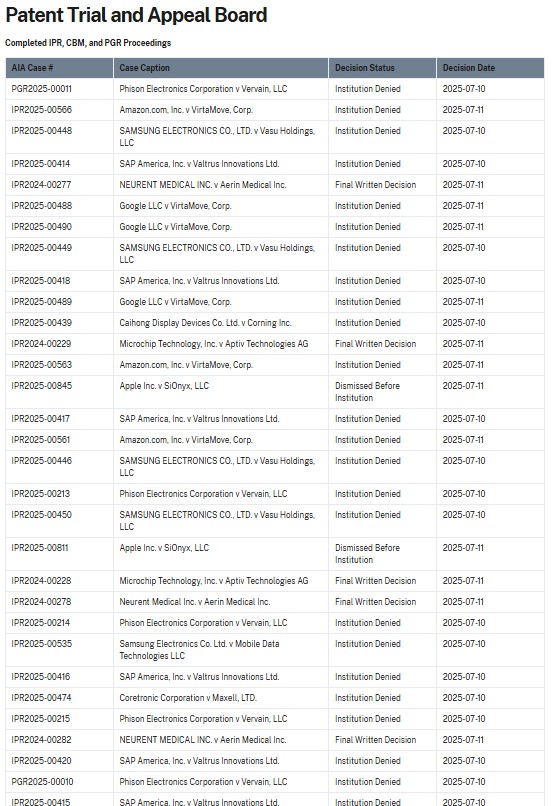
9 months agoStewart Grants Request to Deny IPR Institution Due to Patent Owner's 'Settled Expectations'
Petitioner's awareness of Patent Owner's applications and failure to seek early review of the patents favors denial and outweighs the above-discussed considerations.
Intellectual property law
fromIPWatchdog.com | Patents & Intellectual Property Law
11 months agoFederal Circuit Issues Precedential Order Denying Mandamus Relief for SAP, Despite District Court Errors
The Federal Circuit panel indicated that the district court imposed an unjustifiably high standard on SAP in regard to specifying trial witnesses, though SAP's neutrality claim was upheld.
Intellectual property law
[ Load more ]