#patent-settlement
#patent-settlement
[ follow ]
#patent-law #federal-circuit #intellectual-property #uspto #ptab #copyright #patent-eligibility #prior-art
#patent-law
fromIPWatchdog.com | Patents & Intellectual Property Law
2 days agoIntellectual property law
Other Barks & Bites for Friday, April 3: Trump EO Sets 100% Tariffs on Patent Pharmaceutical Imports; Squires Vacates TikTok IPRs Under Tianma Microelectronics; and Kallay Voices DOJ's Preference for FRAND Obligations
Intellectual property law
fromIPWatchdog.com | Patents & Intellectual Property Law
3 days agoFederal Circuit Upholds District Court's View That Omission of Coinventor Invalidates Patent
The CAFC affirmed the invalidity of two patents due to incorrect inventorship, emphasizing the importance of including all coinventors.
Intellectual property law
fromIPWatchdog.com | Patents & Intellectual Property Law
2 days agoOther Barks & Bites for Friday, April 3: Trump EO Sets 100% Tariffs on Patent Pharmaceutical Imports; Squires Vacates TikTok IPRs Under Tianma Microelectronics; and Kallay Voices DOJ's Preference for FRAND Obligations
President Trump signed an executive order imposing 100% tariffs on imported patented pharmaceuticals and ingredients from 17 drugmakers.
#ptab
Intellectual property law
fromIPWatchdog.com | Patents & Intellectual Property Law
4 days agoThe USPTO is Trying-But the Most Abusive Practices to Kill Patents Are Still in Play
Aggressive procedural strategies in PTAB practice exploit reexamination to bypass IPR estoppel, creating significant loopholes in patent litigation.
#uspto
Intellectual property law
fromIPWatchdog.com | Patents & Intellectual Property Law
8 years agoWhat I Want and Why: An Open Letter to the Next PTO Director
New USPTO Director should believe in patents and support the professional staff to improve the patent system.

Intellectual property law
fromIPWatchdog.com | Patents & Intellectual Property Law
4 days agoHow to Draft AI Patents That Survive the Next Guidance Cycle, and the One After That
The rapid changes in USPTO AI guidance create challenges for patent application strategies, necessitating a durable prosecution philosophy.
Intellectual property law
fromFuturism
2 days agoAnthropic Suddenly Cares Intensely About Intellectual Property After Realizing With Horror That It Accidentally Leaked Claude's Source Code
Anthropic's copyright takedown request for its AI model's source code highlights hypocrisy in its stance on copyright laws.
fromIPWatchdog.com | Patents & Intellectual Property Law
4 days agoAs 'Pro Codes Act' is Reintroduced, Opponents Warn of Threats to Standards Development System
Without effective copyright protections, there is a grave risk that these organizations will no longer be able to produce the high-quality codes and standards that the public and lawmakers have come to rely on.
Intellectual property law
fromIPWatchdog.com | Patents & Intellectual Property Law
5 days agoWIPO in Focus: Beyond Treaties, Toward a Market-Driven IP System | IPWatchdog Unleashed
WIPO is not merely a distant UN bureaucracy; it is a dynamic, fee-driven organization that has been undergoing significant operational and cultural transformation in recent years.
Intellectual property law
Intellectual property law
fromIPWatchdog.com | Patents & Intellectual Property Law
6 days agoAmicus, Sanofi Urge USPTO Appeals Panel to Uphold Ex Parte Baurin's Approach to ODP Analysis
Judges have consistently ruled on obviousness-type double patenting, emphasizing the need for clarity in term extension evaluations.
Intellectual property law
fromGlobal IP & Technology Law Blog
1 week agoFederal Circuit Strikes Down Millions in Damages Tied to Foreign Sales, with a Lesson for Future Litigants
The Federal Circuit's decision limits patent damages for software sales outside the U.S., emphasizing geographic restrictions on patent eligibility.
Intellectual property law
fromIPWatchdog.com | Patents & Intellectual Property Law
1 week agoIPWatchdog LIVE Panel Asks Whether Patent Licensing Still Works - The Answer Is Complicated
The voluntary patent licensing ecosystem is broken, leading to disincentivized licensing and increased exposure for patent owners.
Intellectual property law
fromIPWatchdog.com | Patents & Intellectual Property Law
1 week agoCalculating the Patent Liabilities of the 'Magnificent Seven'
Implementers face significant patent liability, leading to covert actions against the U.S. patent system and increased litigation over the past 30 years.
Intellectual property law
fromIPWatchdog.com | Patents & Intellectual Property Law
2 weeks agoThe Problem of Abusive Serial Challenges Using Reexaminations Needs to Be Addressed by the USPTO
Serial patent challenges undermine the patent system and create unfair advantages for larger companies over smaller competitors.
Intellectual property law
fromIPWatchdog.com | Patents & Intellectual Property Law
2 weeks agoWhat They Don't Teach You In School About Corporate Patent Monetization
Patent monetization transforms dormant intellectual property into revenue streams by leveraging exclusive rights to technological innovations, but requires rigorous portfolio analysis and market understanding to succeed.
Intellectual property law
fromIPWatchdog.com | Patents & Intellectual Property Law
2 weeks agoAI, Budget Cuts, and the Future of In-House Patent Teams | IPWatchdog Unleashed
Corporate IP departments face budget constraints and must prioritize portfolio quality, business value, and strategic use of AI tools to maintain competitive advantage.
fromPatently-O
2 weeks agoThe Patent Term Distribution, and What it Reveals
Congress set the patent term at twenty years from the earliest effective filing date. 35 U.S.C. § 154(a)(2) (not counting provisional or foreign national filing). But that statutory baseline is just the starting point. But, the actual term is shaped by a series of prosecution decisions, USPTO delays, terminal disclaimers, and patent family structure.
Intellectual property law
Intellectual property law
fromIPWatchdog.com | Patents & Intellectual Property Law
2 weeks agoNetlist, Samsung Spar Over RPI Requirements for PTAB Trial Petitions in Requests for Director Review
Netlist seeks dismissal of Samsung's PTAB proceedings for failing to identify all real parties in interest, including Samsung Electronics America as a corporate affiliate with shared liability in related litigation.
Intellectual property law
fromIPWatchdog.com | Patents & Intellectual Property Law
2 weeks agoCAFC Affirms Dismissal for Lack of Standing in Software Patent Dispute
AIT lacked constitutional standing to sue for patent infringement because ASI had no patent rights to transfer in 2012, as Nelson owned all rights since 2006.
Intellectual property law
fromIPWatchdog.com | Patents & Intellectual Property Law
14 years agoPatent Strategy: Discovering Crucial Patent Examiner Data
Track 1 acceleration may cost less overall than waiting in the standard patent queue, making the $4,800 fee a worthwhile investment for clients needing faster patent issuance.
Intellectual property law
fromIPWatchdog.com | Patents & Intellectual Property Law
3 weeks agoWhat Shrinking Patent Budgets Say About the Patent System/ IPWatchdog Unleashed
Shrinking patent budgets combined with rising expectations reveal that companies have lost faith in the patent system's value and strength.
Intellectual property law
fromPatently-O
3 weeks agoThe Expanding Patent Document: Fewer Claims, More Words, and a Trend That Predates Alice
Patent specifications have nearly doubled in length over twenty years to over 13,000 words, but claim counts have declined since 2005, contradicting expectations that Alice Corp. v. CLS Bank would cause a structural break in 2014-2015.
#uspto-allowance-rates
Intellectual property law
fromPatently-O
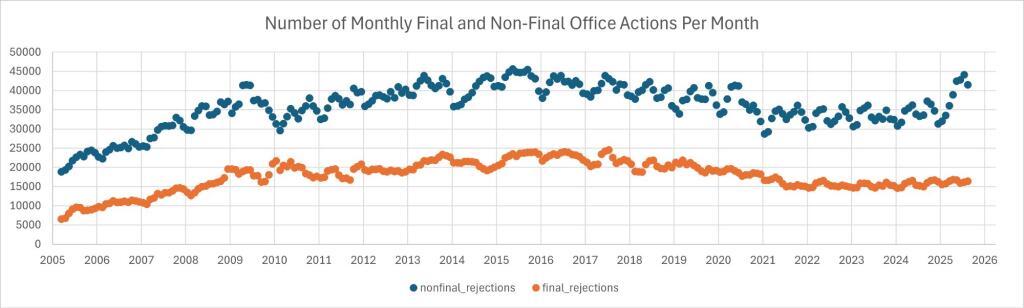
1 month agoThe Third Way: Examiner Action Dates and the Allowance Rate Curve
Examining USPTO allowance rates by anchoring outcomes to examiner mail dates provides the most direct measure of examination policy by capturing the moment examiners make final decisions.
Intellectual property law
fromPatently-O
1 month agoThe Third Way: Examiner Action Dates and the Allowance Rate Curve
Examining USPTO allowance rates by anchoring outcomes to examiner mail dates provides the most direct measure of examination policy by capturing the moment examiners make final decisions.
Intellectual property law
fromIPWatchdog.com | Patents & Intellectual Property Law
1 month agoWhen Policy Narratives Override the Facts: A Response to Recent Commentary on My PTAB Case
A PTAB case was mischaracterized in policy debate; the case involved obviousness rejections based on hindsight bias, not discovery of missed prior art, fundamentally changing the policy implications.
Intellectual property law
fromIPWatchdog.com | Patents & Intellectual Property Law
12 years agoPatent Claim Drafting 101: The Basics
Self-drafted patent applications typically result in narrower rights and prosecution complications, making professional attorney assistance strongly advisable despite higher costs.
Intellectual property law
fromIPWatchdog.com | Patents & Intellectual Property Law
1 month ago'Patent Prosecutor' or 'AI-Agile IP Counselor'?-A High-Stakes Crossroads
AI-driven patent prosecution tools will significantly impact the profession, requiring practitioners to evolve beyond traditional patent prosecution into strategic IP counseling roles to avoid commoditization and maintain competitive relevance.
Intellectual property law
fromPatently-O
1 month agoExtolling the Virtues: 'Space-Efficient' Preamble Fails to Limit
The Federal Circuit reversed an indefiniteness ruling while affirming dismissal of breach-of-contract claims in NimbeLink Corp. v. Digi International Inc., with the patent issue centering on whether claim preambles impose substantive limitations.
Intellectual property law
fromIPWatchdog.com | Patents & Intellectual Property Law
1 month agoDOJ and USPTO File Statement Backing Injunctions for NPEs
The USPTO and DOJ argue that restricting injunctive relief for patent owners, including non-practicing entities, undermines innovation incentives and should not be categorically denied.
Intellectual property law
fromIPWatchdog.com | Patents & Intellectual Property Law
8 years agoInherency Rejections: Combating Inherent Obviousness
Inherency in prior art can justify anticipation or obviousness rejections, often subjective and difficult to overcome, but remains a legally supported doctrine.
Intellectual property law
fromIPWatchdog.com | Patents & Intellectual Property Law
1 year agoWhy Companies Should Still Build a Patent Portfolio
Building and maintaining a strong patent portfolio remains valuable despite litigation pressures such as IPRs, Section 101 attacks, apportionment limits on damages, and eBay injunctions.
Intellectual property law
fromIPWatchdog.com | Patents & Intellectual Property Law
1 month agoPatent Portfolio Economics: Balancing Quality, Cost and Market Coverage
Patent portfolios must be strategically managed to balance quality, lifecycle cost, and market coverage to deliver business value rather than becoming liabilities.
fromIPWatchdog.com | Patents & Intellectual Property Law
5 months agoIf You Care About the Patent System, Consider Filing an Amicus Brief in Hyatt
The enormity of the problem cannot be understated. A Federal Circuit panel recently reached a final decision that, if not overturned, will destroy the U.S. patent system, and will ironically impact the most valuable patents disproportionately. The ruling was simple and continues a disturbing and inexplicable trend-a patent issued after more than six years in prosecution is presumed unenforceable as the result of prosecution laches.
Intellectual property law
Intellectual property law
fromIPWatchdog.com | Patents & Intellectual Property Law
2 months agoPTAB Masters Panelists Predict Rough Road for Pending Patent Bills, Tough Questions from Congress on USPTO Rules, Warn of Widening Gap Between CAFC and USPTO
Significant political division and congressional turnover make meaningful patent reform unlikely this year, likely causing a difficult period for the USPTO and PTAB oversight.
Intellectual property law
fromIPWatchdog.com | Patents & Intellectual Property Law
2 months agoCAFC Again Declines to Overturn USPTO's 'Settled Expectations' Doctrine
The CAFC repeatedly denied mandamus petitions challenging the USPTO's settled expectations doctrine, upholding discretionary denials of IPRs including Google's.
fromIPWatchdog.com | Patents & Intellectual Property Law
1 month agoPTAB Whiplash: Predictability, Policy and the PTAB Pendulum
This week on IPWatchdog Unleashed, I speak with Todd Walters, who is Chair of the Patent Office Litigation practice group at Buchanan. We explore the current state of Patent Trial and Appeal Board (PTAB) practice and the growing tension among stakeholders as policy changes continue to reshape post-grant proceedings. We reflect on the intensity of opinion from patent owners and petitioners and discuss the high financial stakes and strategic importance of America Invents Act (AIA) proceedings.
Intellectual property law
fromAbove the Law
2 months agoFrom Cost Center To Value Engine: Patent Management In The AI Era - Above the Law
In a recent Tradespace and Above the Law survey, two-thirds of companies that draft patents in-house described IP as a value driver, while 71 percent of companies that outsource drafting viewed IP as a cost. When drafting and prosecution move inside, IP teams work closer to engineers and product leaders. This proximity improves invention quality, strengthens claim strategy, and aligns patent decisions with product direction, market timing, and business priorities.
Intellectual property law
fromIPWatchdog.com | Patents & Intellectual Property Law
2 months agoSquires Issues Precedential Decision Holding Parallel Petitions on Same Patent Claims Should Be Rare
The Board's Trial Practice Guide explains that 'one petition should be sufficient to challenge the claims of a patent in most situations' and 'multiple petitions by a petitioner are not necessary in the vast majority of cases.'
Intellectual property law
Intellectual property law
fromIPWatchdog.com | Patents & Intellectual Property Law
7 years agoProtecting an Idea: Can Ideas Be Patented or Protected?
Ideas cannot be patented or copyrighted; only concrete inventions and expressions receive intellectual property protection, so ideas require tangible manifestation or contractual secrecy.
fromIPWatchdog.com | Patents & Intellectual Property Law
1 month agoUSPTO De-Designates Two PTAB Decisions on RPIs in Light of Corning Optical
The Office de-designated Proppant Express Invests., LLC v. Oren Techs., LLC, IPR2017-01917, Paper 86 (PTAB Feb. 13, 2019); and Adello Biologics LLC v. Amgen Inc., PGR2019-00001, Paper 11 (PTAB Feb. 14, 2019). According to a USPTO email sent Tuesday, both decisions conflict with the decision in Corning Optical Communications RF, LLC v. PPC Broadband Inc., IPR2014-00440, Paper 68 (PTAB Aug. 18, 2015) (precedential).
Intellectual property law
Intellectual property law
fromIPWatchdog.com | Patents & Intellectual Property Law
2 months agoCounting ROI or Chasing Hype: Stephanie Curcio on the True Test of AI in Patents
AI adoption in patent practice demands rigorous measurement of ROI, accuracy, and workflow impact rather than assuming efficiency gains.
[ Load more ]