#play-framework
#play-framework
[ follow ]
#scala #java #dependency-injection #software-development #javascript #scala-3 #spring #ai #functional-programming

#javascript



Software development
fromThe NodeSource Blog - Node.js Tutorials, Guides, and Updates
2 weeks agoJavaScript Is Evolving Faster Than Ever - And JSConf Spain Made It Impossible to Ignore
JavaScript is evolving into a platform for intelligence, infrastructure, and decision-making systems, transforming how developers build and think.



React
fromThisweekinreact
3 days agoThis Week In React #275: Next.js, TanStack, React Compiler, Inertia, Astro, Trusted Types, Signals | ExecuTorch, Unistyles, RN.run, Preflight, Confetti, AI, Lynx | Pretext, Axios, Node, Playwright, Turborepo | This Week In React
Next.js introduces a stable Adapter API for better compatibility across platforms, enhancing its functionality and support for developers.

#scala
Scala
fromScala-lang
4 days agoScala 3.8.3 is now available!
Scala 3.8.3 introduces local coverage exclusions and a safe mode for capability-safe code, enhancing code safety and coverage measurement.
Scala
fromMedium
5 days agoData Extraction and Classification Using Structural Pattern Matching in Scala
Scala pattern matching enhances code readability and extensibility in real-world data engineering use cases.
Scala
fromScala-lang
1 week agoPorting the Scala 2 optimizer to Scala 3
The Scala 3 compiler's optimizer improves performance by 10-30% for high-level functional code without complicating developer tasks.
Software development
fromMedium
2 months agoScala Dependency Injection for Java Developers (Part 5): Where Scala DI Can Go Wrong
Scala dependency injection via given/using is powerful but can produce confusing, hard-to-maintain implicit dependencies unless explicit using parameters and discipline are applied.

#java

Java
fromInfoQ
5 days agoJava News Roundup: GraalVM Build Tools, EclipseLink, Spring Milestones, Open Liberty, Quarkus
Multiple Java frameworks and tools have released updates and new features, enhancing performance and fixing issues.
Java
fromMedium
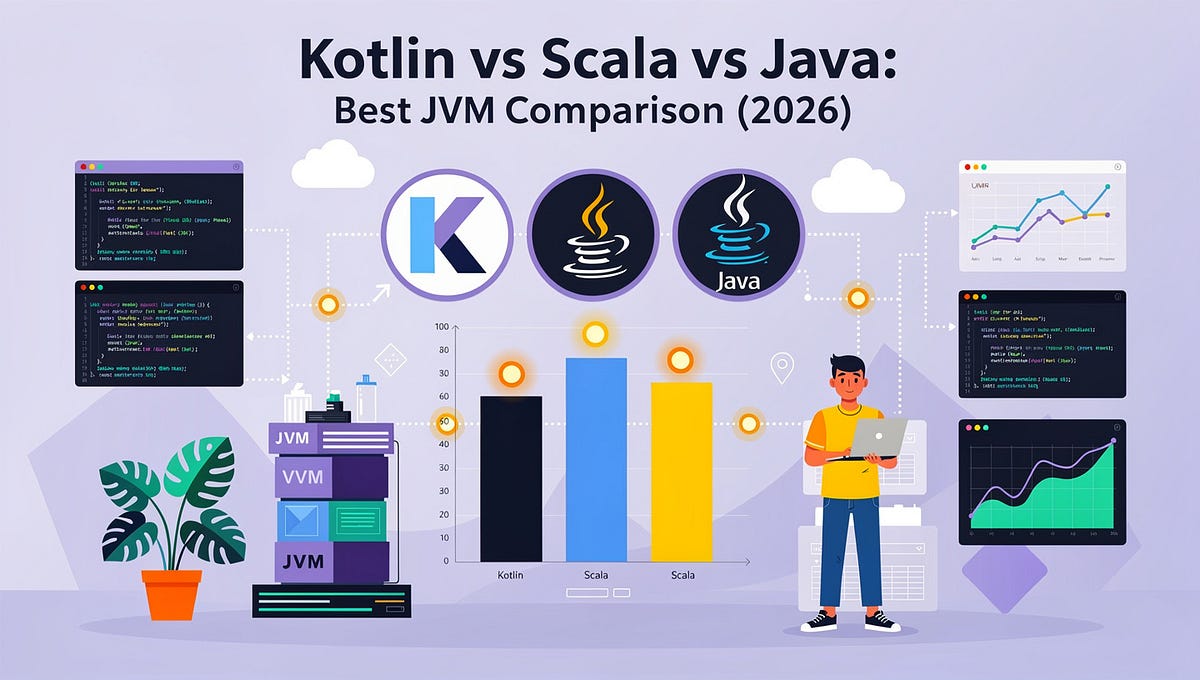
1 week agoJava vs Kotlin vs Scala: Which to Choose in 2026
Java, Kotlin, and Scala serve different audiences and problems despite running on the JVM.




fromInfoWorld
2 weeks agoWe mistook event handling for architecture
Events are essential inputs to modern front-end systems. But when we mistake reactions for architecture, complexity quietly multiplies. Over time, many front-end architectures have come to resemble chains of reactions rather than models of structure. The result is systems that are expressive, but increasingly difficult to reason about.
React
DevOps
fromInfoQ
2 weeks agoQCon London 2026: Managing Asynchronous APIs at Scale
Event-driven architectures require explicit specifications, governance, and provisioning practices to scale beyond informal ad-hoc approaches, using tools like AsyncAPI to enable discovery, schema consistency, and automated infrastructure deployment.
fromInfoWorld
1 month agoThe right way to architect modern web applications
Modern web applications are no longer just "sites." They are long-lived, highly interactive systems that span multiple runtimes, global content delivery networks, edge caches, background workers, and increasingly complex data pipelines. They are expected to load instantly, remain responsive under poor network conditions, and degrade gracefully when something goes wrong.
Web frameworks
#java-26-release
Java
fromDevOps.com
2 weeks agoJava 26 Arrives With AI Integration and a New Ecosystem Portfolio - What It Means for DevOps Teams - DevOps.com
Java 26 positions Java as the infrastructure layer for AI workloads, with 73 billion active JVMs already running enterprise systems where agentic AI will operate.
Software development
fromMedium
2 weeks agoFrom Concept to Production: The Complete Guide to XML Prompt Engineering for Software Developers
Treat LLMs as compilers, not chatbots, using Structured XML Prompting to generate professional-grade code through a five-stage AI-assisted development cycle with rigid constraints.



Web development
fromLogRocket Blog
1 month agoAnti-libraryism: 10 web APIs that replace modern JavaScript libraries - LogRocket Blog
Major browsers provide native Web APIs that replace many common JavaScript libraries, enabling smaller bundles, improved runtime performance, and reduced dependency maintenance.


fromLogRocket Blog
1 month agoHow to build agentic frontend applications with CopilotKit - LogRocket Blog
The web is full of AI assistants that appear to understand application UIs, user data, and intent. In practice, however, most of these systems operate outside the application itself. When you try to build one from scratch, you quickly run into a core limitation: large language models have no native understanding of your React state, component hierarchy, or business logic.
Web development
fromInfoWorld
2 months agoGet started with Angular: Introducing the modern reactive workflow
Angular is a cohesive, all-in-one reactive framework for web development. It is one of the larger reactive frameworks, focused on being a single architectural system that handles all your web development needs under one idiom. While Angular was long criticized for being heavyweight as compared to React, many of those issues were addressed in Angular 19. Modern Angular is built around the Signals API and minimal formality, while still delivering a one-stop-shop that includes dependency injection and integrated routing.
Web frameworks

fromMedium
2 months agoAgentic Workflows in Scala (Without the Buzzwords)
High-level view of the travel search workflow, highlighting parallel searches, explicit decision points, and iterative refinement. In Scala, we define this workflow using Workflows4s, encoding both state and transitions explicitly in the type system. Instead of opaque state blobs or untyped contexts, the state of the process is represented using algebraic data types - types like Started, Found, Sent, and Booked - each corresponding to a distinct point in the workflow's lifecycle.
Scala
fromMedium
1 year agoModern Web Architectures: Composability with Harmony
Over the past decade, software development has undergone a massive transformation due to continuous innovations in tools, processors and novel architectures. In the past, most applications were monoliths and then shifted to microservices, and now we find ourselves embracing composability - a paradigm that prioritizes modular, reusable, and flexible software design. Instead of writing separate, tightly coupled applications, developers now compose software using reusable business capabilities that can be plugged into multiple projects. This enables greater scalability, maintainability, and collaboration across teams and organizations. At the heart of this movement is Bit Harmony, a framework designed to make composability a first-class citizen in modern web development.
Software development
fromMedium
2 months agoFunctional Programming Isn't Just for Academics: Why It Matters for the Systems We Build Now
In 1983 I asked my parents for an Atari for Christmas, instead I got a Commodore 64... Needless to say, I was very disappointed until I discovered how much cooler Wizard of Wor was than Combat. To their credit, my parents thought a computer was a better investment than a video game. I used that C64 through my sophomore year of college until I replaced it with a 486; my first real investment.
Software development
fromMedium
2 months agoTwo Months of Vibe-Coding: Scala, Constraints, Trust and Shipping
If there's one thing I want you to take away from this article, it's this: testing harness is the most important thing for vibe-coding. Not prompt engineering, not fancy plugins, just constraining your AI outside AI toolchain. I'm calling it harness because it's not only tests. It's tests, types, linters, and any other automated checks you can put in place. The more you rely on AI, the more harness you need.
Software development
fromInfoQ
2 months agoJava News Roundup: Jakarta EE 12, Spring Shell, Open Liberty, Quarkus, Tomcat, JHipster, Gradle
From the discussions in the Jakarta EE Platform call[s] the last couple of weeks, it looks like we won't see a release of Jakarta EE 12 on this side of summer (on the Northern Hemisphere at least). The reason is that since Jakarta EE 11 was delayed by a year, most of the vendors are currently working on their implementations.
Java
fromMedium
1 month agoFire-and-Forget REST APIs: A TDD Journey.
The request for its API val request = Request[IO](Method.POST, uri"/jobs")val api = new AsyncJobApi // this will not compile since AsyncJobApi is not defined yet Minimal implementation to make it green: class AsyncJobApi Red test: The API should return a 202 Accepted response: "POST /jobs returns Accepted" in { val request = Request[IO](Method.POST, uri"/jobs") val api = new AsyncJobApi api.routes.orNotFound.run(request).asserting : response => response.status shouldBe Status.Accepted} Make it green: class AsyncJobApi { val routes: HttpRoutes[IO] = HttpRoutes.of[IO] : case req @ POST -> Root / "jobs" => Accepted()} 5.2 Add headers (Trivial Implementation) Red test: add X-Total-Count and Location headers with job ID (only the assertion is shown)
Scala
fromScala-lang
2 months agoScala 3.8 released!
We're pleased to announce the release of Scala 3.8 - a significant release that modernizes the Scala ecosystem and paves the way for Scala 3.9 LTS. This release introduces a standard library compiled by Scala 3 itself, stabilizes highly-anticipated features like Better Fors (SIP-62) and runtimeChecked (SIP-57), and introduces experimental features including flexible varargs and strict equality pattern matching. A runtime regression was detected after publishing Scala 3.8.0 artifacts.
Scala
fromMedium
1 month agoMonadris: Why Functional Design Makes Tetris Safer and Easier (Scala 3 + ZIO)
A real Tetris loop has time (ticks), concurrent inputs (keystrokes), state transitions (collision, locking, line clears), and non-determinism (piece generation). In many imperative designs, these concerns end up tangled in shared mutable state, which tends to produce bugs that are: hard to reproduce (timing-dependent), hard to test (logic mixed with effects), hard to debug (replay isn't deterministic).
Software development
[ Load more ]