#salpa
#salpa
[ follow ]
#climate-change #conservation #marine-life #krill-fishing #marine-conservation #animal-welfare #marine-biology
fromwww.scientificamerican.com
2 days agoSee these ziti-sized fish scale a 50-foot waterfall
During major floods, thousands of tiny fish convene at Luvilombo Falls in the upper Congo River Basin to undertake a peculiar vertical migration, described for the first time today in Scientific Reports.
OMG science
Psychology
fromwww.scientificamerican.com
2 weeks agoThese fish can tell when you're staring
Fish can perceive when they or their offspring are being watched and respond with increased aggression, demonstrating attention attribution abilities previously documented mainly in primates, birds, and domestic animals.
OMG science
fromNature
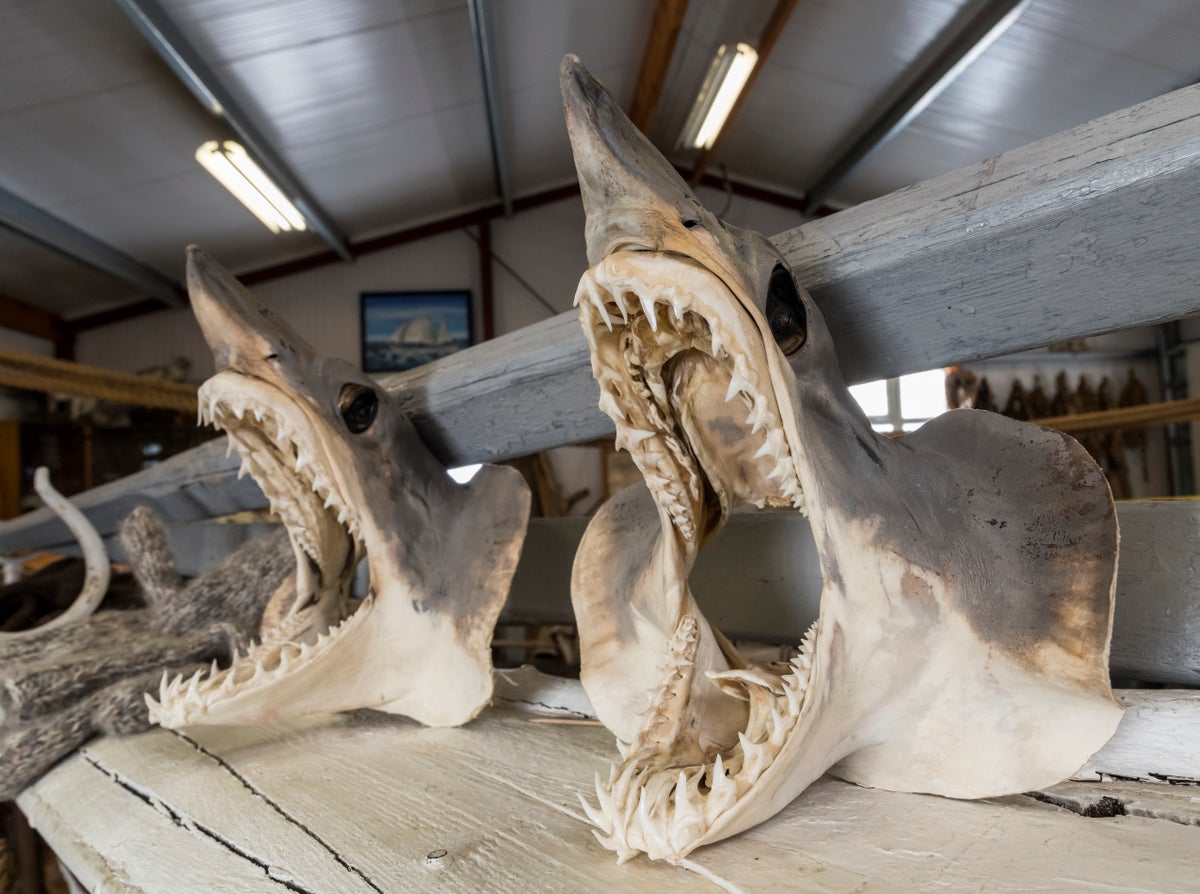
3 weeks agoDaily briefing: Genomes shake up the shark family tree
Doom's cultural impact extends beyond gaming into scientific research, with neurons playing the game and developers porting it to unexpected devices, while shark taxonomy may require reclassification based on genomic analysis revealing Hexanchiformes as a distinct evolutionary lineage.
fromSFGATE
1 month agoRare footage captures a 'glass' animal deep in Monterey Bay
We've documented sightings of glass squids to better understand the remarkable transformations they undergo from hatchlings to adults. This new observation, captured in ultra high-resolution 4K, allowed us to zoom in on a juvenile likely no bigger than a baby carrot and reveal more details than we have been able to see before.
OMG science
fromwww.theguardian.com
1 month agoWorld's largest krill harvester at centre of row over blue tick' sustainability label
Krill are a keystone species and the main food source for whales, penguins and seals. Aker QRILL, the world's largest harvester of krill, a tiny crustacean and keystone of Antarctica's fragile ecosystem, and its sister company, Aker BioMarine, produce feed additives for aquaculture and dietary supplements for pets and humans.
Environment
Miscellaneous
fromwww.theguardian.com
1 month agoIt's betrayal': Shetland's scallop fishers brace for arrival of UK's largest salmon farm
Approval of the UK's largest planned salmon farm in Shetland intensifies conflict between local scallop fishers and fish-farm operators over ecological and economic strain.
Environment
fromABC7 San Francisco
1 month agoTracking fisherman to track fish: The new technological approach to better understand ocean life
Global Fishing Watch uses AIS transponder data and artificial intelligence to track fishing vessels worldwide, providing unprecedented visibility into global fishing fleet movements and activities.
Environment
fromwww.theguardian.com
1 month agoChronic ocean heating fuels staggering' loss of marine life, study finds
Chronic ocean warming reduces fish biomass by 7.2% per 0.1°C of seabed warming per decade, with marine heatwaves masking long-term decline through temporary population booms in cold-water regions.
Environment
fromwww.montereyherald.com
1 month agoFinding Sanctuary: Ranking the most wanted kelp forests
Northern California kelp forests have declined dramatically, central California shows patchy loss; small-scale restoration cannot offset losses, requiring prioritization and high-resolution monitoring.
fromwww.latimes.com
2 months agoCalifornia diver documents close encounter with lacy, undulating sea creature far from home
It looked like the silvery blade of a knife. Peering through his goggles, diver Ted Judah had laid eyes on a deep-sea creature rarely encountered by humans. He and wife Linda were diving off McAbee Beach in Monterey County in late December when, near the surface, he spotted the undulating thing. It was some kind of ribbon fish, he wrote in a post on the Facebook group Monterey County Dive Reports. Kevin Lewand solved the mystery.
Science
fromenglish.elpais.com
1 month agoA jellyfish the size of a school bus: The new scientific discovery in the Argentine Sea
Argentina's deep sea holds more biodiversity than scientists previously thought. An expedition that traveled from the north of Buenos Aires province to Tierra del Fuego, the country's southernmost point, observed the world's largest known Bathelia candida coral reef, worms, sea urchins, snails, anemones, and a specimen that captured the public's attention: a rare phantom jellyfish that can grow as large as a school bus.
Science
Environment
fromState of the Planet
1 month agoHarnessing AI, Scientists Discover a Rise in Floating Algae Across the Global Ocean
Floating algae blooms have increased globally since about 2008–2010, driven by warming oceans, changing currents, and nutrient pollution, with coastal ecological and economic harms.
fromwww.mercurynews.com
2 months agoFrom fuzzy flowers to see-through sea slugs, here are some of the new species discovered last year by California scientists
But as he swept his flashlight through the dark waters, something unexpected emerged. Inching through the beam of light, an alien creature crawled across the surface of the sand, resembling an inch-long cluster of ghostly leaves fringed with silvery filigree and capped with a pair of antennae-like stalks. It immediately caught my eye, said Gosliner, Invertebrate Zoology Curator for the California Academy of Sciences. I've been diving there for 30 years and this one immediately struck me as different.
Science
Environment
fromwww.theguardian.com
1 month agoClimate crisis linked to fall in southern right whale birth rates as researchers raise warning signal'
Southern right whales have shifted from three-year to four- or five-year calving cycles since 2017, linked to climate-driven changes in Antarctic foraging grounds.
fromNature
2 months agoFloating science stations: my month on a research vessel looking after buoys
In this photo, I'm preparing drifting buoys for deployment. This was my main responsibility aboard the RV Falkor (too), during a 27-day research expedition in October 2025 exploring the Malvinas Current, an ocean current that runs alongside Argentina. The expedition included biologists, geologists and physical oceanographers such as myself; I'm a PhD candidate at the Sea and Atmosphere Research Center (CIMA) in Buenos Aires, Argentina.
Science
[ Load more ]