#senator
#senator
[ follow ]
#immigration-enforcement #congress #government-shutdown #department-of-homeland-security #midterm-elections

fromTechCrunch
9 hours agoAnthropic ramps up its political activities with a new PAC | TechCrunch
Anthropic's political activities have ramped up as the company continues to be enmeshed in a nasty legal battle with the Defense Department. The dispute erupted earlier this year over the government's use of Anthropic's AI models and what guidelines (if any) should exist for that usage.
Artificial intelligence
fromNextgov.com
3 days agoLawmaker looks to award grants for veteran suicide prevention AI models
The Recovery Engagement and Coordination for Health-Veteran Enhanced Treatment, or REACH VET, program identifies veterans in the top 0.1% of suicide risk by analyzing health records for specific indicators of potential self-harm.
Non-profit organizations
Media industry
fromNonprofit Quarterly | Civic News. Empowering Nonprofits. Advancing Justice.
3 days agoPolitics in an Attention Economy | Nonprofit Quarterly | Civic News. Empowering Nonprofits. Advancing Justice.
Candidates must be cultural figures to succeed in today's American politics, navigating an attention economy shaped by algorithms.
Law
fromAbove the Law
4 days agoBiglaw To D.C. Circuit: This Isn't Just About Us - It's About Whether The President Can Put Lawyers On A Leash - Above the Law
The fight over Trump-era executive orders targeting Biglaw firms intensifies as firms argue these orders threaten constitutional independence and the rule of law.
Intellectual property law
fromPatently-O
1 week agoBipartisan Skepticism Greets Director Squires at First House Oversight Hearing
The House Judiciary Subcommittee hearing addressed various USPTO issues under Director John Squires, revealing bipartisan skepticism and concerns over patent quality and IPR changes.
#voter-registration
US politics
fromNonprofit Quarterly | Civic News. Empowering Nonprofits. Advancing Justice.
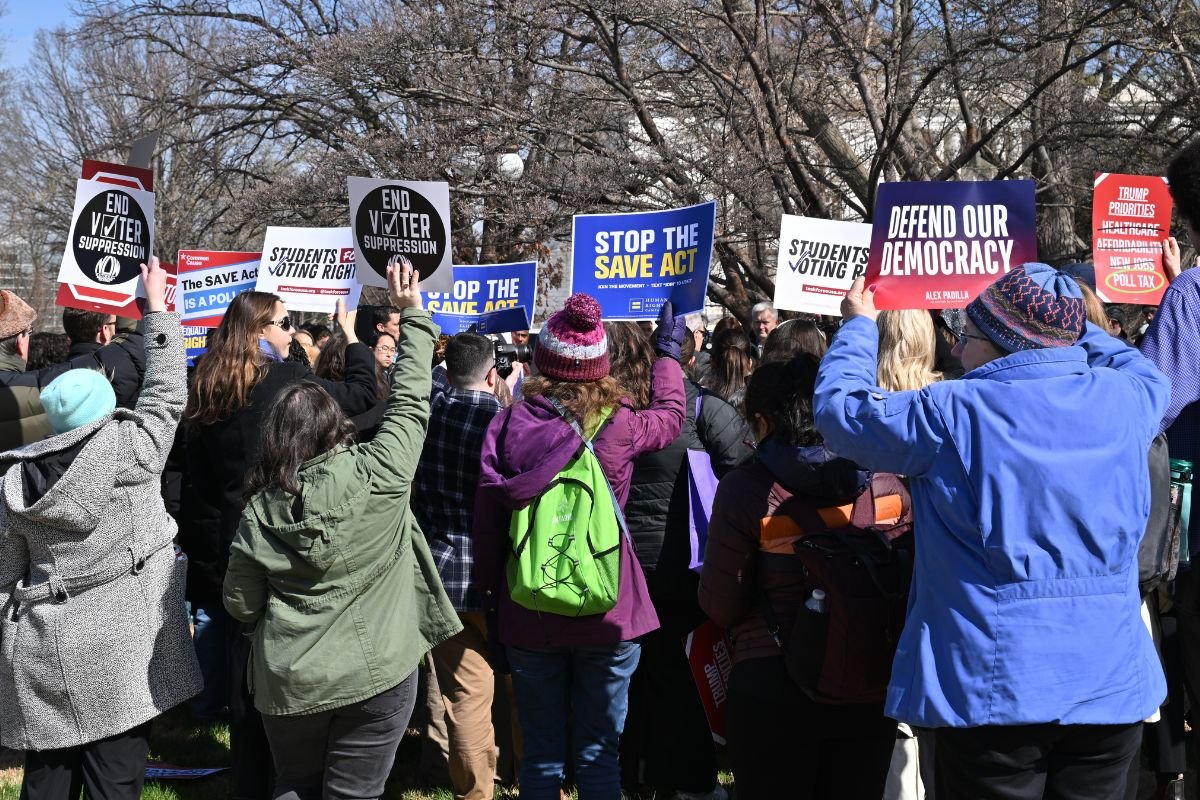
1 week agoWhat Is the SAVE America Act? | Nonprofit Quarterly | Civic News. Empowering Nonprofits. Advancing Justice.
The SAVE America Act aims to impose stricter voter registration requirements, raising concerns about its impact on marginalized groups.



Philosophy
fromApaonline
3 weeks agoWhy We Need a Formal, Mandatory, and Remunerated "Citizen Lobby"
Post-Cold War optimism about democracy and internet freedom has been undermined by geopolitical tensions, neoliberalism, nationalism, and corporate influence that concentrate power among the already wealthy.
Left-wing politics
fromwww.aljazeera.com
2 weeks agoPresident or Congress? Who in the US has the power to declare war?
Trump launched military strikes against Iran citing self-defense, bypassing Congress, while Democrats challenged his constitutional authority and Republicans blocked a war powers resolution to halt further action.
fromPsychology Today
4 weeks agoFilibustering and Delay Strategies That Block Social Justice
Organizational filibustering refers to strategies that delay and obstruct efforts to pursue social justice in systems. These additions can stretch out the process of implementation of diversity strategic plans or multicultural programs for years. Change agents can become battle-fatigued and give up their efforts. They can also become so disheartened that they leave a group or organization altogether.
Social justice
fromwww.npr.org
3 weeks agoSenate passes bipartisan housing bill targeting large investors and easing regulations
If we want to bring down the cost of housing, we've got to build a lot more. And what I love about this bill is that it has more than 40 different provisions in it, all of which aim in the same direction, which is to give a push toward building more housing.
US news
SF politics
fromwww.mediaite.com
2 weeks agoRepublican Congressman Turned Independent Now Says He's Open to Caucusing With Dems
Rep. Kevin Kiley switched to Independent status and remains open to caucusing with Democrats if reelected, while currently maintaining Republican caucus membership due to House rules.
Left-wing politics
fromwww.theguardian.com
1 month agoThe Democrat who schools Republicans I would say do more of that'
Isaiah Martin, a 27-year-old Democrat, gained 400 million social media views by effectively debating 20 MAGA Republicans on Trump-related topics, demonstrating Democratic voters' desire for bold, confrontational leadership.
fromFortune
2 weeks agoAn effort similar to the SAVE Act was tried once, but was blocked by courts when over 30,000 eligible citizens were prevented from registering to vote | Fortune
I didn't know that anything had officially changed walking in there. And then being told that I had to provide a passport that I've never had or a birth certificate that's usually tucked away somewhere safe just to cast my vote - which I've done before - it was frustrating.
US politics
fromThe New Yorker
1 month agoDemocracy Dies in Broad Daylight
Last week- after the Wall Street Journal broke more news about the Trump family's dodgy crypto-business dealings and before the President shared a racist video of the Obamas depicted as dancing apes-the Amazon entrepreneur Jeff Bezos decided that one of his smaller properties, the Washington Post, has proved such a drag on his two-hundred-and-thirty-billion-dollar fortune that prudence required that he obliterate much of its newsroom.
Media industry
US politics
fromAxios
3 weeks agoDems plan probes into companies, colleges that cooperated with Trump
Democratic senators plan investigations into Trump administration cooperation with major institutions, corporations, and wealthy individuals, leveraging broader House subpoena authority and targeting private entities unable to claim executive privilege.
US politics
fromAbove the Law
3 weeks agoFrom 'Hold Me In Contempt' To 'Elect Me To Congress' - Above the Law
Former Justice Department attorney Julie Le, who criticized the immigration system's workload demands, is now running for Congress in Minnesota's 5th District as a Democrat challenging Ilhan Omar.
fromPsychology Today
2 months agoHow to Have Better Political Conversations
The principle of intellectual charity is fundamental to constructive political conversations. This principle states that, in any discussion, we should accept the best version of an opponent's ideas, not a distorted version or a "straw man." Exaggeration and distortion of opposing opinions (always present, to some degree, in political debates) have become the standard form of political argument in contemporary America.
Philosophy
US politics
fromNextgov.com
1 month agoBipartisan lawmakers worried about shaky progress on modernized government worker background check system
The National Background Investigation Services system for federal employee vetting faces a decade-long delay until fiscal 2028, costing $2.4 billion with $2.2 billion more needed, impacting national security and government contractors.
US politics
fromBronx Times
1 month agoMother of Dylan Contreras attends State of the Union as guest of Senator Chuck Schumer - Bronx Times
A Bronx mother whose son has been detained by ICE for nine months despite entering legally and following all asylum procedures attended the State of the Union as Senator Schumer's guest to advocate for immigration reform.
US politics
fromBoston.com
1 month agoMass. representatives, including minority whip, to skip State of the Union address
Several Massachusetts congressional representatives are boycotting the State of the Union address to protest Trump administration policies on healthcare, costs, Social Security, tariffs, and ICE enforcement.
fromPOLITICO
1 month agoTrump doesn't give Congress much to do before the midterms
I think we know what the agenda items are. Accomplishing those is going to be hard with a small majority. The upshot is that Trump's prime-time address is unlikely to make more than a ripple in the congressional agenda over the coming months. It's the reality, Republicans acknowledged Wednesday, of life in Washington right now: Despite its trifecta, the party's legislative ambitions are being hemmed in by its barely-there majorities.
US politics
US politics
fromwww.mediaite.com
1 month agoRepublican Joins With Dems on Constitutional Amendment to Give Congress Power to Reject Trump Pardons
A proposed constitutional amendment would let Congress review and potentially nullify presidential pardons via a two-thirds congressional vote within 60 days.
fromLGBTQ Nation
1 month agoPolitical pragmatism is not a moral failing. It may be the only thing that can save us. - LGBTQ Nation
He is not worthy of the presidency. He takes bribes blatantly. And now he's being a racist, blatantly. They were supposed to deport the dangerous criminals. They were not supposed to go after small children, storm schools, bring terror upon, you know, the little kids and the women and children, not just the immigrants in the school. All the children are scared.
US politics
from24/7 Wall St.
1 month agoAmerica's Oldest Lawmakers Still Serving in Congress
Age has long been a point of debate in American politics, but it becomes especially controversial when lawmakers remain in office well beyond traditional retirement years. As the nation grapples with issues like healthcare, technology, and economic change, questions naturally arise about how age, generation status, and experience influence leadership at the highest levels of government. For some voters, longevity in office represents wisdom; for others, it raises concerns about representation and outdated reasoning.
US politics
fromwww.mercurynews.com
2 months agoBarabak: The Senate is a mess. Jeff Merkley wants to fix it, from the inside.
To say the U.S. Senate has grown dysfunctional is like suggesting water is wet or the nighttime sky is dark. The institution that fancies itself the world's greatest deliberative body is supposed to serve as a cooling saucer that tempers the more hotheaded House, applying weight and wisdom as it addresses the Great Issues of Our Time. Instead, it's devolved into an unsightly mess of gridlock and partisan hackery.
US politics
US politics
fromwww.theguardian.com
1 month agoDemocrats have a constitutional power they aren't using to fight back: state resolutions | Sidney Blumenthal
Democratic state legislatures can revive pre-17th Amendment orders of instruction to pressure senators and counter attempts to impose a police state.
US politics
fromwww.mediaite.com
2 months agoNEW POLL: Americans Trust Republicans Over Democrats On Most Major Issues in Congress
Americans view Congressional Republicans as better equipped to handle most major issues—especially border security, immigration, and the economy—while Democrats lead on the generic congressional ballot.
fromThe Atlantic
2 months agoPurge the Public Servants
In this new season, I'm asking how the Trump White House is rewriting the rules of U.S. politics, and talking to Americans whose lives have been changed as a result. Today's episode examines the destruction of the civil service: the removal of professionals, and their replacement with loyalists. I've seen this kind of transformation before, in other failing democracies. Everyone suffers from the degradation of public services.
US politics
fromPOLITICO
1 month agoHouse Democrats once again left complaining about a Senate spending deal
The interchamber tensions between Democrats are becoming a regular feature of funding fights in the second Trump term. Lawmakers, strategists and voters alike exploded in anger last March when Senate Minority Leader Chuck Schumer and a handful of colleagues allowed a spending package to move forward amid the Elon Musk-led DOGE assault on federal agencies. In November, tempers again flared when a handful of Senate Democrats joined with Republicans to end a record 43-day shutdown.
US politics
fromwww.theguardian.com
1 month agoCongressional Democrats vow justice for US citizens harmed by immigration agents: You deserve peace'
Luke Ganger said he and his brother were there to ask for you help and suggested the sense of loss his family felt had been deepened by subsequent events in Minneapolis, where a protester, Alex Pretti, also aged 37, was shot dead by two border patrol agents on 24 January. The deep distress our family feels at Renee's loss in such a violent and unnecessary way is complicated by feelings of disbelief, distress and desperation, he said.
US politics
[ Load more ]