#serverless-applications
#serverless-applications
[ follow ]
#aws #kubernetes #model-context-protocol #cloud-computing #agentic-ai #software-development #ai-integration

fromInfoQ
1 day agoModule Federation 2.0 Reaches Stable Release with Wider Support Outside of Webpack
The dynamic type hints feature in Module Federation 2.0 dramatically streamlines the development process by automatically generating and loading types from remote modules, eliminating the need for shared type packages.
Angular

fromInfoWorld
2 weeks agoWe mistook event handling for architecture
Events are essential inputs to modern front-end systems. But when we mistake reactions for architecture, complexity quietly multiplies. Over time, many front-end architectures have come to resemble chains of reactions rather than models of structure. The result is systems that are expressive, but increasingly difficult to reason about.
React
fromInfoWorld
1 month agoThe right way to architect modern web applications
Modern web applications are no longer just "sites." They are long-lived, highly interactive systems that span multiple runtimes, global content delivery networks, edge caches, background workers, and increasingly complex data pipelines. They are expected to load instantly, remain responsive under poor network conditions, and degrade gracefully when something goes wrong.
Web frameworks
Software development
fromAmazon Web Services
4 weeks agoStandardizing construct properties with AWS CDK Property Injection | Amazon Web Services
Property Injection in AWS CDK v2.196.0 automatically applies default properties to constructs, eliminating manual repetitive configuration and ensuring organizational compliance standards without code modifications.

Artificial intelligence
fromDevOps.com
3 weeks agoMicrosoft Azure Skills Plugin Gives AI Coding Agents a Playbook for Cloud Deployment - DevOps.com
Microsoft's Azure Skills Plugin bridges the gap between AI code generation and production deployment by combining 19+ curated Azure skills, 200+ tools, and operational knowledge in a single install.
#event-driven-architecture
DevOps
fromInfoQ
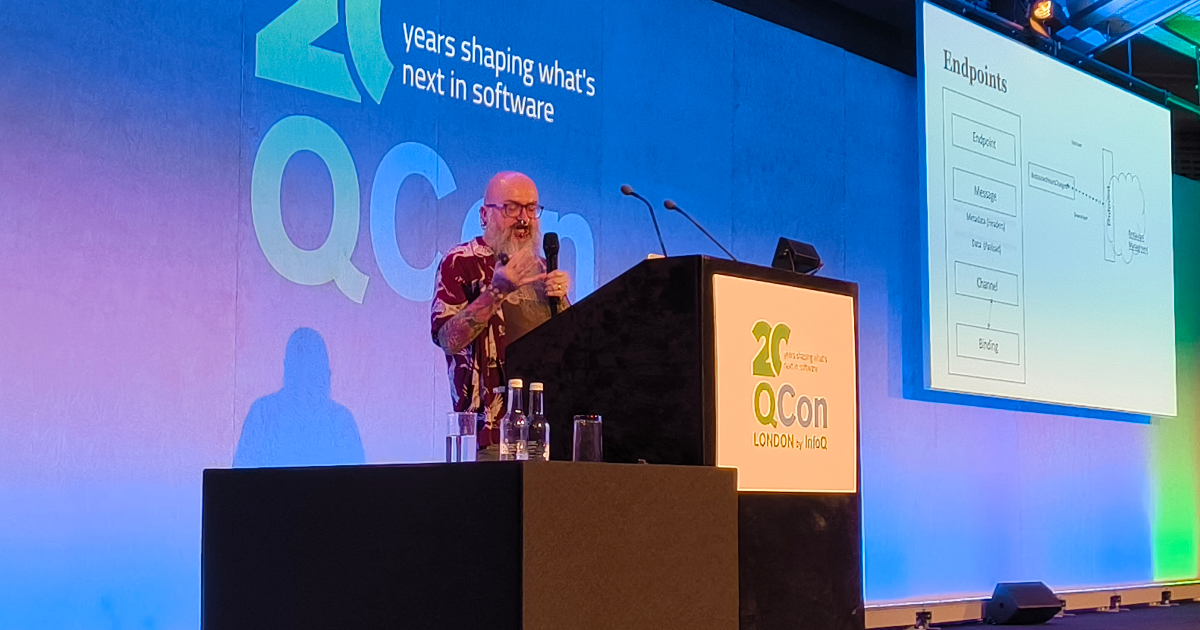
2 weeks agoQCon London 2026: Managing Asynchronous APIs at Scale
Event-driven architectures require explicit specifications, governance, and provisioning practices to scale beyond informal ad-hoc approaches, using tools like AsyncAPI to enable discovery, schema consistency, and automated infrastructure deployment.
Software development
fromInfoQ
1 month agoReducing Onboarding From 48 Hours to 4: Inside Amazon Key's Event-Driven Platform
A centralized, event-driven architecture on Amazon EventBridge replaced a monolithic, tightly coupled platform to enable millions of daily events, millisecond latency, and scalable consumer onboarding.
Java
fromAmazon Web Services
1 month agoAWS Transform custom: AI-driven Java modernization to reduce tech debt | Amazon Web Services
AWS Transform custom automates large-scale Java modernization using agentic AI, standardized AWS-managed transformations, and customizable packages to reduce technical debt and speed upgrades.
fromMedium
1 month agoFire-and-Forget REST APIs: A TDD Journey.
The request for its API val request = Request[IO](Method.POST, uri"/jobs")val api = new AsyncJobApi // this will not compile since AsyncJobApi is not defined yet Minimal implementation to make it green: class AsyncJobApi Red test: The API should return a 202 Accepted response: "POST /jobs returns Accepted" in { val request = Request[IO](Method.POST, uri"/jobs") val api = new AsyncJobApi api.routes.orNotFound.run(request).asserting : response => response.status shouldBe Status.Accepted} Make it green: class AsyncJobApi { val routes: HttpRoutes[IO] = HttpRoutes.of[IO] : case req @ POST -> Root / "jobs" => Accepted()} 5.2 Add headers (Trivial Implementation) Red test: add X-Total-Count and Location headers with job ID (only the assertion is shown)
Scala

fromNew Relic
2 months agoSetting Up AWS Distro for OpenTelemetry with Container-Based Lambda Functions and New Relic
Observability in serverless environments can be challenging, but AWS Distro for OpenTelemetry (ADOT) simplifies this by providing a standardized, vendor-neutral way to collect and export telemetry. ADOT allows you to leverage industry-standard OpenTelemetry APIs to instrument your applications without being locked into a single observability backend. The challenge with containerized Lambdas is that they do not support standard Lambda Layers. Since ADOT is typically deployed as a layer for Lambda functions, we need an alternative way to get the telemetry agent into our execution environment.
Node JS
Node JS
fromThe NodeSource Blog - Node.js Tutorials, Guides, and Updates
5 months agoNode.js 22 Features You Should Be Using
Node.js 22 LTS delivers stability, dependency reduction, improved performance, built-in WebSocket and fetch, and enhanced runtime visibility with N|Solid and N|Sentinel for production readiness.
fromDevOps.com
3 weeks agoZero Downtime Multicloud Migrations for Observability Control Planes - DevOps.com
An observability control plane isn't just a dashboard. It's the operational authority system. It defines alert rules, routing, ownership, escalation policy, and notification endpoints. When that layer is wrong, the impact is immediate. The wrong team gets paged. The right team never hears about the incident. Your service level indicators look clean while production burns.
DevOps
fromMedium
1 year agoModern Web Architectures: Composability with Harmony
Over the past decade, software development has undergone a massive transformation due to continuous innovations in tools, processors and novel architectures. In the past, most applications were monoliths and then shifted to microservices, and now we find ourselves embracing composability - a paradigm that prioritizes modular, reusable, and flexible software design. Instead of writing separate, tightly coupled applications, developers now compose software using reusable business capabilities that can be plugged into multiple projects. This enables greater scalability, maintainability, and collaboration across teams and organizations. At the heart of this movement is Bit Harmony, a framework designed to make composability a first-class citizen in modern web development.
Software development


DevOps
fromAmazon Web Services
1 month agoAutomate AWS Lambda Runtime Upgrades with AWS Transform custom | Amazon Web Services
AWS Transform custom is an AI agent that automates code transformations across organizations, learning organization-specific patterns and executing them at scale to reduce technical debt from aging codebases and deprecated runtimes.
fromInfoWorld
2 months agoThe private cloud returns, for AI workloads
A North American manufacturer spent most of 2024 and early 2025 doing what many innovative enterprises did: aggressively standardizing on the public cloud by using data lakes, analytics, CI/CD, and even a good chunk of ERP integration. The board liked the narrative because it sounded like simplification, and simplification sounded like savings. Then generative AI arrived, not as a lab toy but as a mandate. "Put copilots everywhere," leadership said. "Start with maintenance, then procurement, then the call center, then engineering change orders."
Artificial intelligence
DevOps
fromAmazon Web Services
1 month agoMigrate Amazon EC2 to ECS Express Mode using Kiro CLI and MCP servers | Amazon Web Services
Amazon ECS Express Mode simplifies containerized workload deployment by automating task definitions and service orchestration, reducing manual operational overhead and accelerating migration from traditional EC2 deployments.
Artificial intelligence
fromMedium
4 months agoBridging AI and AWS: A Deep Dive into Using Model Context Protocol (MCP) for Intelligent Cloud...
MCP enables AI models to securely access real-time AWS infrastructure data, allowing natural-language queries and contextual, actionable insights across AWS services.
fromInfoQ
1 month agoLocalStack for AWS Drops Community Edition Raising Developer Concerns
LocalStack started as a scrappy open-source experiment, and the community made it what it is today. Over time, however, the scope, security requirements, and operational complexity of maintaining high-fidelity AWS emulation have grown significantly. To continue delivering accurate, secure, and production-grade cloud emulation - while still offering a free entry point - we need a distribution model that lets us engage directly with users, understand how LocalStack is used, and sustainably invest in the platform.
Software development
fromMedium
4 months agoCI/CD and Gitops with Microservices: Open Ecosystem vs AWS Native
While building apps I learned that writing code is only half the journey - getting it deployed, updated, and running reliably is also just as important if not more. When I started deploying my apps to the cloud, I realized how many manual steps it took to get the app running. That's when I discovered CI/CD and GitOps tools that automate everything from testing to deployment, so developers can focus on writing code instead of wasting time on manually deploying each time.
Software development
DevOps
fromInfoWorld
2 months agoFrom distributed monolith to composable architecture on AWS: A modern approach to scalable software
Migrating distributed monoliths to a composable AWS architecture yields loosely coupled, autonomous services that improve scalability, resilience, deployment velocity, and team autonomy.
DevOps
fromAmazon Web Services
1 month agoBuilding a scalable code modernization solution with AWS Transform custom | Amazon Web Services
An open-source infrastructure enables enterprise-scale, parallel AWS Transform custom code modernizations using AWS Batch, Fargate, REST APIs, and CloudWatch monitoring.
fromAmazon Web Services
1 month agoChoosing between Amazon ECS Blue/Green Native or AWS CodeDeploy in AWS CDK | Amazon Web Services
Blue/green deployments on Amazon Elastic Container Service (Amazon ECS) have long been a go-to pattern for shipping zero-downtime deployments. Historically, the recommended approach in the AWS Cloud Development Kit (AWS CDK) was to wire ECS to AWS CodeDeploy for traffic shifting, lifecycle hooks, and tight integration with AWS CodePipeline. In July 2025, Amazon ECS launched built-in blue/green deployments. This allows you to operate directly within the ECS service, without requiring the use of Amazon CodeDeploy.
DevOps
fromDbmaestro
5 years agoDatabase Delivery Automation in the Multi-Cloud World
The main advantage of going the Multi-Cloud way is that organizations can "put their eggs in different baskets" and be more versatile in their approach to how they do things. For example, they can mix it up and opt for a cloud-based Platform-as-a-Service (PaaS) solution when it comes to the database, while going the Software-as-a-Service (SaaS) route for their application endeavors.
DevOps
[ Load more ]