Retirement
fromSilicon Canals
4 hours agoWhat no one tells you about a working-class retirement - Silicon Canals
Retirement can lead to unexpected physical and identity challenges for those who defined themselves by their work.
One way is to increase income taxes. There's also the option for an annual or one-off wealth tax on everything someone has above a certain mark. A few governments want to tax extreme wealth to lower taxes on a stagnating middle class or to make up for social inequality.
It has become increasingly clear how great the challenges are in implementing the directive in a national context, both for us in Sweden and in other EU countries. Therefore, a relaunch at EU level is needed and we are now taking the initiative to do so.
The result was a vote of no confidence in a centrist government led by the Social Democrat Mette Frederiksen. Her administration was, in the Danish context, an unusual political construction.
Life expectancy in the EU continues to increase, reaching 81.5 years in 2024, 0.1 years more than the previous year and higher than in 2019, the year before the pandemic (81.3). As a reference, at the height of COVID-19, in 2021, the expectation of life had declined to 80.1 years across EU countries.
According to the institute's research professor, Jari Hakanen, working life in Finland is facing challenges posed by four negative trends. Workloads have increased, resources have declined, expectations for the future have become more uncertain, and at the same time, workers are increasingly getting burnt out.
A child born this morning in Britain can expect to be in good health only until they are 61. The last 20 years of their life will be blighted by illness: dodgy hearts, painful joints, an inability to get about. Our healthy life expectancy has been dropping for years; it is now the lowest since 2011, when records began.
Around 1.9 million people with university-level qualifications were at risk of poverty in 2025, an increase of 350,000 compared with 2022. The figures from Germany's official statistics office were released in response to a request from the Sahra Wagenknecht Alliance (BSW). The rise comes as the number of graduates grew to 21 million nationwide. Yet data from the Federal Employment Agency show unemployment among academics climbed to 3.3%, up from 2.2% three years earlier.
I do a video a day when I'm on my dog walk in Lund, and I try to find different topics to talk about. My son pointed out to me a video from national broadcaster SVT about a guy named Shahdad who came here from Iran when he was 14. Now he's 25 and he was about to be deported, even though his mum has a permanent residency and he had a job, so I did a video on him, because I didn't agree with that.
When it comes to understanding where your tax dollars actually go, the answer might surprise you. According to data from USASpending.gov, total federal obligations per capita can vary dramatically across states, with some receiving more than $24,000 per resident while others receive less than half that amount. These numbers are important because they help shape local economies, influence the cost of living, and quietly determine how far the dollar can stretch across the country.
One in three graduates who are out of work and claiming benefits say poor health is preventing them from finding employment, as new analysis highlights mounting concern over the value of some university degrees and the UK's approach to skills training. Research by the Centre for Social Justice (CSJ) shows that 707,000 graduates are now claiming benefits, a 46 per cent increase since 2019.
The UK's poorest families are getting poorer, with record numbers of people classed as in very deep poverty meaning their annual household incomes fail to cover the cost of food, energy bills and clothing, according to analysis. Although overall relative poverty levels have flatlined in recent years at about 21% of the population, life for those below the breadline has got materially worse as they try to subsist on incomes many thousands of pounds beneath the poverty threshold.
The forecasts from the Independent Commission on Neighbourhoods (Icon) show crime rates and unemployment will rise until the next election in England's 613 most deprived neighbourhoods, despite the government's promises to invest in local communities. The report's authors warn the extra money ministers have pumped in is not enough to counteract longer-term trends such as the increase in antisocial behaviour and the problems facing the retail and hospitality sectors.
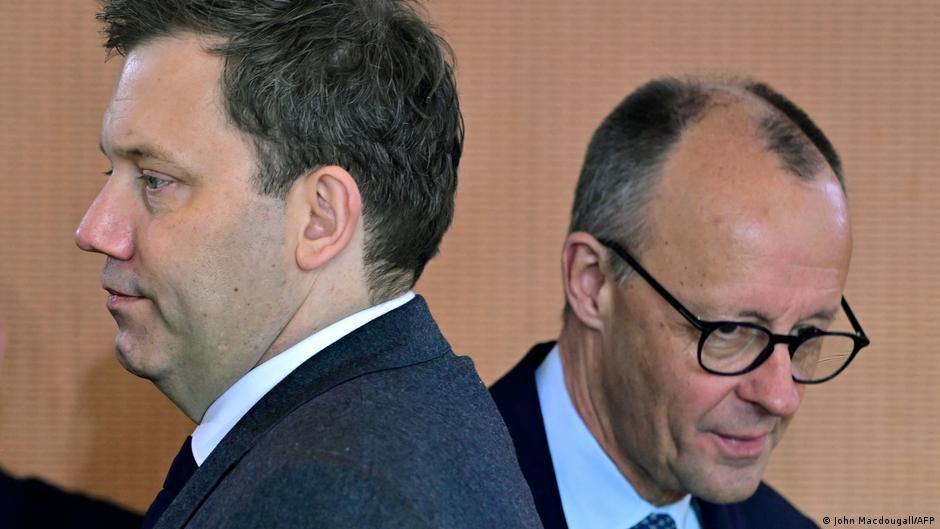
Guten Morgen from a wet and dreary Bonn. We are expecting the five suspects who were arrested on Monday on suspicion of violating sanctions against Russia to appear in court today and we will be looking into a new report about poverty in Germany. German Chancellor Friedrich Merz is also expected to host a carnival reception at the Chancellery in Berlin, which will hopefully provide some interesting pictures. For this and more, keep reading.
Pip is designed to support disabled people with the additional costs of daily living and mobility, yet for many claimants it has instead become a source of prolonged uncertainty, financial hardship and distress. Waiting months and in some cases more than a year for a decision can push people into debt, rent arrears and poverty, especially as Pip unlocks other support such as carer's allowance.
I studied abroad in Spain, and really loved it there. It opened my world and gave me more perspective, so I knew I wanted to go abroad after I graduated. I was interested in bioenergy, and that industry isn't very developed in the US. After doing some research, I landed on Finland, which has a huge forestry and bioenergy industry. The Nordics, in general, also have a lot of English-language master's degree programs. Through a Fulbright scholarship, I moved to Finland to pursue my master's degree.
From reproductive rights to climate change to Big Tech, The Independent is on the ground when the story is developing. Whether it's investigating the financials of Elon Musk's pro-Trump PAC or producing our latest documentary, 'The A Word', which shines a light on the American women fighting for reproductive rights, we know how important it is to parse out the facts from the messaging.
This is not to say that fraud does not exist, because it very obviously does, woven into the fabric of our society. The pandemic in particular was its own little golden age of American federal fraud, involving untold and unprecedented dollar totals being siphoned off from legitimate support programs, including the Paycheck Protection Program and the Economic Injury Disaster Loan program.
The UK population is estimated to have grown by nearly three million between 2020 and 2025, official figures show, not by 12 million as stated by Manchester United co-owner Sir Jim Ratcliffe. In an interview for Sky News broadcast on Wednesday, Sir Jim said: The population of the UK was 58 million in 2020, now it's 70 million that's 12 million people. It had climbed to just under 69.5 million by mid-2025, an increase since 2020 of almost 2.8 million.
Britain is getting older and sicker, while a greater share of its population has a disability. While these trends affect the whole of society, they are starkest in the poorest half of working-age families across the country. While we talk a lot about the effects of ageing and ill-health, the implications on demand for unpaid care is largely absent from political debate.
My reforms changed the welfare system to make work pay and brought workless households to an all-time low. But because of the post-Covid collapse in vetting and rise of health-related welfare claims, millions of workers could take home more from welfare than wages after tax. This is an outrageous state of affairs. The system must stop writing off thousands every day and incentives to work need to be restored to end this ruinous waste of human potential.




:max_bytes(150000):strip_icc()/TAL-porvoo-finland-HAPPIESTCOUNTRY0326-a84e8d54e32c4b2681c80bc3cf237cc1.jpg)