Software development
fromDevOps.com
2 days agoWhy Code Validation is the Next Frontier - DevOps.com
Shared staging environments are inadequate for modern development; isolated, on-demand setups are needed for effective validation.
Lydia noticed the machine's battery was running low and told two other team members. The more senior went to fetch the backup battery, while the junior team member suggested a quicker method that Lydia firmly rejected.
Readable failures. When something breaks, I want to understand why in seconds, not minutes. Predictable setup. I want to know exactly what state my tests are running against. Minimal magic. The less indirection between my test code and what's actually happening, the better. Easy onboarding. New team members should be able to write tests on day one without learning a new paradigm.
"I've never felt this much behind as a programmer. The profession is being dramatically refactored as the bits contributed by the programmer are increasingly sparse and between. I have a sense that I could be 10X more powerful if I just properly string together what has become available over the last ~year and a failure to claim the boost feels decidedly like skill issue."
The integration of AI-enhanced microservices within the SAFe 5.0 framework presents a novel approach to achieving scalability in enterprise solutions. This article explores how AI can serve as a lean portfolio ally to enhance value stream performance, reduce noise, and automate tasks such as financial forecasting and risk management. The cross-industry application of AI, from automotive predictive maintenance to healthcare, demonstrates its potential to redefine processes and improve outcomes.
The Harness Resilience Testing platform extends the scope of the tests provided to include application load and disaster recovery (DR) testing tools that will enable DevOps teams to further streamline workflows.
This extends to the software development community, which is seeing a near-ubiquitous presence of AI-coding assistants as teams face pressures to generate more output in less time. While the huge spike in efficiencies greatly helps them, these teams too often fail to incorporate adequate safety controls and practices into AI deployments. The resulting risks leave their organizations exposed, and developers will struggle to backtrack in tracing and identifying where - and how - a security gap occurred.
For years, reliability discussions have focused on uptime and whether a service met its internal SLO. However, as systems become more distributed, reliant on complex internet stacks, and integrated with AI, this binary perspective is no longer sufficient. Reliability now encompasses digital experience, speed, and business impact. For the second year in a row, The SRE Report highlights this shift.
To find the typical example, just observe an average stand-up meeting. The ones who talk more get all the attention. In her article, software engineer Priyanka Jain tells the story of two colleagues assigned the same task. One posted updates, asked questions, and collaborated loudly. The other stayed silent and shipped clean code. Both delivered. Yet only one was praised as a "great team player."
A secure software development life cycle means baking security into plan, design, build, test, and maintenance, rather than sprinkling it on at the end, Sara Martinez said in her talk Ensuring Software Security at Online TestConf. Testers aren't bug finders but early defenders, building security and quality in from the first sprint. Culture first, automation second, continuous testing and monitoring all the way; that's how you make security a habit instead of a fire drill, she argued.
Manual database deployment means longer release times. Database specialists have to spend several working days prior to release writing and testing scripts which in itself leads to prolonged deployment cycles and less time for testing. As a result, applications are not released on time and customers are not receiving the latest updates and bug fixes. Manual work inevitably results in errors, which cause problems and bottlenecks.
Industry professionals are realizing what's coming next, and it's well captured in a recent LinkedIn thread that says AI is moving on from being just a helper to a full-fledged co-developer - generating code, automating testing, managing whole workflows and even taking charge of every part of the CI/CD pipeline. Put simply, AI is transforming DevOps into a living ecosystem, one driven by close collaboration between human judgment and machine intelligence.
Integrating databases into the CI/CD process or the DevOps pipeline is overlooked in the current DevOps landscape. Most organizations have adapted automated DevOps pipelines to handle application code, deployments, testing, and infrastructure configurations. However, database development and administration are left out of the DevOps process and handled separately. This can lead to unforeseen bugs, production issues, and delays in the software development life cycle.
Let's trace Agile's trajectory: From 2001 to roughly 2010, Agile was a practitioner movement. Seventeen people wrote a one-page manifesto with four values and twelve principles. The ideas spread through communities of practice, conference hallways, and teams that tried things and shared what worked. The word meant something specific: adaptive, collaborative problem-solving over rigid planning and process compliance. Then came corporate capture.
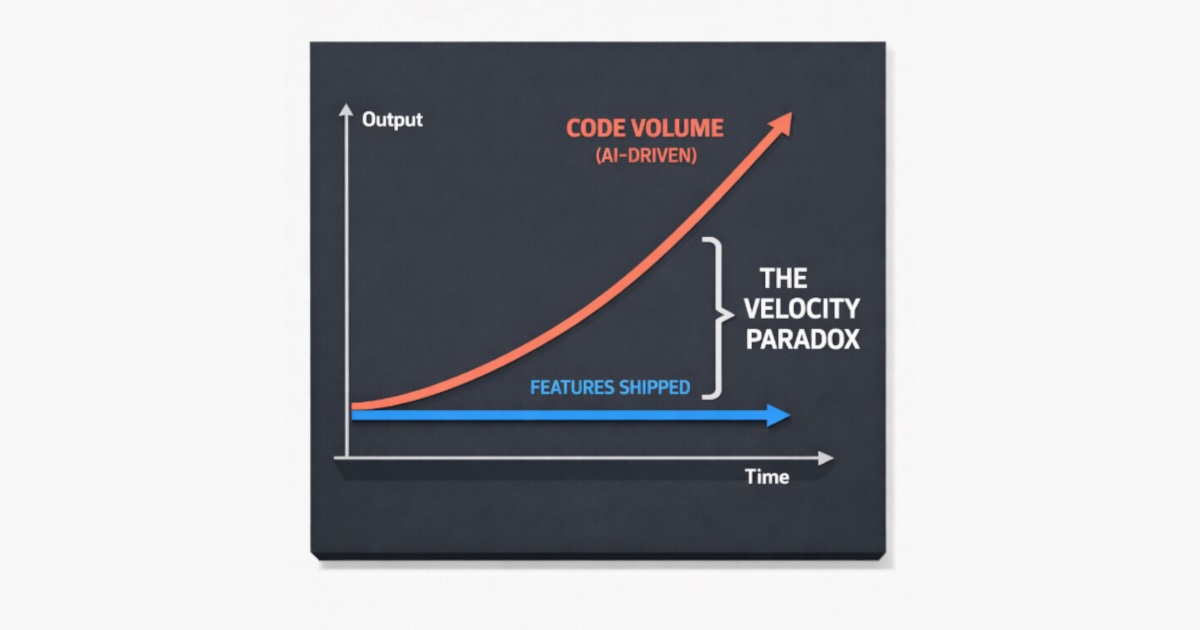
On December 19, 2025, Cursor acquired Graphite for more than $290 million. CEO Michael Truell framed the move simply: code review is taking up a growing share of developer time as the time spent writing code keeps shrinking. The message is clear. AI coding tools have largely solved the generation speed. Now the industry is betting that review is the next constraint to break.