#yisa-alao
#yisa-alao
[ follow ]
#contemporary-art #african-diaspora #afrobeat #afrobeats #sideshow #tigray-funk #hip-hop #ibrahim-mahama
fromwww.theguardian.com
1 week agoBlack music is not a subculture it is the engine': Why the Mobo awards matter more than ever, 30 years on
Kanya King stated, 'Black music shapes what we listen to, how we speak, how we dress, how we tell our stories and I guess it's defined as Britain's cultural identity but structurally and institutionally is still often treated as m.'
London music
#yaya-bey
Music production
fromKALTBLUT Magazine
2 weeks agoYaya Bey Unveils Dreamy New Single 'Egyptian Musk' Featuring NESTA From Forthcoming Album 'Fidelity' - KALTBLUT Magazine
Yaya Bey releases new single 'Egyptian Musk' featuring NESTA, part of her upcoming album 'Fidelity' exploring personal and communal themes.
.jpeg)
Music production
fromKALTBLUT Magazine
2 weeks agoYaya Bey Unveils Dreamy New Single 'Egyptian Musk' Featuring NESTA From Forthcoming Album 'Fidelity' - KALTBLUT Magazine
Yaya Bey releases new single 'Egyptian Musk' featuring NESTA, part of her upcoming album 'Fidelity' exploring personal and communal themes.
Social justice
fromCN Traveller
2 weeks ago"Black excellence is everywhere, Black connection is not": Inside the event designed to connect, unite and inspire Black thinkers
The Diaspora Salon in Marrakech convenes African and diaspora intellectuals, artists, and entrepreneurs to discuss culture, power, and economic futures across multiple disciplines.
Miscellaneous
fromdesignboom | architecture & design magazine
3 weeks agoinspired by the japanese engawa, a new installation opens at accra's limbo museum
Limbo Museum in Accra opens an architectural installation reinterpreting the Japanese engawa concept using woven structures from salvaged billboard material within an unfinished concrete frame.

fromHyperallergic
2 weeks agoWhen a Palestinian Artist Asserts Her Own Humanity
There is a scene in "Morgenkreis | Morning Circle" (2025), a 16-mm film by Berlin-based Palestinian artist Basma al-Sharif, that unfolds at the threshold of a daycare center. A young boy clings to his father, his fists locked into the fabric of his coat, his arms wrapped tightly around him. The father gently tries to pry himself free while a daycare worker crouches nearby, attempting to distract the child and coax him inside. It is an ordinary moment, one that anyone who has ever been a child - or cared for one - recognizes instantly, as well as the gut-wrenching feeling it provokes.
Arts
fromArtnet News
4 weeks agoLudovic Nkoth on Painting the 'Emotional Texture of Everyday Scenarios'
Stars under the border began with a simple image of people resting together in an open field, but that idea quickly expanded into something more complex, both visually and formally. I kept thinking about aspiration: how it persists beneath systems that try to define or limit us. The title suggests this tension. Stars suggest hope or possibilities existing in an endless veil of darkness, while a border implies a sense of limitation and separation.
Arts


Fashion & style
fromKALTBLUT Magazine
1 month agoBackstage at Orange Culture Fall/Winter 2026 - Backyards of Memory - KALTBLUT Magazine
Orange Culture's FW26 'Backyards of Memory' revisits childhood nostalgia through gender-fluid, sculptural designs that honor memory, warmth, and resilience after loss.
fromHyperallergic
1 month agoKoyo Kouoh's Final Show
Each artist functions almost as a musical key signature of their own, which together 'refuse the orchestral bombast and goose-step military marches and come alive in the quiet tones, the lower frequencies.' That description comes from Rasha Salti, one of the exhibition advisors who spoke at yesterday's announcement of the roster. It's an apt invitation to think of curation as an act of composition, with Kouoh's vision singing at every turn.
Arts
fromItsnicethat
2 months agoOllie Babajide Tikare holds onto "little fragments of life" in his photobook Eko
The photos, in Ollie's words, lean towards "quiet symmetry". The photo Man on Bike, a particuarly pleasing shot which shows a figure stationary, seemingly pausing to take a call, is often mistaken as staged. According to Ollie, it's "entirely serendipitous". He continues: "I was wandering through Ikoyi when I saw him stop, completely unaware of me, and everything just aligned - the colours, the posture, the stillness."
Photography
fromThe Art Newspaper - International art news and events
1 month ago'If a work is meant to be mine, there's always time': Mashonda Tifrere on the art she collects and why
While taking a break from her musical career, Tifrere founded the nonprofit organisations ArtLeadHER and Art Genesis in 2016. ArtLeadHER provides visual-arts education and exhibition opportunities to women and teenage girls, while Art Genesis helps organise shows for emerging and underrepresented artists.
Arts
Music
fromwww.theguardian.com
1 month agoFabiano Do Nascimento & Vittor Santos Orquestra: Vila review | Ammar Kalia's global album of the month
Fabiano do Nascimento combines virtuosic fingerpicked guitar with Vittor Santos's 16-piece orchestral arrangements to create lush, percussive, bossa-influenced instrumental music on Vila.

from48 hills
2 months agoUnder the Stars: Satya's rock-tinged R&B hits the right spot - 48 hills
January is the month where music is moving underneath the surface, feeling out the venues, plotting and planning for those great days under the sun, at a festival. If you are a globe-trotting DJ or band, January is the month you're finishing up those FaceTime calls with managers and bookers, and plotting out which month you'll be on the road playing the Empty Bottle in Chicago, the Iron Horse in Northampton, MA, or the Continental Club in Austin, TX.
Music
fromColossal
1 month agoAmoako Boafo Weaves His Portraiture into an Architectural Replica of His Accra Studio
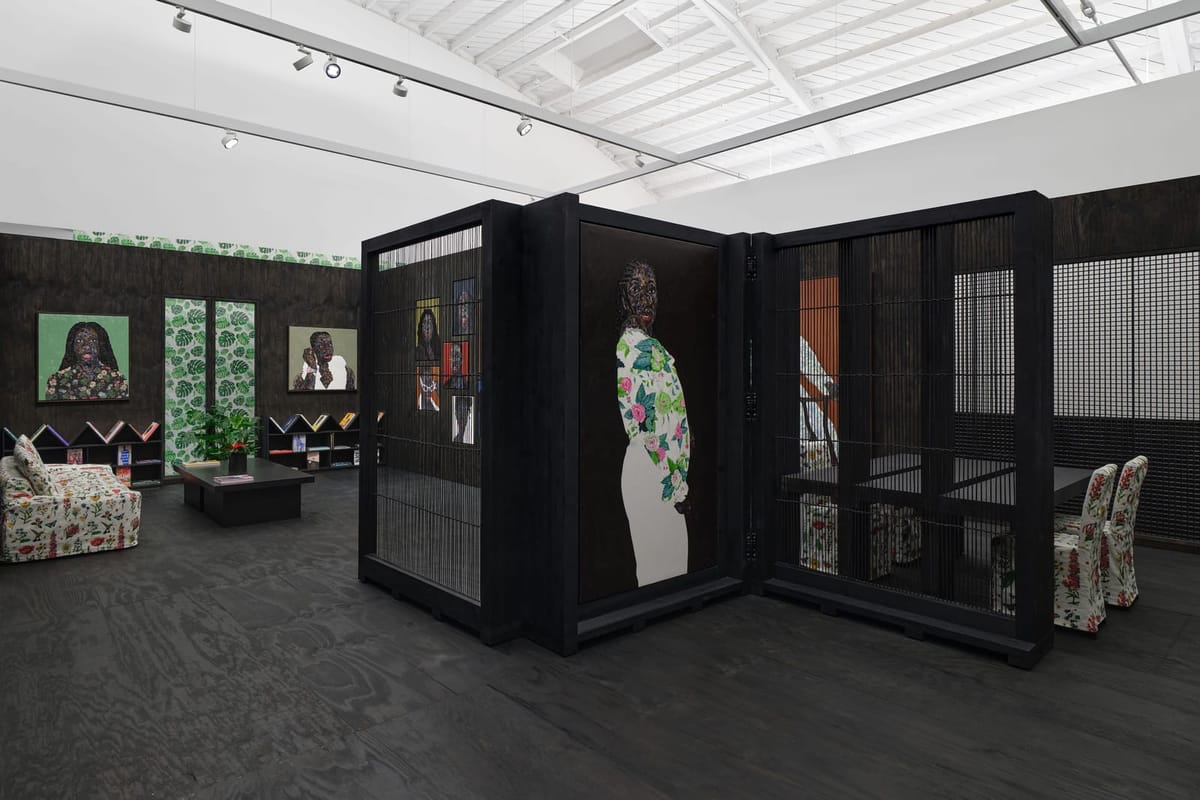
Although this truism is typically offered as a negative, it can also be read as a positive that provides comfort and stability amid new environments. In I Bring Home with Me, Ghanaian artist Amoako Boafo recreates his Accra studio in an architectural reproduction within Roberts Projects ' Los Angeles gallery. Boafo is known for his stylized portraiture of Black people, whose skin the artist renders in swirling gestures made with his fingers.
Arts
fromHyperallergic
2 months agoA Somali-American Artist Speaks Out
Amid the savagery of the Trump administration's crackdown on immigration - culminating in the killing of Renee Nicole MacklinGood - everyday Americans have shown incredible courage in pushing back against ICE's takeover of their cities. Joining them today are several Minnesotaart institutions that will close their doors to protest against the cruel treatment of their neighbors. You can read all about that today, plus a moving personal essay by Ifrah Mansour, a Somali-American artist based in Minnesota.
Arts
fromHyperallergic
2 months agoThe African Diaspora Pictures Itself
Walking through Ideas of Africa: Portraiture and Political Imaginationat the Museum of Modern Art, I noticed that the exhibition didn't have definite sections or texts, and the wall labels abstained from naming the nationalities of the photographers. It was an invigorating experience to be in a show that eschews geographic boundaries set up by Western nations, as well as rejects a cause-and-effect narrative that centers Western colonialism as a framework for understanding African aesthetic production.
Arts
fromColossal
2 months agoRegina Silveira Pieces Together an Evolving Narrative of Latin America
Regina Silveira has spent the better part of three decades considering the relationship between media and meaning, particularly as it relates to Latin America. First presented in 1997, "To Be Continued..." features 100 black-and-white reproductions of photos, newspaper clippings, propaganda, advertisements, and more. Silveira nests each image into an oversized puzzle piece, which cuts off faces and scenes to leave fragments of pop culture icons, flora and fauna, and even the occasional mugshot spliced next to one another.
Arts
[ Load more ]