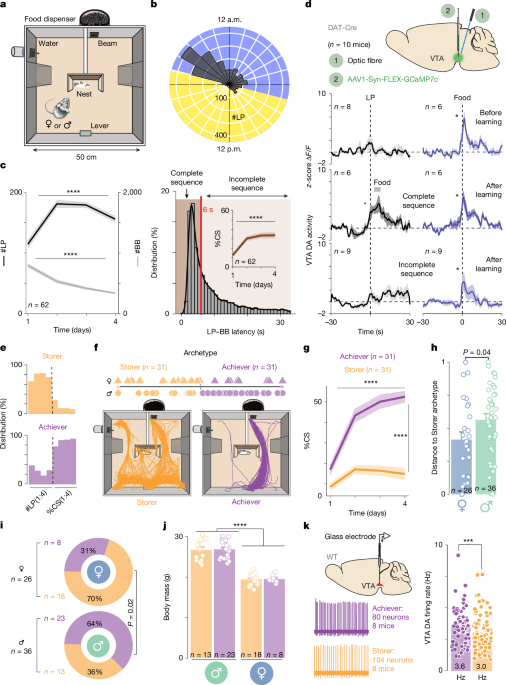
"Social foraging strategies illustrate the balance between competition and cooperation, where individuals either produce resources or exploit the efforts of others, navigating ecological and social constraints."
"Dopaminergic signaling plays a crucial role in reinforcing rewarded actions, particularly in social contexts, by indicating when rewards exceed expectations, thus influencing adaptive behaviors."
"The exploration-exploitation trade-off is a critical decision-making process for individuals, requiring them to choose between utilizing known resources and seeking new alternatives, with dopamine implicated in this dynamic."
Social animals create structured social organizations through interactions that stabilize into collective forms, such as division of labor and specialized roles. Understanding how individual behavioral differences contribute to collective actions and their neural underpinnings is a challenge in behavioral science. While the effects of social organization on behavior are documented, the cognitive and neurophysiological mechanisms remain largely unexplored. Strategies like competition and cooperation in resource access drive social foraging, influenced by dopaminergic signaling and the exploration-exploitation trade-off.
Read at Nature
Unable to calculate read time
Collection
[
|
...
]