Right-wing politics
fromTruthout
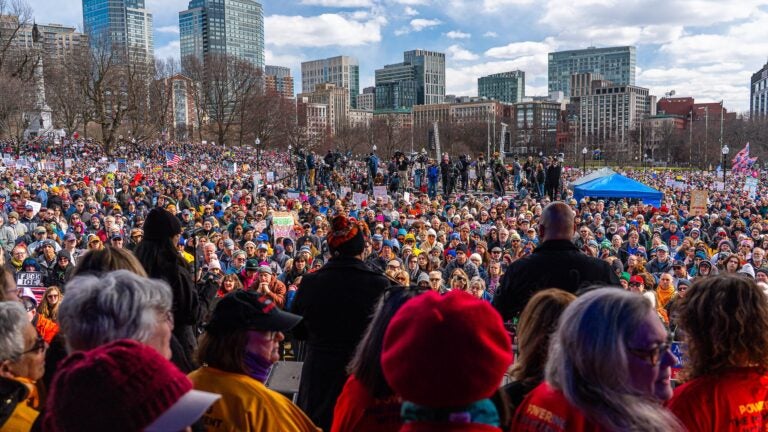
1 day agoNo Kings Must Mean No War: Foreign Policy Is Least Democratic Space in Politics
The majority of Iranian Americans oppose the war on Iran, despite media portrayal of pro-monarchy sentiments.
The rally, held at 1 Silber Way, was organized by Terrier Courage, a group that has collected more than 2,000 signatures on a petition urging the university to reconsider its rules on displays on public-facing windows and walls.
John Kaehny has written and successfully lobbied for the passage of state and New York City laws related to government transparency and accountability, including the first open data law in the world in 2012.
The labor of this kind of organizing was invisible and deeply exhausting. In a precarious workplace, where a so-called 'performance review' could amount to job loss, organizing meant building a bridge while standing on it.
"Singapore is in a very unique position because they face a lot of land constraints, so there are few ways for them to generate their own renewable energy. Singapore is pushing for integrated energy systems throughout ASEAN, so that renewable energy produced in other countries can be brought back to Singapore. There's a very distinct, coordinated effort for countries to come together to work on climate change and energy security in a way that I haven't really seen."
Campaigner Aysha Hawcutt stated that residents were 'not anti-homes', but believed the Adlington plan was 'the wrong proposal in the wrong place'. She expressed pride in the community's resilience against the development threats.
Losing staff could be detrimental to the projects we worked on, and there was a growing dissatisfaction with how meetings were run. These mostly one-sided discussions left the quieter half of us feeling pushed aside, like our thoughts didn't matter much. If things stayed this way, I worried the good people on our team would start quitting one by one.
Real change rarely happens through debate or persuasion. Instead, transformation grows out of relationships, shared struggle, cognitive dissonance, and practice. Together, Kelly and Lewis explore what organizers can learn from the science of neuroplasticity, the role of rupture and confrontation, and why movements need to focus less on 'changing minds' and more on creating conditions where people can unlearn harmful beliefs and step into collective action.
In the early 20th century, sociologist Max Weber noted that sweeping industrialization would transform how societies worked. As small, informal operations gave way to large, complex organizations with clearly defined roles and responsibilities, leaders would need to rely less on tradition and charisma, and more on organization and rationality. He also foresaw that jobs would need to be broken down into specialized tasks and governed by a system of hierarchy,
There's a myth in our society that real change requires force, strength, and domination. We celebrate athletes, CEOs, and politicians who crush their opponents. But history tells a different story. Lasting social change has often been triggered by humble people whose weapons were passion, principle, and an unwavering commitment to justice and the truth - not the truth we see on TV or read in print media, but rather the truth that we feel deep inside ourselves.
We argue that "faculty members could hold strong viewpoints and yet act in accordance with the highest professional standards." We state emphatically that "it is not possible to make faculty experts refrain from articulating any political viewpoint" while adding that "it is possible to require that they limit the viewpoints expressed in classes to those that are academically justifiable and germane, and to create a space in class where other defensible positions can be expressed."
Colleges and universities hold huge influence in their communities. They can mediate differences and foster healthy debate. Indeed, several institutions have established schools of civic life that would, presumably, raise the alarm when constitutional rights are being violated. Academic research influences policy and informs public conversations. Scholars can put this violence into context and help remind us that this is not OK.