OMG science
fromFuturism
8 hours agoScientists Say They've Found "Dark Points" That Move Faster Than the Speed of Light
Faster-than-light 'dark points' in light waves have been observed, moving without mass and not violating relativity.
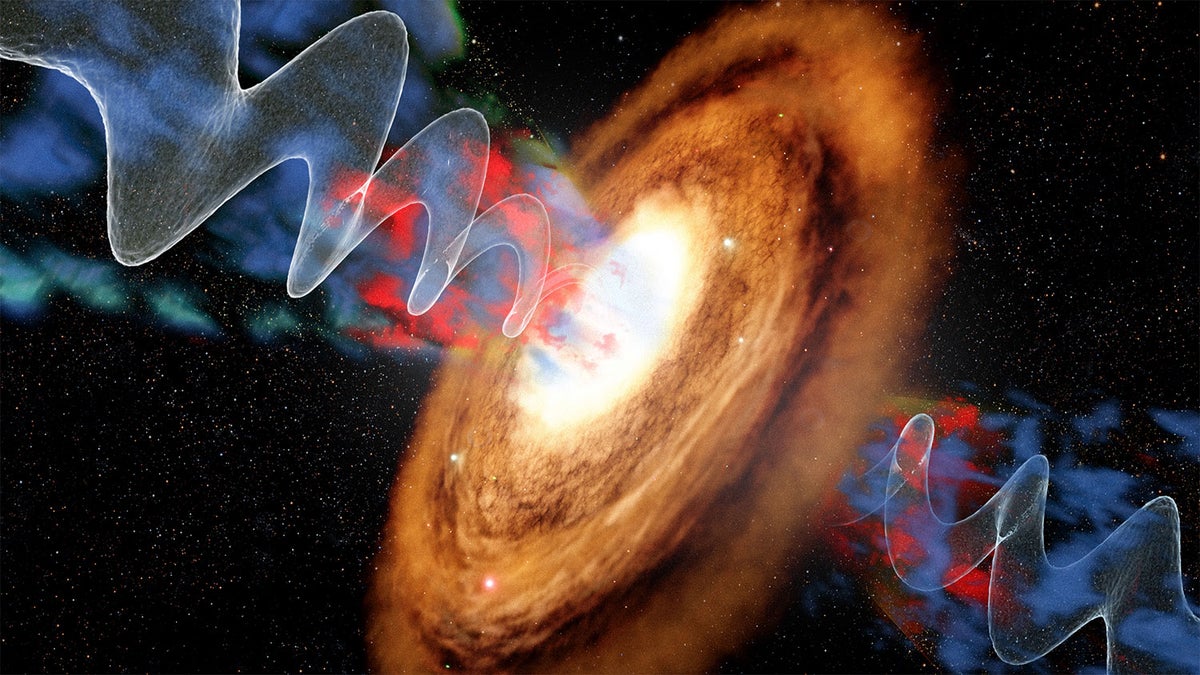
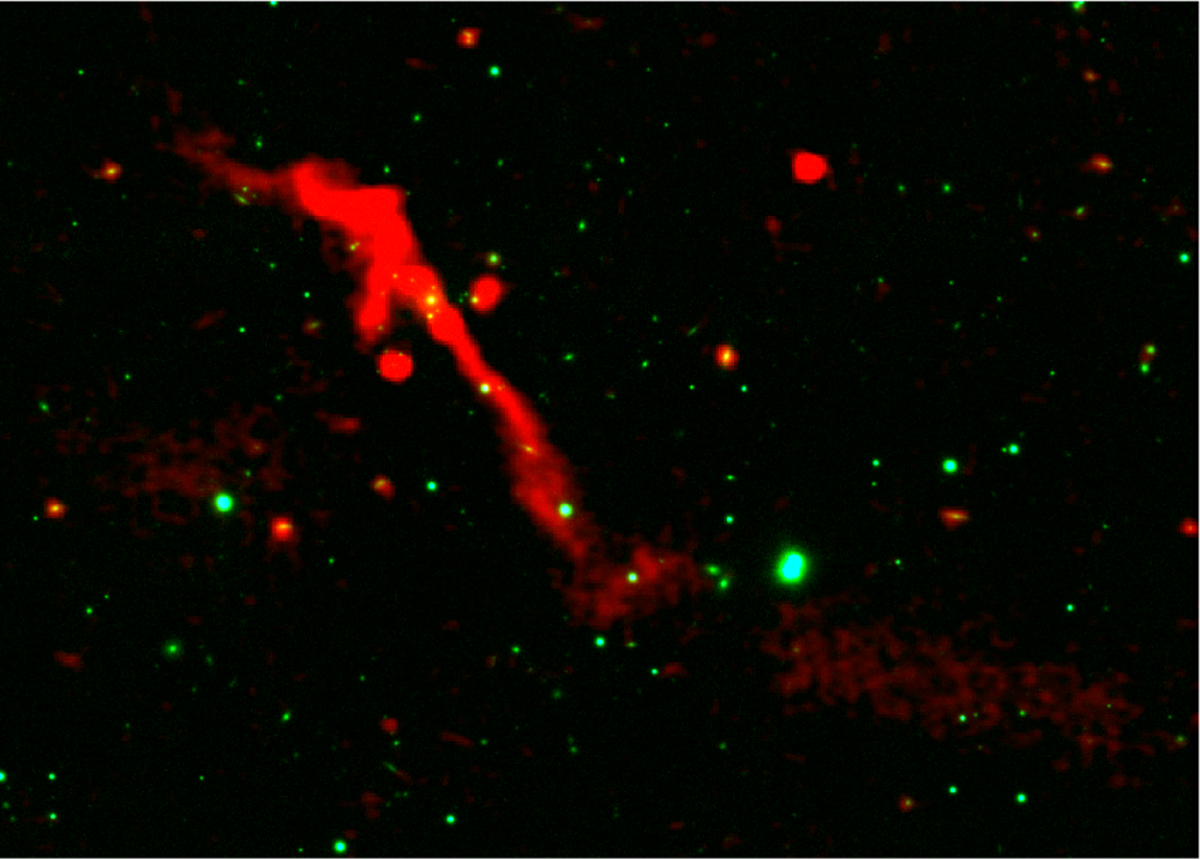
This system is truly extraordinary. We are seeing the radio equivalent of a laser halfway across the universe. This galaxy acts as a lens, the way a water droplet on a window pane would, because its mass curves the local space-time. So we have a radio laser passing through a cosmic telescope before being detected by the powerful MeerKAT radio telescope.
Light is one aspect of the Universe that, for most people, holds a deep and noticeable value in everyday life, helping them to navigate, learn from, and connect with the world around them. Yet it's not particularly difficult to imagine life without it. After all, many nonhuman animals live in lightless environments. However, as Gideon Koekoek, an associate professor of physics in the research group Gravitational Waves and Fundamental Physics
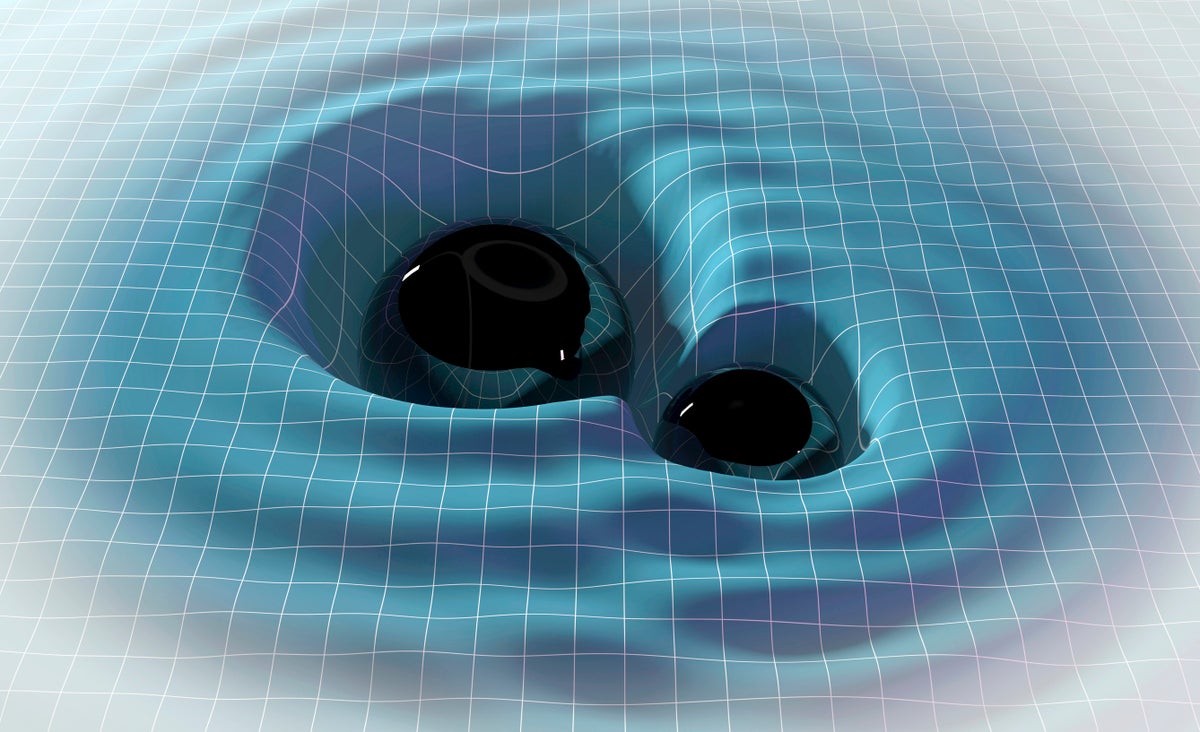
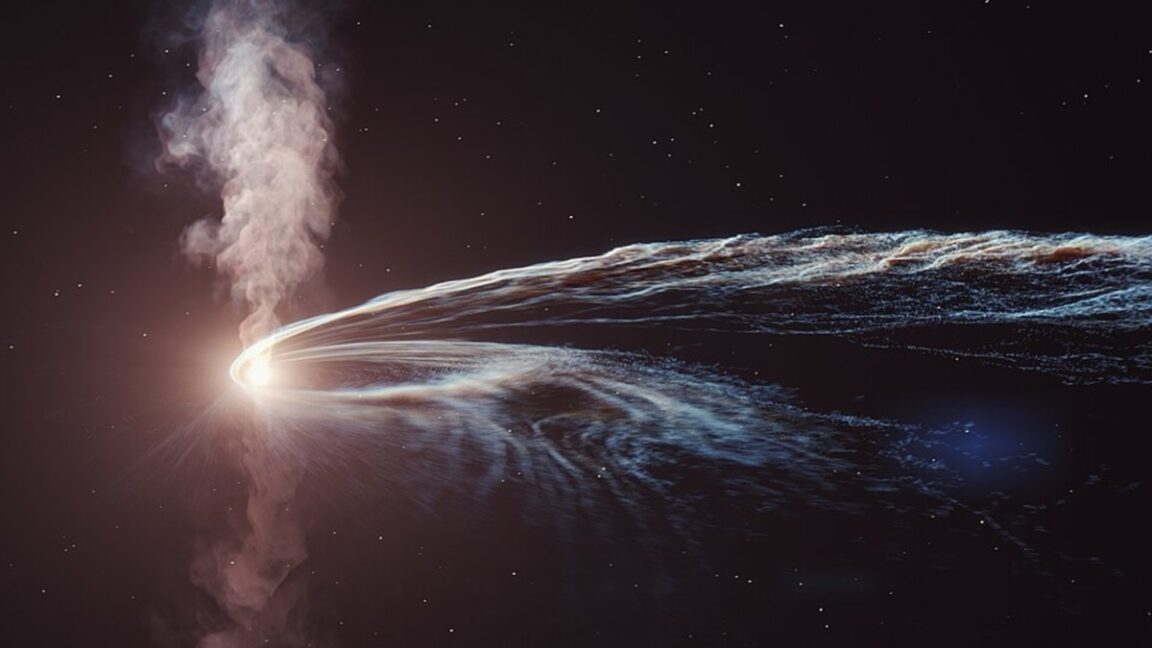
According to Einstein's General Relativity, for every black hole that exists within the Universe, there are only three properties that go into it that matter in any way: the black hole's total mass, the black hole's net electric charge, and the black hole's intrinsic angular momentum, and that's it. It doesn't matter what type of matter went into the black hole in order to form it; all that matters is its mass, charge, and angular momentum.
Star-formation will eventually end, and then the last shining stars will burn out. Galaxies will dissociate due to gravitational interactions, ejecting all masses and leaving only supermassive black holes behind. And then those black holes will decay via Hawking radiation, leaving only cold, stable, isolated bodies, from which no further energy can be extracted, all accelerating away from us within our dark energy-dominated Universe.
This system is truly extraordinary. We're seeing the radio equivalent of a laser halfway across the universe. Fundamentally, masers and lasers are focused beams of light in the same frequency. In the realm of astrophysics, these can arise from clouds of dust being excited into a higher energy state from the light emitted by other sources, like stars and black holes.
Your consciousness can connect you with the entire universe, a groundbreaking study suggests. Experts from Wellesley College in Massachusetts claim that traditional connections in the brain cannot fully explain how we are aware of our existence. Instead, they argue that quantum physics taking place within our skull is what generates awareness. This includes the idea that particles can exist in multiple states and locations at the same time.
The first time that University of Oxford astronomer Lyla Jung saw the cosmic configuration on her monitor, she almost didn't believe it was real. But it wasand Jung and her colleagues went on to identify one of the largest rotating structures ever found in space: a chain of galaxies embedded in a spinning cosmic filament 400 million light-years from Earth. The finding, published in Monthly Notices of the Royal Astronomical Society, may give astronomers new insights into galaxies' formation, evolution and diversity, Jung says.
The universe is exploding. Or parts of it are. The night sky may seem calm, even serene, but that masks events of a catastrophic and nearly unimaginable scale. Across the galaxy and even the cosmos itself, immense outbursts of energy occur that could easily vaporize our planet. Happily, space is vast, and the terrible distance between these events and us diminishes what we see to a faint glowusually.
A dead star 730 light years away appears to be forming a powerful structure around itself - and despite their best efforts, astronomers aren't sure how. The cosmic corpse, designated RXJ0528+2838, is an incredibly dense stellar remnant known as a white dwarf, with a Sun-like star orbiting around it. This binary arrangement isn't uncommon throughout the universe, but what is strange is the structure surrounding the former body: a highly energetic and luminescent cloud known as a nebula,
Okay, first thing first: the universe is in fact expanding. We've known this for more than a century now, and it's the basis for modern cosmology. This idea is called the big bang modelwhich is an unfortunate name because it brings to mind a cosmos expanding like an explosion, with galaxies moving away from each other through space like shrapnel. But in fact space itself is expanding, and that's different.
Y.W. designed the experimental protocols, performed experiments, analysed the data and wrote the manuscript. Y.H., X.K., D.C., J.X.X. and W.Z. performed experiments and edited the manuscript. Y.C. and S.P. edited the manuscript. M.J., X.P. and J.D. proposed the experimental concept, designed experimental protocols and proofread and edited the manuscript. All authors contributed with discussions and checking the manuscript. Corresponding authors Correspondence to Min Jiang or Xinhua Peng.
Looking skyward fills us with wonder. Off-world, the Sun, planets, stars, and galaxies all await. Our Solar System encompasses our own cosmic backyard. Farther away, stars and star clusters abound within the Milky Way. Hundreds of billions of stars exist just within our home galaxy. Inside our Local Group, only Andromeda surpasses us in mass, size, and stars. More than 5 million light-years away, galaxies abound in groups and clusters.
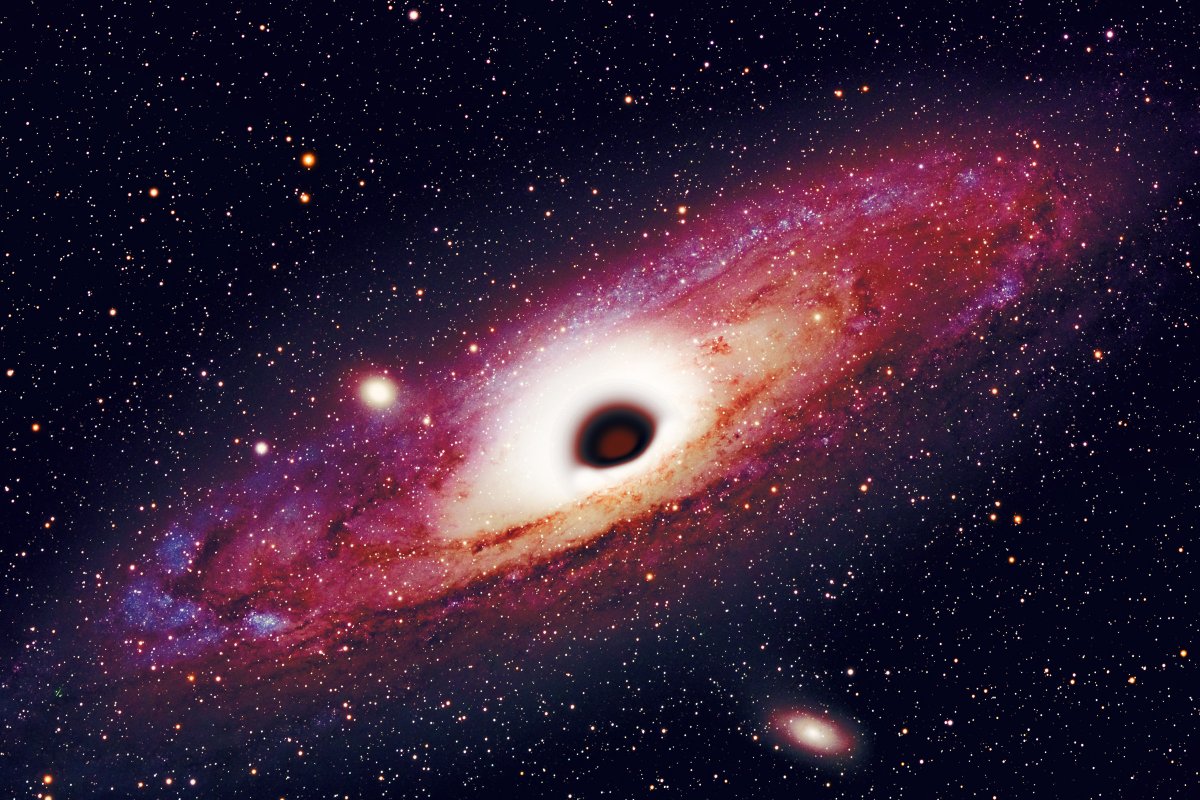
A bright star in a nearby galaxy has essentially vanished. Astronomers believe that it died and collapsed in on itself, transforming into the eerie cosmic phenomenon known as a black hole. "It used to be one of the brightest stars in the Andromeda galaxy," says Kishalay De, an astronomer with Columbia University and the Flatiron Institute. "Today, it is nowhere to be seen, even with the most sensitive telescopes."