#expert-opinion
#expert-opinion
[ follow ]
#ai-agents #artificial-intelligence #ai-adoption #consulting #leadership #cybersecurity #b2b-marketing


Information security
fromSecuritymagazine
3 days agoThe Rising Tide of Executive Protection: Corporations Ramp Up Security in an Era of Heightened Threats
Companies are increasingly investing in executive protection due to rising threats, making it a strategic necessity for business continuity and resilience.
#artificial-intelligence
Marketing tech
fromFinancial Planning
3 days agoAI for advisor marketing - without alienating clients
Consumers prefer human-created ads over AI-generated ones, emphasizing the importance of a human touch in marketing.

Higher education
fromInside Higher Ed | Higher Education News, Events and Jobs
3 weeks agoAI, Ethics and You (opinion)
Universities face evolving AI challenges requiring practical understanding rather than ideological positions, as AI capabilities advance and student usage becomes ubiquitous regardless of institutional policies.
Venture
from24/7 Wall St.
3 weeks agoClarivate: The Data Intelligence Company Flying Under the Radar
Clarivate, a London-based data intelligence company with defensible assets in research and patent workflows, trades at $2.64 per share while generating $365 million in annual free cash flow and planning strategic asset sales to reduce leverage.
fromFast Company
1 month agoWhy forward-looking organizations apply a design lens
Design is a strategic lens—a way of seeing systems, solving problems, anticipating consequences, gleaning insights, and making decisions to ensure better outcomes for all stakeholders. As a function truly custom-built to navigate complexity, design trains its practitioners to synthesize competing inputs. It translates abstract goals into tangible outcomes and considers the needs of diverse user groups.
Design
Marketing tech
fromTechzine Global
2 weeks agoQualtrics uses AI to accelerate market research
Qualtrics launched synthetic consumer panels using custom-trained AI and a Research Hub platform to accelerate market research and decision-making by making consumer testing faster and past research searchable.
Marketing
fromForbes
3 weeks agoAI Is Asking For Content. Why Aren't You Listening?
AI-powered search engines now provide direct answers from curated sources rather than listing webpages, requiring businesses to optimize their online presence and content quality for AI consumption to maintain positive brand visibility.
fromTalentLMS Blog
4 weeks agoThe 19-Point Skills Gap Leaders Can't See
Recent data from The TalentLMS 2026 L&D Benchmark Report reveals a 19-point perception gap on AI learning support. 83% of HR leaders believe they actively support AI learning, but only 64% of employees agree. This extremely polarized viewpoint raises an uncomfortable question: If leaders are this far off on AI skills support, what else might they be misreading about their teams' capabilities?
Business
Artificial intelligence
fromPsychology Today
3 weeks agoIntelligence as a Commodity
Framing intelligence as a metered utility service risks shifting it from a cultivated human capacity to an external commodity, potentially weakening the cognitive habits and judgment-building processes developed through personal effort and experience.
UX design
fromBusiness Matters
1 month agoHow User Interviews Can Be Accelerated with an AI-Powered Insights Platform
AI-powered research platforms address the infrastructure burden surrounding user research—recruitment, scheduling, transcription, and synthesis—rather than the interviews themselves, removing friction that causes teams to abandon research.



fromBusiness Insider
1 month agoI'm an AI consultant and using AI agents saves me hours. My clients follow 5 steps to become more efficient.
An AI agent is simply a model that receives input, follows defined goals and rules, makes step-by-step decisions, and uses tools to take actions. Instead of viewing AI agents as autonomous digital workers, break it down. First principles thinking says this definition captures the essence of how AI agents function and operate within business workflows.
Artificial intelligence



fromEntrepreneur
2 months agoHow AI Will Help Decide the Way Private Equity Firms Invest
Data science and artificial intelligence are fundamentally redefining what constitutes skill in investment management, shifting the sources of sustainable competitive advantage in ways most firms have yet to comprehend. This is not about automating existing workflows. It is about reconceptualizing which analytical tasks can be systematized and which genuinely require human judgment, then rebuilding investment processes around that distinction. Firms that fail to recognize this depth are not simply adopting tools more slowly. They are misunderstanding the nature of the change itself.
Venture
fromSilicon Canals
1 month agoCaliber Releases Inaugural Stakeholder Intelligence Report - Silicon Canals
COPENHAGEN, Denmark-(BUSINESS WIRE)- Caliber, a stakeholder intelligence platform helping organizations build and protect trust, released its inaugural Stakeholder Intelligence Report, revealing global trends in brand, reputation, and data-driven communications. As economic anxiety, AI disruption, and geopolitical uncertainty intensify, leaders across industries are making higher-stakes decisions under conditions of compressed trust and heightened reputational risk. This report equips executives with data and actionable insights to support decision-making in 2026 and beyond.
Business intelligence
Law
fromAbove the Law
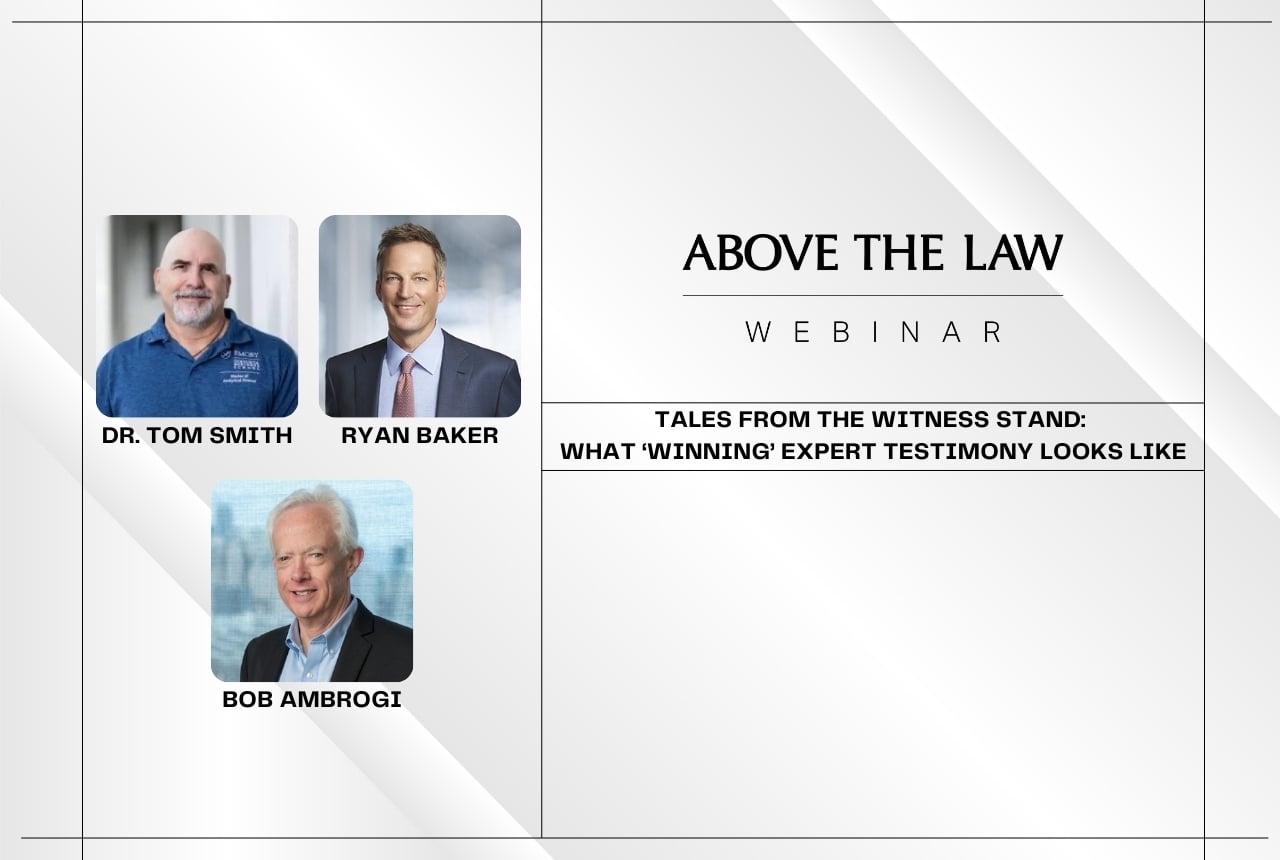
2 months agoOn-Demand Webinar: What Winning Expert Testimony Looks Like - Above the Law
Effective expert testimony balances credibility with openness to opposing perspectives, clear translation of technical concepts for factfinders, and resilience under rigorous cross-examination.
UX design
fromLogRocket Blog
1 month agoUX designers don't need to be data scientists - but they must challenge data - LogRocket Blog
Designers must combine usability insights with product analytics and business metrics to understand real-world user behavior and the design's impact on business outcomes.
Business
fromForbes
2 months ago20 Expert-Backed Culture Strategies For Hybrid Agencies
Hybrid agency performance depends on intentionally designed culture: transparency, trust, personalized motivation, ownership, development, purposeful in-person moments, and multidisciplinary collaboration to sustain engagement.



fromEntrepreneur
2 months agoWhy Thought Leadership Is Failing - and How to Solve It
Traditional thought leadership is losing impact. Long reports and gated content no longer capture attention in today's zero-click world. As a result, thought leadership is entering a new phase - experiential thought leadership. Engaging formats like interactive webinars, immersive events and podcasts make ideas felt and memorable rather than just consumed. Success depends on cross-team collaboration, testing and building experiences around real audience understanding.
Marketing
fromThe Drum
2 months agoTop creatives share how they're grappling with AI use at agencies
Pencil's experiment focused on written copy in Facebook product ads rather than big-budget creative. Despite widely held concerns that the tech could cannibalize copywriting jobs, that doesn't mean professional creatives are ignoring the tech. Shruthi Subramanian of Serviceplan Munich (above) was named the most-awarded copywriter in the world in The Drum's World Creative Rankings. She says the tools can be put to good use, albeit with caution.
Marketing
Artificial intelligence
fromeLearning Industry
1 month agoAI Strategy Consulting: How Companies Can Build, Position, And Scale High-Value Advisory Services
AI strategy consulting is a high-demand, high-margin opportunity requiring demonstrated expertise, credibility, and thought leadership to win and scale advisory engagements.
fromThe Drum
2 months agoThe secrets of award-winning teams revealed
Does the strength of relationship between marketer and agency correlate with more effective work? Using two unique and robust sets of data we have, for the first time, answered this question with an emphatic 'yes' The implications of our latest report are profound for marketers and their agencies, and arguably for any business relationship. Our analysis of winners of effectiveness awards over a 9-year period discovered that award-winning client and agency teams had better relationships than the average.
Marketing
fromBusiness Insider
2 months agoThe top management consulting firms in the US
Business Insider teamed up with Plant-A Insights, a leading insights and technology company that publishes business rankings in cooperation with world-class media brands, to find the 300 top management consulting firms in America. The list includes giants of the industry as well as a slew of more specialized and boutique firms. The list is based on a large-scale survey of around 25,000 professionals who have worked with consulting firms, who evaluated them on factors like industry and practice area expertise, as well as client satisfaction.
Business
fromThe Drum
2 months agoDeeper data delivers more inspired partnership decisions
Imagine you're selecting an influencer to work with on your new campaign. You've narrowed it down to two, both in the right area, both creating the right sort of content. One has 24.6 million subscribers, the other 1.4 million. Which do you choose? Now imagine you could find out the first had 8.7 million unique viewers last month, while the second had 9.9 million. Do you want to change your mind?
Marketing
fromThe Drum
2 months agoHow are agencies making their creative and strategic awards work in their favor?
Winning a prestigious award, such as our recent Gold at The Drum Awards for PR in the Entertainment category, is always a proud moment for us as an agency. It validates our expertise, builds credibility, and sets us apart in a competitive market. We leverage awards as a key part of our marketing and business strategy in various ways. Sharing the win with clients reinforces their choice to work with us - after all, everyone wants to partner with a winner!
Marketing
fromThe Drum
2 months agoThe pitch process is broken. Brands should know the value of ideas
With everyone navigating this macroeconomic omnishambles, it's high time we look at the agency-brand pitching process and finally make some changes to level the playing field between the two sides. A recent JFDI/Opinium survey found the average pitch cost agencies more than £11k and withdrawn budgets are responsible for 33% of lost pitches. This all becomes even more complex and frustrating when pitching creative ideas due to the expectations of those ideas and the subjectivity of that audience.
Marketing
fromBusiness Insider
2 months agoBosses don't think AI is paying off yet, a PwC survey of 4,500 CEOs found
The consulting giant questioned 4,454 chief executives across 95 countries and territories about their strategic priorities and outlook in the year up to November 2025. More than half of the CEOs surveyed, 56%, said AI hasn't produced revenue or cost benefits for their businesses to date. Some reported benefits for either revenue or costs: around a third said their revenue was up in the last year, and 26% said they were seeing lower costs from AI.
Artificial intelligence
[ Load more ]