#fundamental-constants

[ follow ]
Philosophy
fromBig Think
2 days ago

The flimsy case for evolving dark energy

Theoretical physicists risk falling into motivated reasoning by overly believing speculative ideas without sufficient supporting evidence.
#universe
OMG science
fromBig Think
3 days ago

The Universe has changed by the time you finish this sentence

The Universe undergoes profound changes over time, despite appearing static on human timescales.
OMG science
fromBig Think
1 week ago

Ask Ethan: Does dark energy curve the Universe over time?

The fate of the Universe is determined by the total energy present and its relation to the initial expansion rate.
#quantum-mechanics
Science
fromArs Technica
6 days ago

Getting formal about quantum mechanics' lack of causality

Superposition of temporal order is a fundamental feature of quantum mechanics, despite existing loopholes in current experiments.
Philosophy
fromwww.scientificamerican.com
2 weeks ago

A 100-year-old theory might explain what's wrong with quantum mechanics

Pilot wave theory, developed by Louis de Broglie a century ago, potentially resolves quantum mechanics' paradoxes by describing particles guided by attendant waves rather than existing in superposition.
Philosophy
fromThe Conversation
4 days ago

Are multiverses real? An astrophysicist explains why it depends on how you define 'real'

The existence of the multiverse remains hypothetical, with no direct sensory evidence but potential indirect effects.
Science
fromNature
2 weeks ago

Elusive 'nuclear clocks' tick closer to reality - after decades in the making

Physicists are nearing the creation of a nuclear clock, which could be the most precise timekeeping device ever developed.
OMG science
fromwww.scientificamerican.com
1 week ago

We thought we knew the shape of the universe. We were wrong

The shape of the universe remains unknown, with three possible geometries and the cosmic microwave background as a key to understanding its topology.
#black-holes
fromBig Think
1 week ago

Gravity and quantum physics are fundamentally incompatible

General Relativity has yet to let us down. Its success rate is 100%, from tabletop experiments to gravitational lensing and the formation of the great cosmic web.
OMG science
Philosophy
fromBig Think
2 weeks ago

Einstein showed space can curve, but data reveals a flat Universe

The Universe has a flat spatial geometry, confirmed through cosmic microwave background observations, rather than the curved or spherical shape many physicists theoretically preferred.
#superluminous-supernovae
Science
fromArs Technica
3 weeks ago

Magnetars drag spacetime to power superluminous supernovae

Frame-dragging from rapidly spinning magnetars explains the irregular light patterns observed in superluminous supernovae, resolving a long-standing discrepancy between theory and observations.
Science
fromArs Technica
3 weeks ago

Magnetars drag spacetime to power superluminous supernovae

Frame-dragging from rapidly spinning magnetars explains the irregular light patterns observed in superluminous supernovae, resolving a long-standing discrepancy between theory and observations.
Science
fromBig Think
3 weeks ago

A quirk of relativity is the closest thing to achieving immortality

While immortality is impossible due to thermodynamic laws, relativity reveals physical scenarios that maximize lifespan relative to the universe by manipulating spacetime through motion and gravity.
Running
fromiRunFar
1 month ago

Time, the Great Unifier

Dylan Harris's film 'The Cutoff' explores how time functions as both constraint and possibility in ultramarathon running, revealing triumph and heartbreak among runners pursuing the Cocodona 250 Mile cutoffs.
Science
fromwww.scientificamerican.com
3 weeks ago

Have astronomers found a runaway monster black hole or just a very weird galaxy?

Astronomers discovered RBH-1, a potentially runaway supermassive black hole traveling at over three million kilometers per hour, though ambiguous data makes its true nature uncertain.
OMG science
fromBig Think
2 weeks ago

The case for and against a 5th fundamental force of nature

Current physics theories cannot explain fundamental cosmic mysteries like matter-antimatter asymmetry, dark matter, dark energy, and cosmic inflation, suggesting undiscovered forces or phenomena remain.
fromwww.scientificamerican.com
3 weeks ago

Mathematicians find one pi formula to rule them all

For more than two millennia, mathematicians have produced a growing heap of pi equations in their ongoing search for methods to calculate pi faster and faster. The pile of equations has now grown into the thousands, and algorithms now can generate an infinitude. Each discovery has arrived alone, as a fragment, with no obvious connection to the others. But now, for the first time, centuries of pi formulas have been shown to be part of a unified, formerly hidden structure.
Science
#particle-physics
OMG science
fromFuturism
1 week ago

Large Hadron Collider Discovers All-New Particle

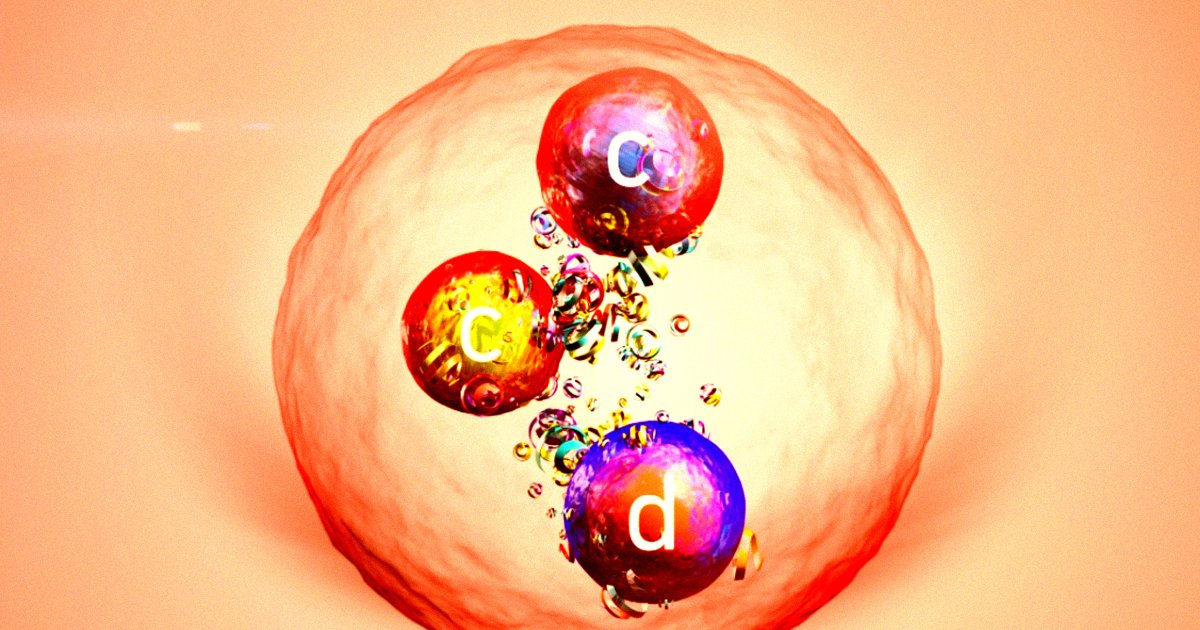
Scientists discovered a new particle, Xi-cc-plus, made of two charm quarks and one down quark, using CERN's Large Hadron Collider.
OMG science
fromBig Think
4 weeks ago

No, particle physics colliders cannot ever destroy the Universe

Particle physics experiments at higher energies reveal fundamental Universe mysteries while carrying theoretical risks, but current and planned accelerators pose no actual danger to Earth.
OMG science
fromBig Think
2 weeks ago

Why "CPT" is the Universe's most unbreakable symmetry

CPT symmetry is a fundamental, unbreakable symmetry that applies universally to all physical laws and phenomena in the Universe.
#cosmic-evolution
OMG science
fromBig Think
2 weeks ago

Ask Ethan: Does nature need to obey laws at all?

The Universe's fundamental laws and constants remain unchanged across space and time, despite the variety of structures formed throughout cosmic evolution.
OMG science
fromBig Think
3 weeks ago

Ask Ethan: How dark will the Universe become?

The Universe will eventually become dark and sparse as stars exhaust their fuel and die, with approximately 95% of all stars already formed, allowing estimation of future cosmic dimming.
OMG science
fromBig Think
2 weeks ago

Ask Ethan: Does nature need to obey laws at all?

The Universe's fundamental laws and constants remain unchanged across space and time, despite the variety of structures formed throughout cosmic evolution.
OMG science
fromBig Think
3 weeks ago

Ask Ethan: How dark will the Universe become?

The Universe will eventually become dark and sparse as stars exhaust their fuel and die, with approximately 95% of all stars already formed, allowing estimation of future cosmic dimming.
#gravitational-waves
fromwww.scientificamerican.com
2 weeks ago
OMG science

A boom in gravitational waves leaves scientists with more questions than answers

A global network of gravitational-wave observatories has detected 218 candidate events, revealing complex structures in cosmic mergers and providing unprecedented insights into the universe.
fromwww.scientificamerican.com
4 weeks ago
OMG science

Newly discovered ripples in spacetime put Einstein's general relativity to the test

A global network of gravitational wave observatories has more than doubled detections of cosmic collisions, revealing a universe filled with black holes, neutron stars, and their mergers with unprecedented variety and characteristics.
OMG science
fromwww.scientificamerican.com
2 weeks ago

A boom in gravitational waves leaves scientists with more questions than answers

A global network of gravitational-wave observatories has detected 218 candidate events, revealing complex structures in cosmic mergers and providing unprecedented insights into the universe.
OMG science
fromwww.scientificamerican.com
4 weeks ago

Newly discovered ripples in spacetime put Einstein's general relativity to the test

A global network of gravitational wave observatories has more than doubled detections of cosmic collisions, revealing a universe filled with black holes, neutron stars, and their mergers with unprecedented variety and characteristics.
fromwww.theguardian.com
3 weeks ago

Please drive carefully: scientists plan to transport volatile antimatter for first time

A core question we want to understand is where did matter come from. And then, if you know about antimatter, it's natural to ask, why is that not here? The process is not understood and we are hunting for clues as to why it happened, says Dr Christian Smorra, a physicist on the Baryon Antibaryon Symmetry Experiment (Base) at Cern.
OMG science
Science
fromArs Technica
1 month ago

Photons that aren't actually there influence superconductivity

Virtual photons from quantum fields can degrade superconductor performance, providing insights into quantum mechanics and superconductivity behavior.
OMG science
fromMail Online
3 weeks ago

Astronomers watch the birth of a magnetar for the first time

Astronomers observed the birth of a magnetar, an extremely dense neutron star with the universe's most powerful magnetic fields, through a superluminous supernova's unusual flickering light pattern over 200 days.
fromBig Think
1 month ago

Ask Ethan: Can quantum entanglement survive a black hole?

According to Einstein's General Relativity, for every black hole that exists within the Universe, there are only three properties that go into it that matter in any way: the black hole's total mass, the black hole's net electric charge, and the black hole's intrinsic angular momentum, and that's it. It doesn't matter what type of matter went into the black hole in order to form it; all that matters is its mass, charge, and angular momentum.
Science
fromBig Think
1 month ago

How Einstein revolutionized the meaning of "where" and "when"

We now recognize that even ideas like "when" and "where" are subject to the laws of Einstein's relativity, and that in relativity, space and time are not absolute quantities, but rather are relative to each and every unique observer.
Science
fromFuturism
1 month ago

Astronomers Spot Huge Microwave Laser Blasting Into Space

This system is truly extraordinary. We're seeing the radio equivalent of a laser halfway across the universe. Fundamentally, masers and lasers are focused beams of light in the same frequency. In the realm of astrophysics, these can arise from clouds of dust being excited into a higher energy state from the light emitted by other sources, like stars and black holes.
OMG science
fromAeon
2 months ago

Our Universe has light not by chance but by necessity | Aeon Videos

Light is one aspect of the Universe that, for most people, holds a deep and noticeable value in everyday life, helping them to navigate, learn from, and connect with the world around them. Yet it's not particularly difficult to imagine life without it. After all, many nonhuman animals live in lightless environments. However, as Gideon Koekoek, an associate professor of physics in the research group Gravitational Waves and Fundamental Physics
Philosophy
fromBig Think
1 month ago

Ask Ethan: Will anything persist when the Universe dies?

Star-formation will eventually end, and then the last shining stars will burn out. Galaxies will dissociate due to gravitational interactions, ejecting all masses and leaving only supermassive black holes behind. And then those black holes will decay via Hawking radiation, leaving only cold, stable, isolated bodies, from which no further energy can be extracted, all accelerating away from us within our dark energy-dominated Universe.
Science
#time
fromAeon
1 month ago
Philosophy

Time is real - if you view it through the lens of heat | Aeon Videos

fromAeon
1 month ago
Philosophy

Time is real - if you view it through the lens of heat | Aeon Videos

#big-bang
Philosophy
fromAeon
2 months ago

Anyons: the two-dimensional particles that reframe reality | Aeon Essays

Anyons constitute a third class of particle with unique exchange statistics whose braided, topological information storage could enable robust, fault-tolerant quantum computing.
fromBig Think
2 months ago

Zeno's Paradox resolved by physics, not by math alone

The fastest human in the world, according to the Ancient Greek legend, was the heroine Atalanta. Although she was a famous huntress who joined Jason and the Argonauts in the search for the golden fleece, she was most renowned for the one avenue in which she surpassed all other humans: her speed. While many boasted of how swift or fleet-footed they were, Atalanta outdid them all. No one possessed the capabilities to defeat her in a fair footrace.
Philosophy
Science
fromBig Think
2 months ago

The most underappreciated achievement in theoretical physics

Modern physics explains luminous matter, black holes, gravity, cosmic expansion, and particle interactions through the Standard Model, quantum field theory, and General Relativity.
Science
fromwww.scientificamerican.com
1 month ago

Physicists trace particles back to the quantum vacuum

RHIC experiments traced virtual particle pairs evolving into real, spin-aligned particle pairs, indicating vacuum fluctuations can produce correlated spin descendants.
Science
fromBig Think
2 months ago

Ask Ethan: What does "gravitationally bound" mean in the expanding Universe?

Gravitationally bound systems remain together when mutual gravity overcomes cosmic expansion; only stronger expansion or external influences can separate bound components.
fromFuturism
2 months ago

Astronomers Intrigued By Impossible Structure Around Dead Star

A dead star 730 light years away appears to be forming a powerful structure around itself - and despite their best efforts, astronomers aren't sure how. The cosmic corpse, designated RXJ0528+2838, is an incredibly dense stellar remnant known as a white dwarf, with a Sun-like star orbiting around it. This binary arrangement isn't uncommon throughout the universe, but what is strange is the structure surrounding the former body: a highly energetic and luminescent cloud known as a nebula,
Science
Science
fromBig Think
2 months ago

Cosmic dust: "too much, too soon" no longer!

Dust measurements in a nearby galaxy reveal how distant early galaxies could produce large dust masses very rapidly.
#dark-matter
fromFuturism
1 month ago
Science

The Object at the Core of the Milky Way Might Not Be a Black Hole at All, Scientists Say

fromFuturism
1 month ago
Science

The Object at the Core of the Milky Way Might Not Be a Black Hole at All, Scientists Say

fromwww.scientificamerican.com
2 months ago

The biggest explosions in the universe, ranked

The universe is exploding. Or parts of it are. The night sky may seem calm, even serene, but that masks events of a catastrophic and nearly unimaginable scale. Across the galaxy and even the cosmos itself, immense outbursts of energy occur that could easily vaporize our planet. Happily, space is vast, and the terrible distance between these events and us diminishes what we see to a faint glowusually.
OMG science
Science
fromFuturism
2 months ago

The Large Hadron Collider Is Being Shut Down

The LHC will shut down for about five years starting in June for a high-luminosity upgrade to increase collision rates by roughly tenfold.
Science
fromFuturism
1 month ago

Physicists Think They Saw a Black Hole Explode

Primordial black holes can evaporate via Hawking radiation and may explosively release particles, potentially explaining a powerful 2023 neutrino detection.
#quantum-superposition
fromNature
1 month ago

Large-scale analogue quantum simulation using atom dot arrays - Nature

Analogue quantum simulations are a useful tool for investigating these systems, particularly in regimes in which the applicability of numerical techniques is limited. For different simulator platforms, figures of merit include the electron bandwidth and interaction strength, temperature and the number of simulated lattice sites. Their use is further underscored by the ability to realize distinct lattice geometries, on-site degrees of freedom and by the physical observables that are accessible to experimental measurement.
Science
Science
fromwww.scientificamerican.com
1 month ago

Scientists may have discovered a pulsar at the Milky Way's hearta result that could reveal new physics

A pulsar near Sagittarius A* would enable more precise measurements of spacetime and gravitational effects around the Milky Way's central supermassive black hole.
[ Load more ]