#graviton-spike
#graviton-spike
[ follow ]
#gravitational-waves

OMG science
fromwww.scientificamerican.com
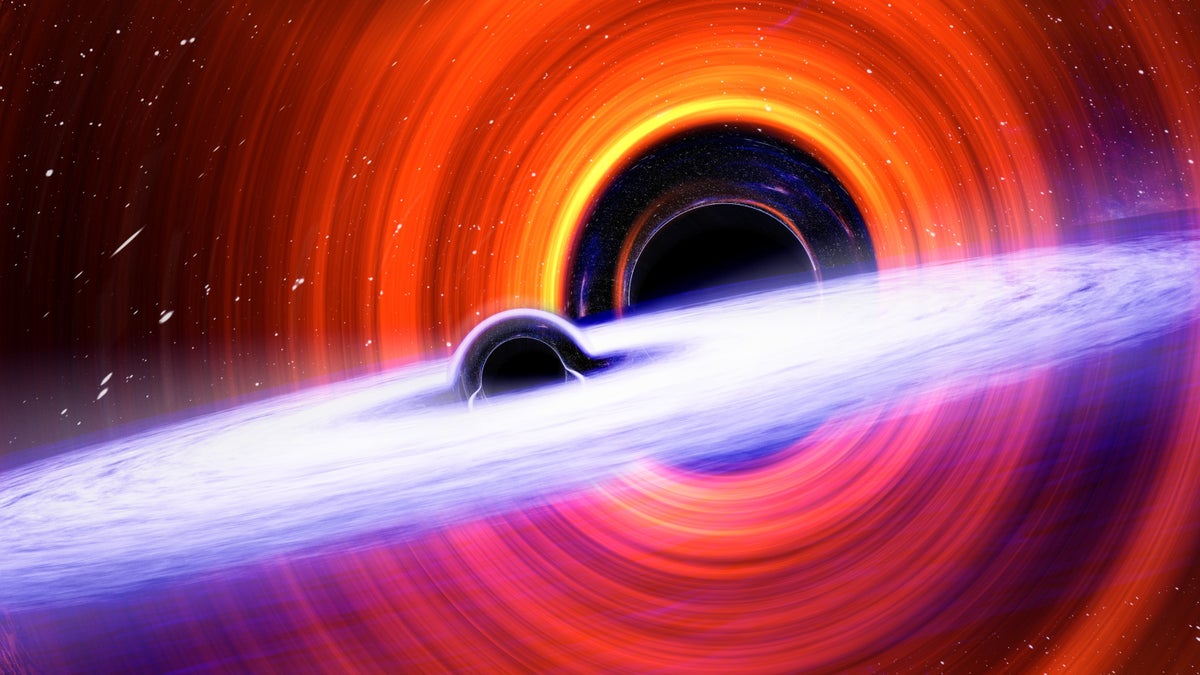
2 weeks agoA boom in gravitational waves leaves scientists with more questions than answers
A global network of gravitational-wave observatories has detected 218 candidate events, revealing complex structures in cosmic mergers and providing unprecedented insights into the universe.
OMG science
fromwww.scientificamerican.com
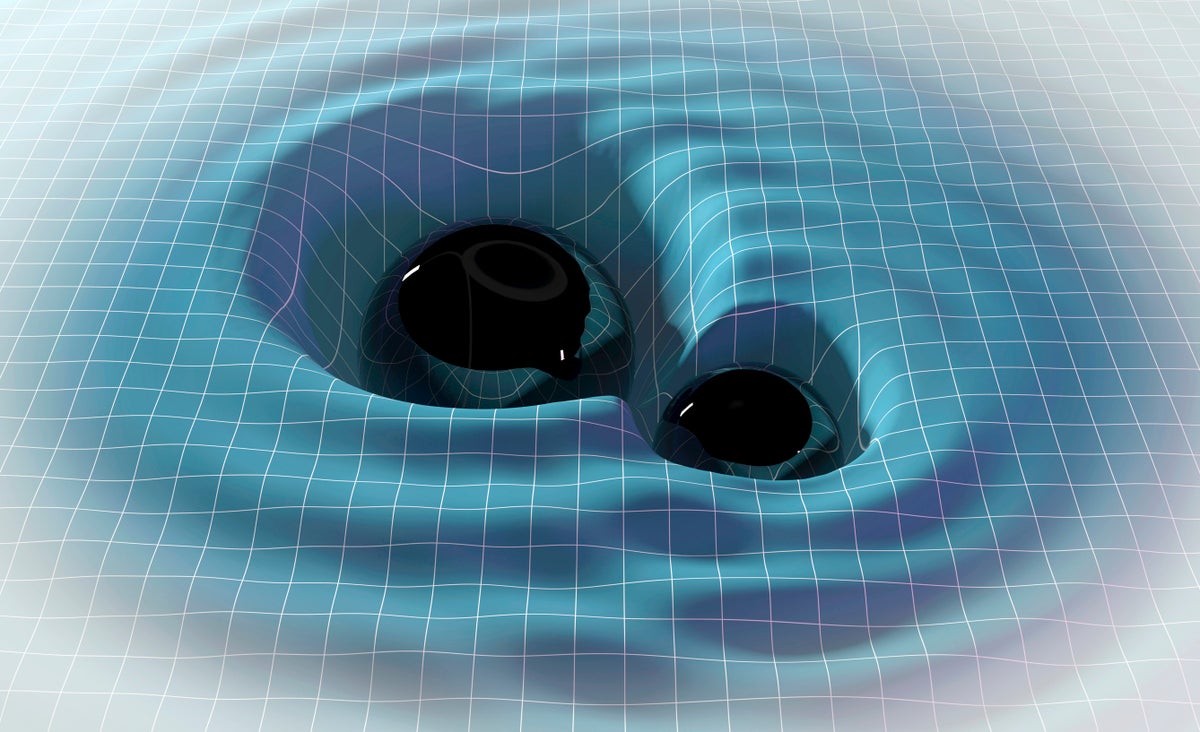
1 month agoNewly discovered ripples in spacetime put Einstein's general relativity to the test
A global network of gravitational wave observatories has more than doubled detections of cosmic collisions, revealing a universe filled with black holes, neutron stars, and their mergers with unprecedented variety and characteristics.
#quantum-mechanics
Philosophy
fromwww.scientificamerican.com
3 weeks agoA 100-year-old theory might explain what's wrong with quantum mechanics
Pilot wave theory, developed by Louis de Broglie a century ago, potentially resolves quantum mechanics' paradoxes by describing particles guided by attendant waves rather than existing in superposition.





Science
fromwww.scientificamerican.com
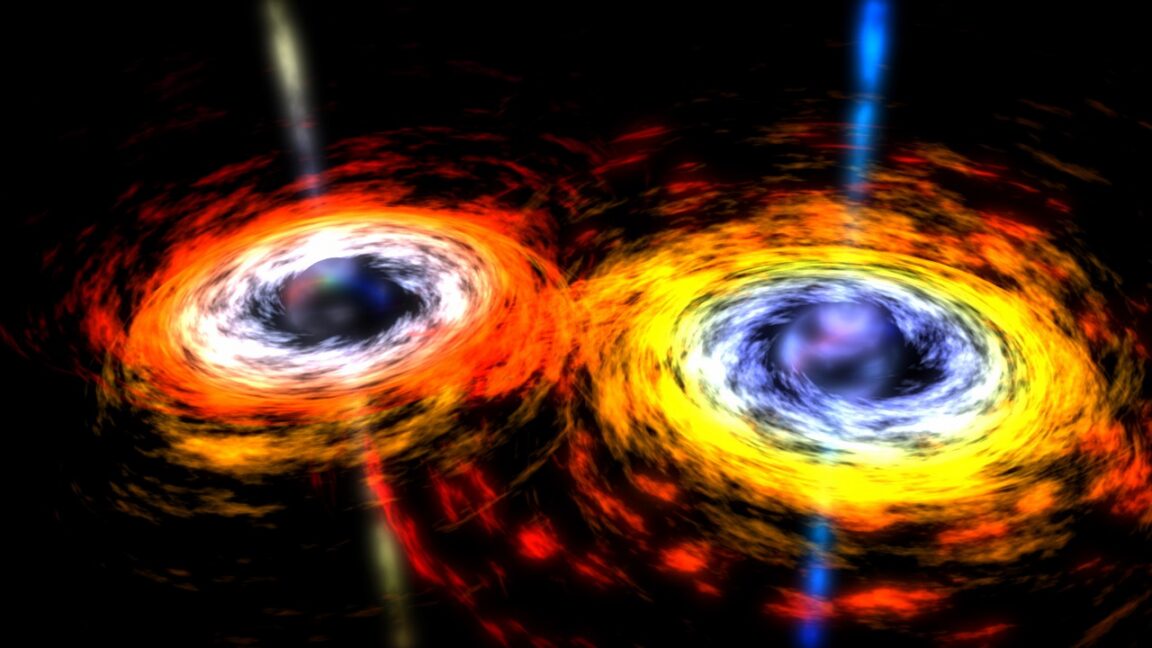
3 weeks agoHave astronomers found a runaway monster black hole or just a very weird galaxy?
Astronomers discovered RBH-1, a potentially runaway supermassive black hole traveling at over three million kilometers per hour, though ambiguous data makes its true nature uncertain.
Science
fromThe Washington Post
1 month agoDeep in Antarctic ice, these particles can answer basic questions about the universe
Scientists upgraded the IceCube Neutrino Observatory at the South Pole by drilling deep into Antarctic ice and installing new cable networks with light detectors to study ghost particles and fundamental physics questions.
fromBig Think
1 month agoAsk Ethan: Can quantum entanglement survive a black hole?
According to Einstein's General Relativity, for every black hole that exists within the Universe, there are only three properties that go into it that matter in any way: the black hole's total mass, the black hole's net electric charge, and the black hole's intrinsic angular momentum, and that's it. It doesn't matter what type of matter went into the black hole in order to form it; all that matters is its mass, charge, and angular momentum.
Science
fromwww.theguardian.com
3 weeks agoPlease drive carefully: scientists plan to transport volatile antimatter for first time
A core question we want to understand is where did matter come from. And then, if you know about antimatter, it's natural to ask, why is that not here? The process is not understood and we are hunting for clues as to why it happened, says Dr Christian Smorra, a physicist on the Baryon Antibaryon Symmetry Experiment (Base) at Cern.
OMG science
fromBig Think
1 month agoRecord-breaking natural laser discovered 11 billion light-years away
an electron within a molecule gets excited to a higher-energy state, the electron de-transitions back to the lower energy state, where it emits light of a very specific wavelength in the process. Then, pumped or injected energy re-excites an electron within that very same molecule back into that higher-energy state, over and over.
Science
fromBig Think
1 month agoHow Einstein revolutionized the meaning of "where" and "when"
We now recognize that even ideas like "when" and "where" are subject to the laws of Einstein's relativity, and that in relativity, space and time are not absolute quantities, but rather are relative to each and every unique observer.
Science
OMG science
fromMail Online
3 weeks agoAstronomers watch the birth of a magnetar for the first time
Astronomers observed the birth of a magnetar, an extremely dense neutron star with the universe's most powerful magnetic fields, through a superluminous supernova's unusual flickering light pattern over 200 days.

fromBig Think
1 month agoAsk Ethan: Will anything persist when the Universe dies?
Star-formation will eventually end, and then the last shining stars will burn out. Galaxies will dissociate due to gravitational interactions, ejecting all masses and leaving only supermassive black holes behind. And then those black holes will decay via Hawking radiation, leaving only cold, stable, isolated bodies, from which no further energy can be extracted, all accelerating away from us within our dark energy-dominated Universe.
Science
fromAeon
2 months agoOur Universe has light not by chance but by necessity | Aeon Videos
Light is one aspect of the Universe that, for most people, holds a deep and noticeable value in everyday life, helping them to navigate, learn from, and connect with the world around them. Yet it's not particularly difficult to imagine life without it. After all, many nonhuman animals live in lightless environments. However, as Gideon Koekoek, an associate professor of physics in the research group Gravitational Waves and Fundamental Physics
Philosophy
#dark-matter
OMG science
fromBig Think
1 month agoDid Hubble's new "dark galaxy" kill modified gravity?
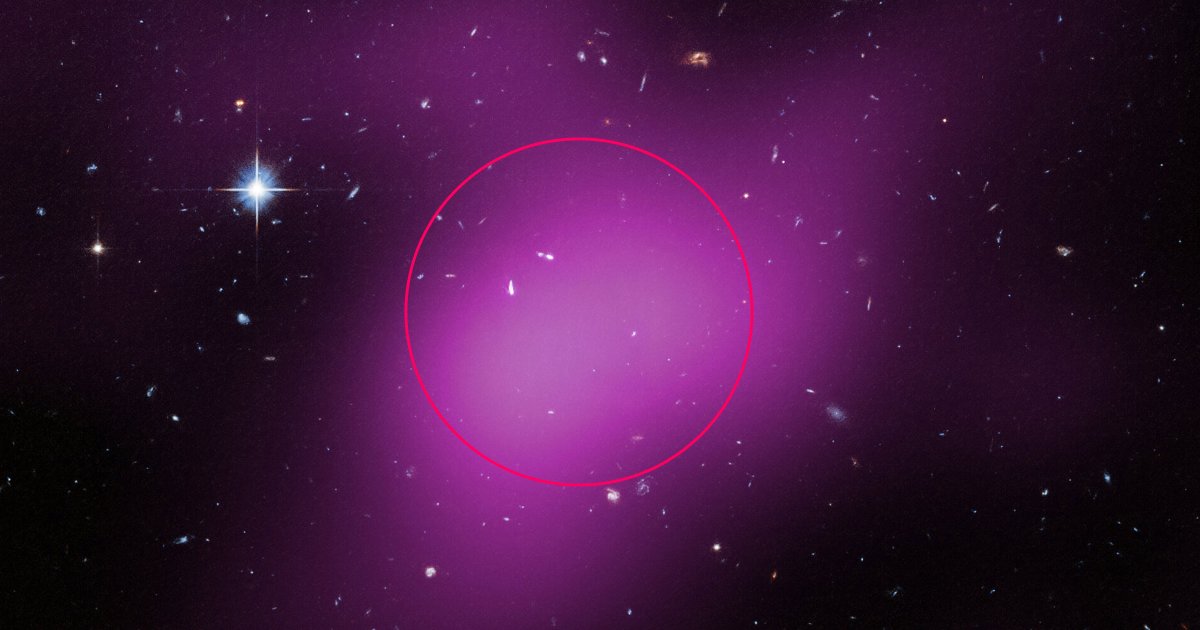
Dark matter, an undetected particle form distinct from Standard Model particles, dominates the Universe's matter content and is essential for explaining cosmic structures, though recent discoveries like CDG-2 present new puzzles about satellite galaxy formation and dark matter's nature.


OMG science
fromBig Think
1 month agoDid Hubble's new "dark galaxy" kill modified gravity?
Dark matter, an undetected particle form distinct from Standard Model particles, dominates the Universe's matter content and is essential for explaining cosmic structures, though recent discoveries like CDG-2 present new puzzles about satellite galaxy formation and dark matter's nature.

Science
fromwww.scientificamerican.com
1 month agoScientists may have discovered a pulsar at the Milky Way's hearta result that could reveal new physics
A pulsar near Sagittarius A* would enable more precise measurements of spacetime and gravitational effects around the Milky Way's central supermassive black hole.

fromFuturism
2 months agoAstronomers Intrigued By Impossible Structure Around Dead Star
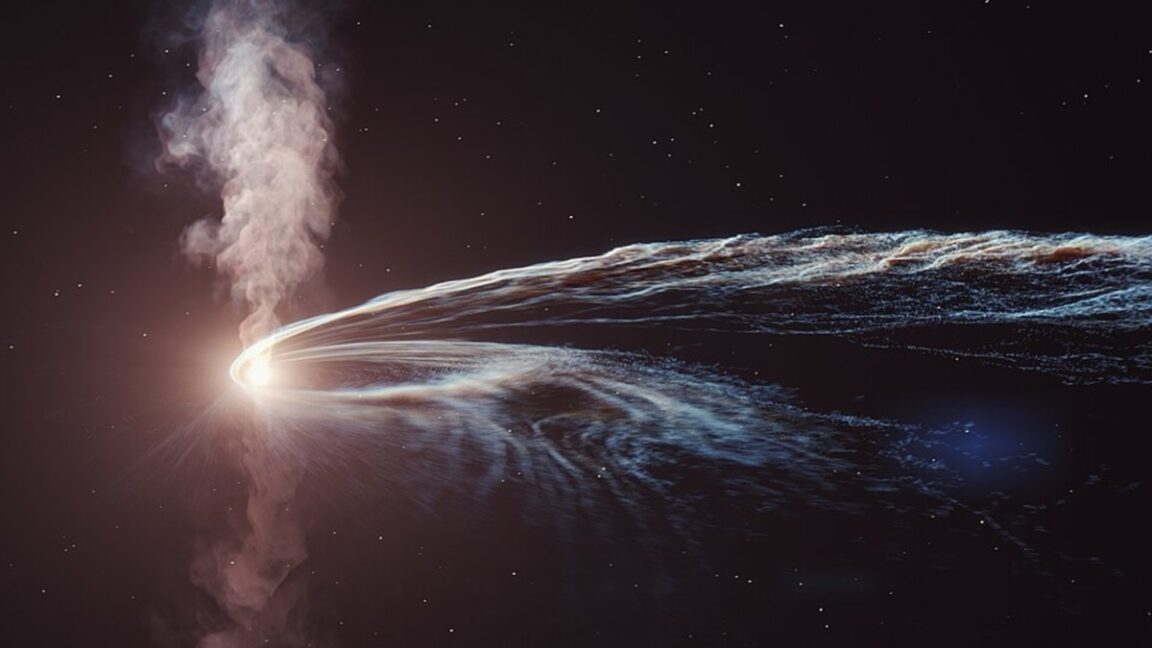
A dead star 730 light years away appears to be forming a powerful structure around itself - and despite their best efforts, astronomers aren't sure how. The cosmic corpse, designated RXJ0528+2838, is an incredibly dense stellar remnant known as a white dwarf, with a Sun-like star orbiting around it. This binary arrangement isn't uncommon throughout the universe, but what is strange is the structure surrounding the former body: a highly energetic and luminescent cloud known as a nebula,
Science
fromwww.scientificamerican.com
2 months agoThe biggest explosions in the universe, ranked
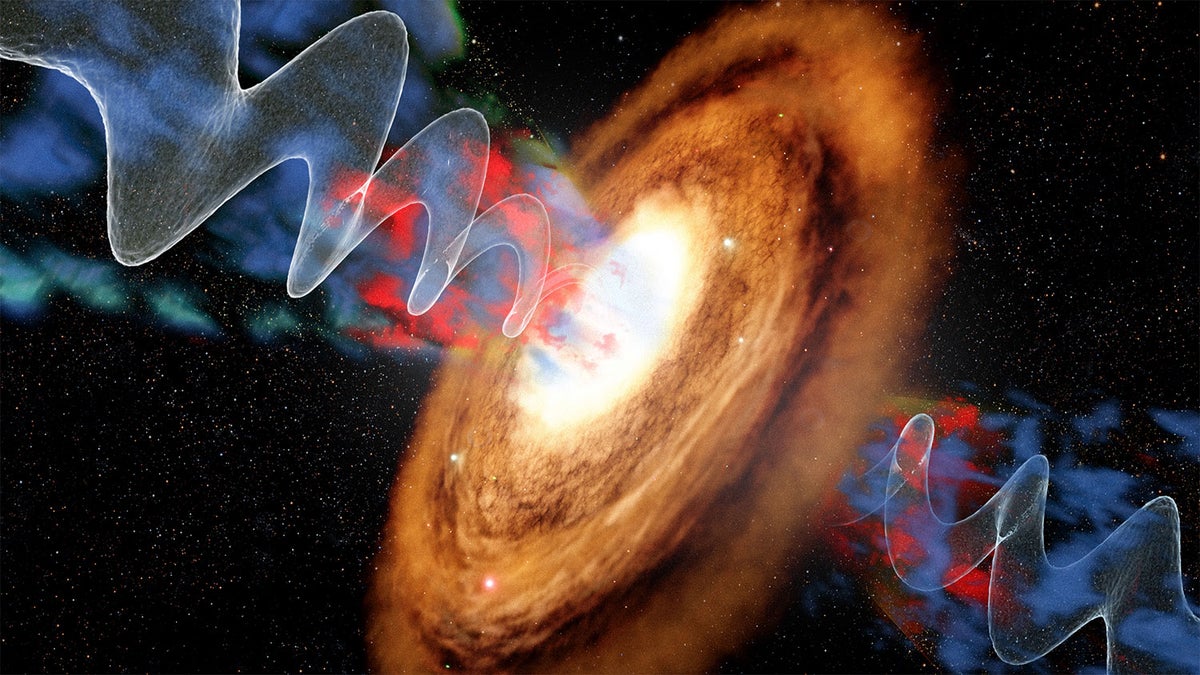
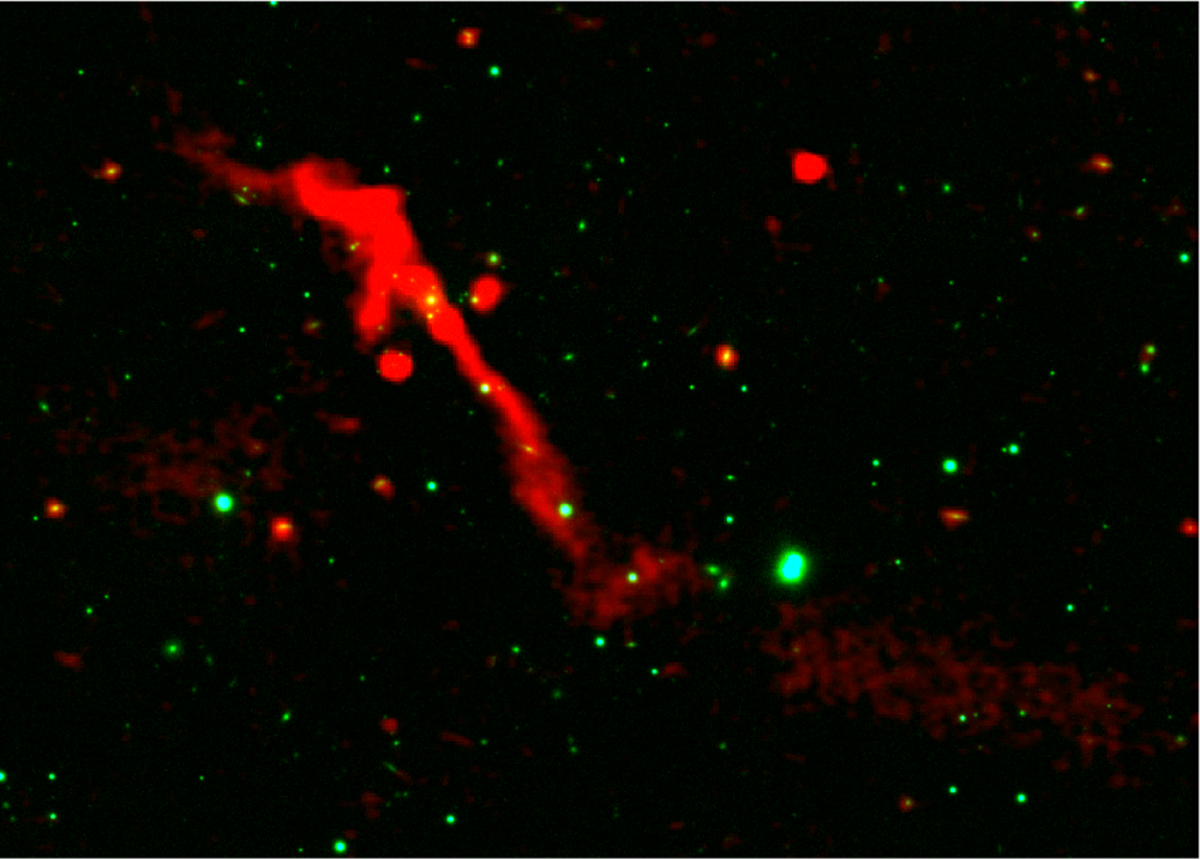
The universe is exploding. Or parts of it are. The night sky may seem calm, even serene, but that masks events of a catastrophic and nearly unimaginable scale. Across the galaxy and even the cosmos itself, immense outbursts of energy occur that could easily vaporize our planet. Happily, space is vast, and the terrible distance between these events and us diminishes what we see to a faint glowusually.
OMG science
fromNature
2 months agoConstraints on axion dark matter by distributed intercity quantum sensors - Nature
Y.W. designed the experimental protocols, performed experiments, analysed the data and wrote the manuscript. Y.H., X.K., D.C., J.X.X. and W.Z. performed experiments and edited the manuscript. Y.C. and S.P. edited the manuscript. M.J., X.P. and J.D. proposed the experimental concept, designed experimental protocols and proofread and edited the manuscript. All authors contributed with discussions and checking the manuscript. Corresponding authors Correspondence to Min Jiang or Xinhua Peng.
Science
fromNature
2 months agoLarge-scale analogue quantum simulation using atom dot arrays - Nature
Analogue quantum simulations are a useful tool for investigating these systems, particularly in regimes in which the applicability of numerical techniques is limited. For different simulator platforms, figures of merit include the electron bandwidth and interaction strength, temperature and the number of simulated lattice sites. Their use is further underscored by the ability to realize distinct lattice geometries, on-site degrees of freedom and by the physical observables that are accessible to experimental measurement.
Science
fromwww.npr.org
1 month agoHave astronomers witnessed the birth of a black hole?
A bright star in a nearby galaxy has essentially vanished. Astronomers believe that it died and collapsed in on itself, transforming into the eerie cosmic phenomenon known as a black hole. "It used to be one of the brightest stars in the Andromeda galaxy," says Kishalay De, an astronomer with Columbia University and the Flatiron Institute. "Today, it is nowhere to be seen, even with the most sensitive telescopes."
Science
fromwww.scientificamerican.com
1 month agoHow can galaxies ever collide in an ever-expanding universe?
Okay, first thing first: the universe is in fact expanding. We've known this for more than a century now, and it's the basis for modern cosmology. This idea is called the big bang modelwhich is an unfortunate name because it brings to mind a cosmos expanding like an explosion, with galaxies moving away from each other through space like shrapnel. But in fact space itself is expanding, and that's different.
Science
[ Load more ]