#history-of-cosmology

[ follow ]
fromFuturism
4 hours ago

Astronomers Found Something Strange In Giant "Forbidden" Planet Nearly the Size of Its Star

The atmosphere of TOI 5205b has a lower concentration of heavy elements relative to hydrogen than gas giants in our own solar system, suggesting something different about its formation.
OMG science
Philosophy
fromBig Think
4 days ago

The flimsy case for evolving dark energy

Theoretical physicists risk falling into motivated reasoning by overly believing speculative ideas without sufficient supporting evidence.
#hubble-space-telescope
OMG science
fromwww.businessinsider.com
1 day ago

As the Hubble Space Telescope turns 36, see 36 of its most breathtaking photos of space

The Hubble Space Telescope has made over 1.7 million observations, significantly contributing to astronomical research since its launch in 1990.
Philosophy
fromThe Conversation
6 days ago

Are multiverses real? An astrophysicist explains why it depends on how you define 'real'

The existence of the multiverse remains hypothetical, with no direct sensory evidence but potential indirect effects.
OMG science
fromFuturism
1 day ago

Scientists Say They've Found "Dark Points" That Move Faster Than the Speed of Light

Faster-than-light 'dark points' in light waves have been observed, moving without mass and not violating relativity.
Science
fromwww.scientificamerican.com
2 weeks ago

Something extremely weird is happening to our galactic neighbor. Scientists think they know why

The Small Magellanic Cloud's unusually slow stellar rotation results from a hundred-million-year-old collision with the Large Magellanic Cloud that disrupted its normal dynamical state.
#universe
OMG science
fromBig Think
5 days ago

The Universe has changed by the time you finish this sentence

The Universe undergoes profound changes over time, despite appearing static on human timescales.
OMG science
fromBig Think
1 week ago

Ask Ethan: Does dark energy curve the Universe over time?

The fate of the Universe is determined by the total energy present and its relation to the initial expansion rate.
Science
fromwww.scientificamerican.com
3 weeks ago

Have astronomers found a runaway monster black hole or just a very weird galaxy?

Astronomers discovered RBH-1, a potentially runaway supermassive black hole traveling at over three million kilometers per hour, though ambiguous data makes its true nature uncertain.
#black-holes
fromwww.scientificamerican.com
1 month ago
Science

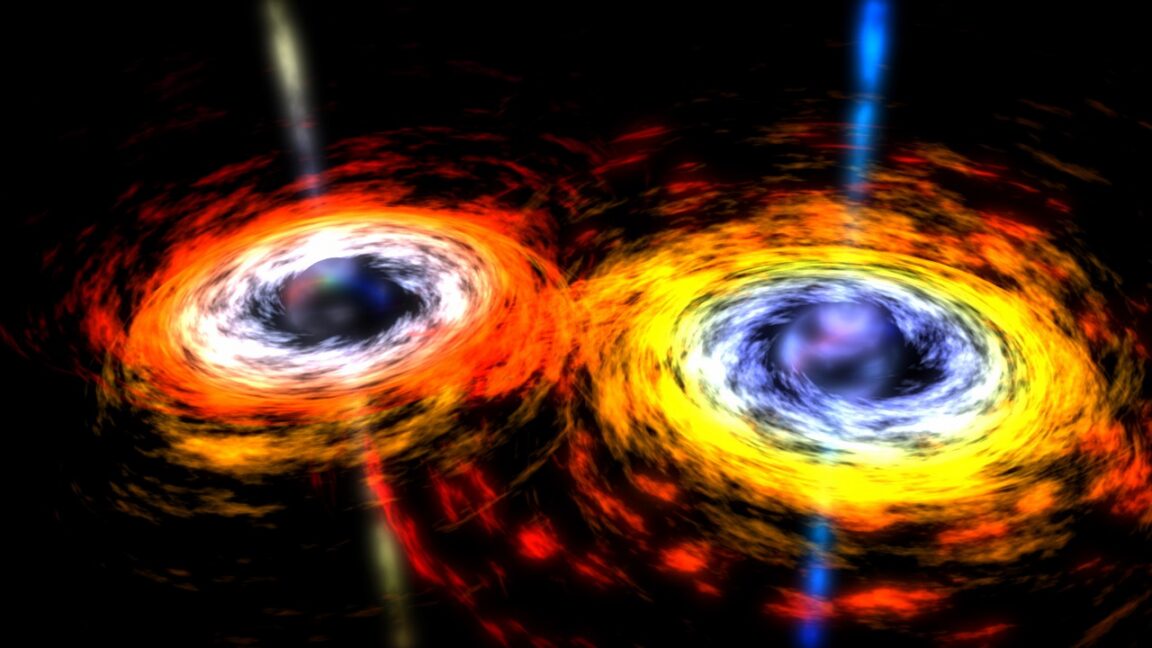
How much energy is released when supermassive black holes collide?

Binary black hole mergers release enormous energy and involve complex interactions near event horizons; many pairs are too distant to merge within the universe's age.
fromMail Online
1 month ago
Science

Watch the moment a star collapses into a black hole

A supergiant star in Andromeda (M31-2014-DS1) collapsed directly into a black hole without a supernova, observed as gradual dimming between 2014 and 2017.
OMG science
fromFuturism
3 weeks ago

Scientists Say Something Bizarre Is Hiding Inside Black Holes

Mathematicians and physicists propose that prime numbers could describe black hole interiors, offering a novel mathematical framework for understanding these cosmic mysteries.
Philosophy
fromBig Think
2 weeks ago

Einstein showed space can curve, but data reveals a flat Universe

The Universe has a flat spatial geometry, confirmed through cosmic microwave background observations, rather than the curved or spherical shape many physicists theoretically preferred.
OMG science
fromBig Think
6 days ago

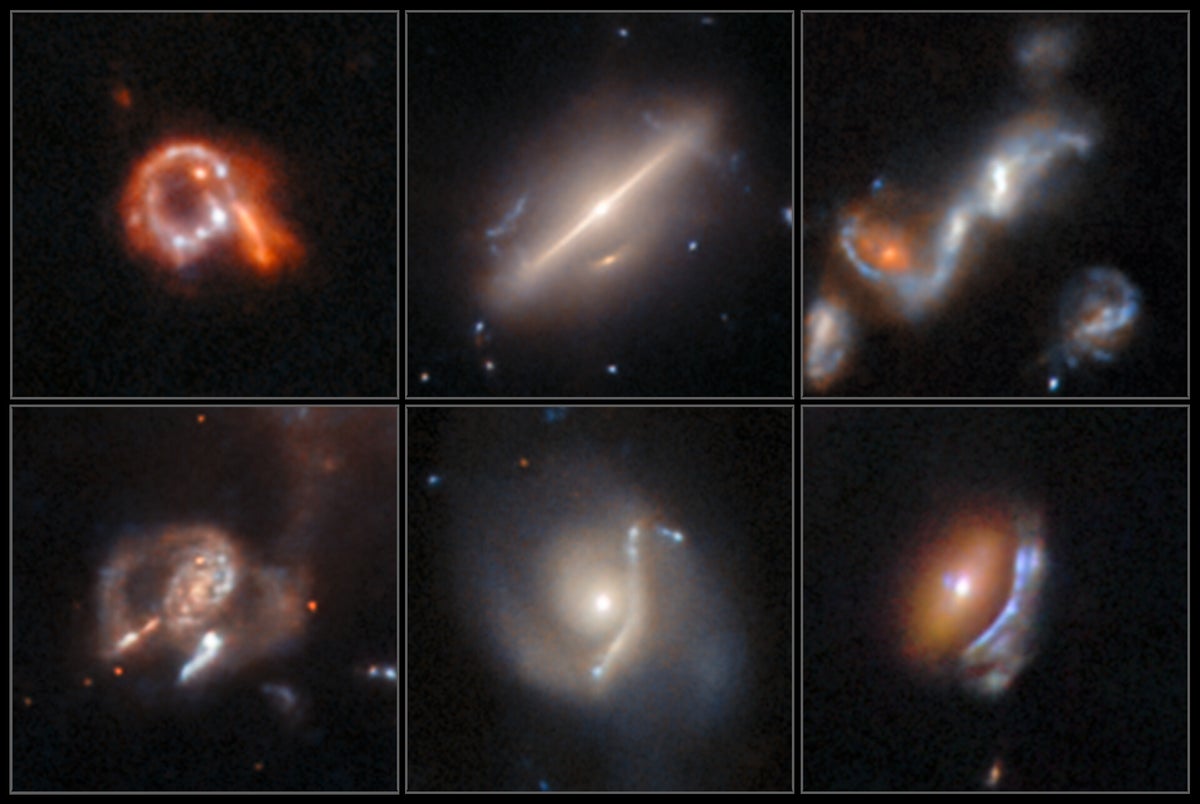
Peculiar galaxies showcase the beauty of cosmic violence

Trillions of galaxies exist, with most stars in large galaxies, while peculiar galaxies showcase unique interactions and transformations.
#superluminous-supernovae
OMG science
fromNature
3 weeks ago

This supernova is too bright - now astronomers might know why

Superluminous supernovae are 10 to 100 times brighter than expected, and a wobbling signal from one explosion may explain how this extreme brightness occurs.
OMG science
fromNature
3 weeks ago

This supernova is too bright - now astronomers might know why

Superluminous supernovae are 10 to 100 times brighter than expected, and a wobbling signal from one explosion may explain how this extreme brightness occurs.
#astronomy
Berlin music
fromwww.nature.com
1 month ago

Jam-packed star system is most compact of its kind ever found

A quadruple star system 584 parsecs from Earth features three closely packed stars orbited by a more distant fourth star in a complex gravitational arrangement.
OMG science
fromwww.scientificamerican.com
1 week ago

We thought we knew the shape of the universe. We were wrong

The shape of the universe remains unknown, with three possible geometries and the cosmic microwave background as a key to understanding its topology.
Science
fromwww.theguardian.com
1 month ago

New image reveals secrets of Milky Way galaxy in stunning detail

The Alma telescope captured an unprecedented detailed image of the Milky Way's center, revealing previously unknown filaments of matter flowing to form stars and planets, advancing understanding of galactic formation.
#gravitational-waves
fromwww.scientificamerican.com
2 weeks ago
OMG science

A boom in gravitational waves leaves scientists with more questions than answers

A global network of gravitational-wave observatories has detected 218 candidate events, revealing complex structures in cosmic mergers and providing unprecedented insights into the universe.
fromwww.scientificamerican.com
1 month ago
OMG science

Newly discovered ripples in spacetime put Einstein's general relativity to the test

A global network of gravitational wave observatories has more than doubled detections of cosmic collisions, revealing a universe filled with black holes, neutron stars, and their mergers with unprecedented variety and characteristics.
OMG science
fromwww.scientificamerican.com
2 weeks ago

A boom in gravitational waves leaves scientists with more questions than answers

A global network of gravitational-wave observatories has detected 218 candidate events, revealing complex structures in cosmic mergers and providing unprecedented insights into the universe.
OMG science
fromwww.scientificamerican.com
1 month ago

Newly discovered ripples in spacetime put Einstein's general relativity to the test

A global network of gravitational wave observatories has more than doubled detections of cosmic collisions, revealing a universe filled with black holes, neutron stars, and their mergers with unprecedented variety and characteristics.
Science
fromwww.scientificamerican.com
1 month ago

Chemistry at the heart of the Milky Way has never looked so gorgeous

ALMA telescope reveals unprecedented detail of the Milky Way's central molecular zone, showing gas, dust, and stars surrounding Sagittarius A* in extraordinary clarity.
OMG science
fromBig Think
3 weeks ago

Ask Ethan: How dark will the Universe become?

The Universe will eventually become dark and sparse as stars exhaust their fuel and die, with approximately 95% of all stars already formed, allowing estimation of future cosmic dimming.
fromMail Online
1 month ago

See the Milky Way like NEVER before in largest image of its kind

One of the most exciting aspects is the rich chemistry we detect. We see dozens of different molecules, including some complex organic molecules that contain carbon, the same element that forms the basis of life on Earth. From ACES, we are learning more about how the ingredients for planets, and potentially life itself, can arise in the universe.
Science
fromBig Think
1 month ago

Record-breaking natural laser discovered 11 billion light-years away

an electron within a molecule gets excited to a higher-energy state, the electron de-transitions back to the lower energy state, where it emits light of a very specific wavelength in the process. Then, pumped or injected energy re-excites an electron within that very same molecule back into that higher-energy state, over and over.
Science
OMG science
fromMail Online
3 weeks ago

Astronomers watch the birth of a magnetar for the first time

Astronomers observed the birth of a magnetar, an extremely dense neutron star with the universe's most powerful magnetic fields, through a superluminous supernova's unusual flickering light pattern over 200 days.
Science
fromwww.scientificamerican.com
1 month ago

Astronomers spot a young sun blowing bubbles inside the Milky Way

NASA's Chandra X-ray Observatory captured the first image of a young sunlike star's astrosphere, a protective bubble of hot gas 120 light-years away, revealing how stellar winds shape these cosmic structures.
#dark-matter
Science
fromwww.scientificamerican.com
2 months ago

JWST unveils most intricate map yet of cosmic dark matter

Astronomers mapped dark matter's detailed distribution in the COSMOS field using JWST imaging to study how dark matter shapes galaxy formation and structure.
Science
fromMail Online
2 months ago

See dark matter like NEVER before in stunning NASA image

James Webb's high-precision dark-matter map shows dark matter forms a gravitational framework guiding galaxy and planet formation, overlapping with normal matter.
OMG science
fromFuturism
1 month ago

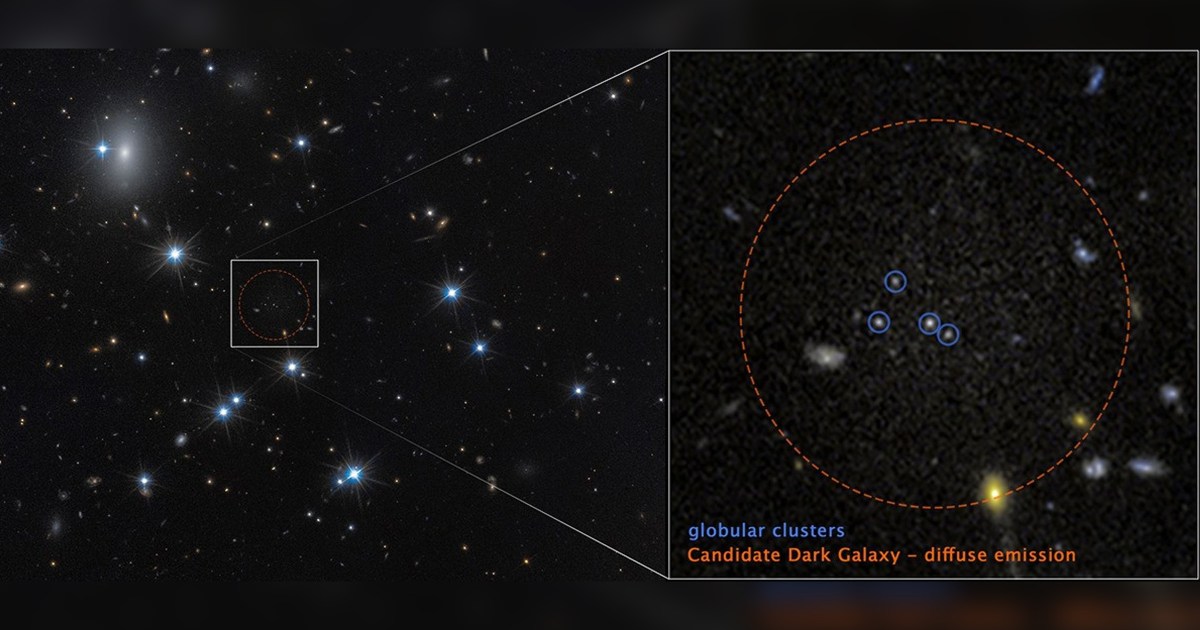
Hubble Spots Bizarre Galaxy That Appears to Be 99.9 Percent Dark Matter

Astronomers discovered galaxy CDG-2, composed of at least 99.9 percent dark matter, representing one of the most dark matter-dominated galaxies ever found and a candidate for theoretical dark galaxies.
OMG science
fromMail Online
1 month ago

Scientists find origin of 3 strange signals from heart of Milky Way

Excited dark matter explains mysterious energy signals emanating from the Milky Way's center that conventional astrophysical events cannot account for.
OMG science
fromBig Think
1 month ago

Did Hubble's new "dark galaxy" kill modified gravity?

Dark matter, an undetected particle form distinct from Standard Model particles, dominates the Universe's matter content and is essential for explaining cosmic structures, though recent discoveries like CDG-2 present new puzzles about satellite galaxy formation and dark matter's nature.
Science
fromNature
1 month ago

Runaway black hole leaves a trail of stars

A supermassive black hole was ejected from a nearby galaxy and is traveling through the intergalactic medium, creating a trail of newly formed stars.
fromBig Think
1 month ago

Ask Ethan: Will anything persist when the Universe dies?

Star-formation will eventually end, and then the last shining stars will burn out. Galaxies will dissociate due to gravitational interactions, ejecting all masses and leaving only supermassive black holes behind. And then those black holes will decay via Hawking radiation, leaving only cold, stable, isolated bodies, from which no further energy can be extracted, all accelerating away from us within our dark energy-dominated Universe.
Science
fromFuturism
1 month ago

Astronomers Spot Huge Microwave Laser Blasting Into Space

This system is truly extraordinary. We're seeing the radio equivalent of a laser halfway across the universe. Fundamentally, masers and lasers are focused beams of light in the same frequency. In the realm of astrophysics, these can arise from clouds of dust being excited into a higher energy state from the light emitted by other sources, like stars and black holes.
OMG science
#big-bang
OMG science
fromFuturism
1 month ago

NASA Spots Sun-like Star Inflating Massive Bubble

Astronomers detected the first astrosphere around a Sun-like star using NASA's Chandra X-ray Observatory, revealing how stellar winds create protective bubbles similar to our Sun's heliosphere.
OMG science
fromFuturism
1 month ago

Evidence Grows That One of the Largest Known Stars Is Poised to Explode in a Spectacular Blast

WOH G64, one of the largest known stars, is undergoing dramatic transformation and may soon explode as a supernova or collapse into a black hole.
fromEngadget
2 months ago

Astronomers share new insights about the early universe via the Webb Space Telescope

With Webb, we are able to see farther than humans ever have before, and it looks nothing like what we predicted, which is both challenging and exciting,
Science
#cosmic-expansion
fromBig Think
2 months ago

What the Universe looks like: from nearby to far away

Looking skyward fills us with wonder. Off-world, the Sun, planets, stars, and galaxies all await. Our Solar System encompasses our own cosmic backyard. Farther away, stars and star clusters abound within the Milky Way. Hundreds of billions of stars exist just within our home galaxy. Inside our Local Group, only Andromeda surpasses us in mass, size, and stars. More than 5 million light-years away, galaxies abound in groups and clusters.
Science
Science
fromBig Think
2 months ago

Ask Ethan: What does "gravitationally bound" mean in the expanding Universe?

Gravitationally bound systems remain together when mutual gravity overcomes cosmic expansion; only stronger expansion or external influences can separate bound components.
fromwww.scientificamerican.com
1 month ago

How can galaxies ever collide in an ever-expanding universe?

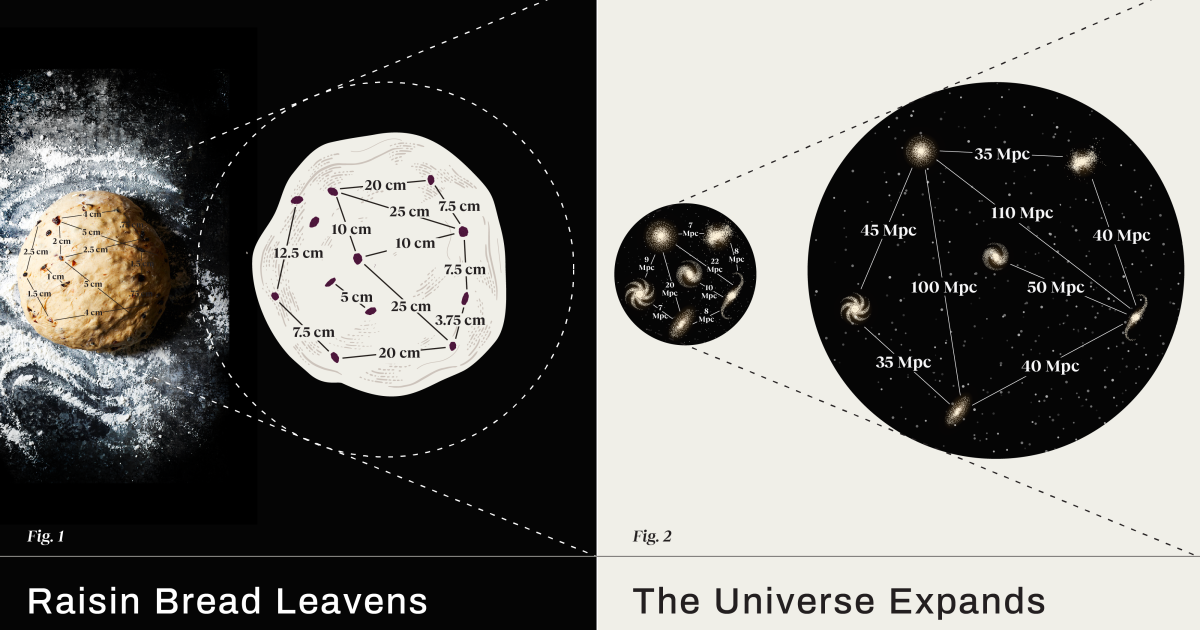
Okay, first thing first: the universe is in fact expanding. We've known this for more than a century now, and it's the basis for modern cosmology. This idea is called the big bang modelwhich is an unfortunate name because it brings to mind a cosmos expanding like an explosion, with galaxies moving away from each other through space like shrapnel. But in fact space itself is expanding, and that's different.
Science
#jwst
Science
fromFuturism
2 months ago

These Snapshots of the Moment a Star Exploded Will Fill You With Cosmic Dread

Interferometric images captured nova eruptions in real time, revealing complex, asymmetric thermonuclear explosions on white dwarfs fueled by accreted hydrogen.
fromFuturism
2 months ago

Astronomers Intrigued By Impossible Structure Around Dead Star

A dead star 730 light years away appears to be forming a powerful structure around itself - and despite their best efforts, astronomers aren't sure how. The cosmic corpse, designated RXJ0528+2838, is an incredibly dense stellar remnant known as a white dwarf, with a Sun-like star orbiting around it. This binary arrangement isn't uncommon throughout the universe, but what is strange is the structure surrounding the former body: a highly energetic and luminescent cloud known as a nebula,
Science
fromwww.npr.org
1 month ago

Have astronomers witnessed the birth of a black hole?

A bright star in a nearby galaxy has essentially vanished. Astronomers believe that it died and collapsed in on itself, transforming into the eerie cosmic phenomenon known as a black hole. "It used to be one of the brightest stars in the Andromeda galaxy," says Kishalay De, an astronomer with Columbia University and the Flatiron Institute. "Today, it is nowhere to be seen, even with the most sensitive telescopes."
Science
Science
fromFuturism
2 months ago

Scientists Discover Impossible Object in Deep Space

A galaxy cluster 1.4 billion years after the Big Bang exhibits gas temperatures at least five times higher than cosmological models predict.
fromwww.scientificamerican.com
2 months ago

The biggest explosions in the universe, ranked

The universe is exploding. Or parts of it are. The night sky may seem calm, even serene, but that masks events of a catastrophic and nearly unimaginable scale. Across the galaxy and even the cosmos itself, immense outbursts of energy occur that could easily vaporize our planet. Happily, space is vast, and the terrible distance between these events and us diminishes what we see to a faint glowusually.
OMG science
#supermassive-black-hole
Science
fromBig Think
2 months ago

New JWST lens survey: can it save the expanding Universe?

Observations from within the local Universe limit measurements, producing conflicting Hubble expansion rates (67 vs 73 km/s/Mpc), motivating new methods such as JWST multiply-lensed supernova observations.
Science
fromBig Think
2 months ago

NASA watched this supernova blast expand for 25 years

Kepler's supernova remnant shows asymmetric expansion observed by Chandra over 25 years, with shockwave speeds ranging from 1,800 to 6,200 km/s.
fromBig Think
2 months ago

JWST shakes up the hunt for earliest galaxy cluster

The Hubble Space Telescope displayed what the Universe looks like. Its successor, JWST, now reveals how the Universe grew up. Galaxies formed and grew massive swiftly: requiring under 300 million years. Larger-scale, more massive structures, like galaxy clusters, take longer. The earliest mature, fully-fledged cluster is CL J1001+0220. Simulations predict such clusters to appear late: after 2-3 billion years. However, proto-clusters, or still-forming galaxy clusters, appear far earlier.
Science
Science
fromwww.scientificamerican.com
1 month ago

This baby cluster' of galaxies in the early universe is mystifying astronomers

Protocluster JADES-ID1, containing at least 66 galaxies and hot X-ray–emitting gas, existed scarcely a billion years after the Big Bang.
Science
fromFuturism
1 month ago

Scientists Intrigued as Prominent Star Suddenly Winks Out of Existence

A massive Andromeda star (M31-2014-DS1) brightened, faded, and vanished, consistent with a failed supernova leading to direct collapse into a stellar-mass black hole.
Science
fromwww.scientificamerican.com
2 months ago

Stunningly Hot Galaxy Cluster Puts New Spin on How These Cosmic Behemoths Evolved

Galaxy cluster SPT2349-56 contained gas at least five times hotter than predicted when the universe was 1.4 billion years old.
Science
fromMail Online
1 month ago

Scientists discover black hole spewing more energy than the Death Star

A supermassive black hole has emitted an increasingly powerful radio jet for four years after shredding a star, reaching unprecedented energy levels.
#dark-energy-survey
Science
fromThe Verge
2 months ago

Scientists let AI loose on Hubble's archives

AI scanned Hubble's archives to find hundreds of astrophysical anomalies, revealing nearly 1,400 unusual objects including many previously undocumented.
Science
fromFuturism
1 month ago

Physicists Think They Saw a Black Hole Explode

Primordial black holes can evaporate via Hawking radiation and may explosively release particles, potentially explaining a powerful 2023 neutrino detection.
fromwww.scientificamerican.com
1 month ago

Astronomers spot one of the largest spinning structures in the universe

The first time that University of Oxford astronomer Lyla Jung saw the cosmic configuration on her monitor, she almost didn't believe it was real. But it wasand Jung and her colleagues went on to identify one of the largest rotating structures ever found in space: a chain of galaxies embedded in a spinning cosmic filament 400 million light-years from Earth. The finding, published in Monthly Notices of the Royal Astronomical Society, may give astronomers new insights into galaxies' formation, evolution and diversity, Jung says.
Science
Science
fromwww.scientificamerican.com
2 months ago

JWST spots most distant galaxy ever, pushing the limits of the observable universe

MoM‑z14 is the most distant galaxy detected, seen 280 million years after the Big Bang, and is unexpectedly bright, dense, and chemically enriched.
Science
fromEngadget
2 months ago

Astronomers discover over 800 cosmic anomalies using a new AI tool

AnomalyMatch scanned nearly 100 million Hubble image cutouts in 2.5 days and identified 1,400 anomalous objects, over 800 previously undocumented.
Science
fromWIRED
2 months ago

Capturing the Moment a White Dwarf Exploded

Near-infrared interferometry captured high-resolution, early-stage images of two 2021 novae, revealing asymmetric, multi-flow ejecta and differing eruption timescales.
Science
fromwww.scientificamerican.com
1 month ago

Scientists may have discovered a pulsar at the Milky Way's hearta result that could reveal new physics

A pulsar near Sagittarius A* would enable more precise measurements of spacetime and gravitational effects around the Milky Way's central supermassive black hole.
Science
fromwww.scientificamerican.com
2 months ago

Astronomers Spot Mysterious Bar-Shaped Cloud of Iron Inside an Iconic Nebula

A bar-shaped cloud of ionized iron atoms, with slightly more mass than Mars, was discovered in the Ring Nebula and its origin remains unknown.
fromBig Think
2 months ago

Starts With A Bang podcast #125 - Large-scale structure

We don't merely have the Hubble tension to reckon with, or the fact that different methods yield different values for the expansion rate of the Universe today, but a puzzle over whether dark energy is truly a constant in our Universe, as most physicists have assumed since its discovery back in 1998. While "early relic" methods using CMB or baryon acoustic oscillation data favor a lower value of around 67 km/s/Mpc, "distance ladder" methods instead prefer a higher, incompatible value of around 73 km/s/Mpc.
Science
Science
fromFuturism
2 months ago

Mind Blowing James Webb Photo Shows Star Crumbling Into Dust

Webb captured an infrared close-up of the Helix Nebula revealing a dying star shedding its outer layers and leaving behind a white dwarf.
[ Load more ]