New York Mets
fromFaithandfearinflushing
9 hours agoGlass Calf Full
The Mets celebrated multiple victories, but concerns arose over Juan Soto's calf tightness after he exited the game early.
"It's an amalgamation of the Chicago neighborhood aesthetic with a Bulls fan, quite literally. It's kind of on the nose, but that's how I juxtapose the elements of my work, with the structure of a home and then a figure who is around or in the home."
David Bellion spent over a decade in top-flight football, playing for clubs like Manchester United and Sunderland, before becoming Red Star FC's creative director, focusing on brand development and cultural connections.
All but one of the song titles on Body Sound, the debut album from experimental string trio Whitney Johnson, Lia Kohl, and Macie Stewart, line up nicely-a few words, usually two, usually nouns, separated by a vertical line. The straight line in the middle means different things in different disciplines. In computing, it's called a 'pipe' and serves as a conduit. In poetry, it denotes a pause or break. In music, it marks the beginning and end of measures.
Officer Scott was sort of born by accident. He was a character in a sketch I wrote, written for a male actor, but I always would direct to give more Chris Farley energy to the character. Unfortunately, the actor that was supposed to play Officer Scott became sick the day before the show, but as showrunner and writer of the sketch, I figured I'd buy a costume and perform Scott myself.
People all saw that there is something new is being attempted here that you've just got to see. I think that is its own reward. In an era where New York's storied Met Opera has faced layoffs, pay cuts, postponed productions, and a controversial financial agreement with Saudi Arabia, forward-thinking artistic direction becomes essential for survival.
Braulio gives the crowd an incredible insight into a decade's worth of poster designs for Good Room, revealing how he finds inspiration in the most mundane things just by paying attention to what has 'already been designed' and remixing it into something new.
Kamrooz Aram is everywhere this year, from Mumbai Art Week to the Whitney Biennial, and critic Aruna D'Souza is grateful. She pens a beautiful meditation on his work, reading his abstract paintings as not simply a denunciation of Western modernism nor a reassertion of Islamic visual motifs, but something else entirely - something gestural, exuberant, riotous, and incomparably his own.
"These works are an exploration of the human body's elasticity and capacity to metamorphose. Informed by my own experience of pregnancy and the birth of my first child last year, these paintings are a meditation on physiological transformation and the body's underlying animalistic and mammalian nature."
Poetry and artificial intelligence can appear as oppositesone deeply human; the other cold and mechanical. Sasha Stiles sees them as expressions of the same impulse. Poetry, the Kalmyk- American poet argues, is one of our most ancient and enduring technologies, a system of meter and rhyme invented to store vital information. She views AI as its natural heir. Stiles's path to AI began with literature, not code.
Hong Kong's particular and seductive Metabolist city planning is an ode to consumption as a great totalizer of culture, and to contemporary art as merely a niche commodity form among many others.
On May 16, 2026,Iris van Herpen: Sculpting the Senseswill make its North American debut at the museum, showcasing more than 140 haute couture creations alongside contemporary art from artists such as Philip Beesley, Rogan Brown, Casey Curran, Kim Keever, and Nick Knight, in addition to unique design and scientific artifacts. The much-anticipated exhibit, which will run through December 6, 2026, will explore how renowned Dutch fashion designer Iris van Herpen fuses various mediums of expression.
The first things that struck me about Jason Gubbiotti's paintings at RecRoom were the small dimensions of the work, the relationship of their modest size to the artist's elaborately precise, often lattice-like geometric compositions, and their brilliant beguiling color. The work is also audaciously, unapologetically beautiful, and deeply pleasurable to look at.
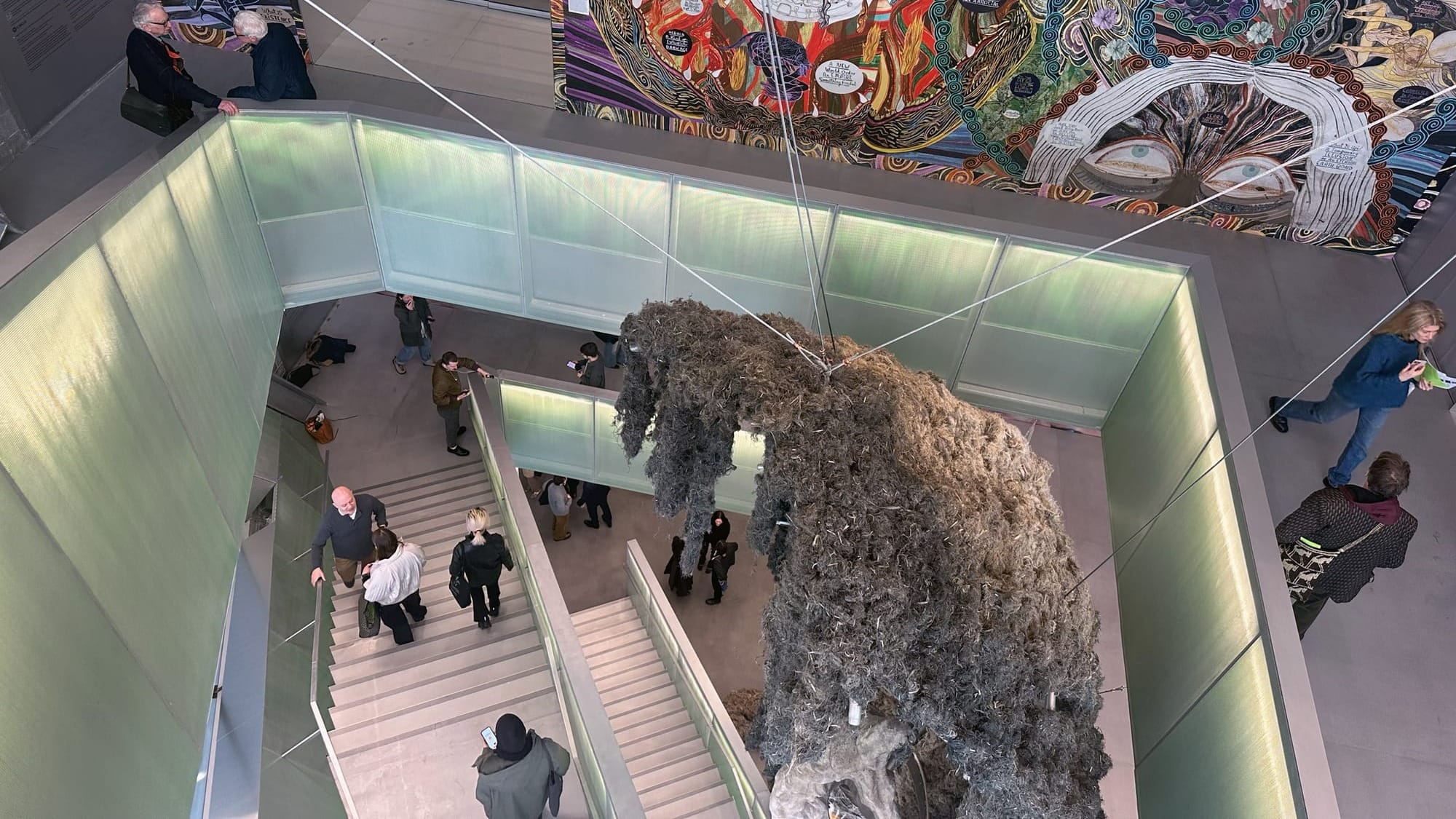
The new New Museum is many things: contemporary, perhaps, but also a science, history, anthropology, and many other museums in one. It echoes the desire of its patron class to own the world and its affiliated courtier class to deliver it to them on a silver platter, or encased in perforated metal, in this case.
On Franklin Street in Brooklyn's Greenpoint neighborhood, one non-commercial gallery fosters 'a small, stubbornly human space for friction.' Friction—the ubiquitous buzzword that captures the simultaneous delight and discomfort of doing things the slow way—is at the heart of artists Pap Souleye Fall and Char Jeré's current show at Subtitled NYC. It also reflects the overall spirit of this little exhibition space and of a burgeoning movement to reject our culture of optimization in favor of a bumpier, more intimate, less alienating experience.
Dealers like artists with established sales records because it lowers their already considerable financial exposure. Renting a gallery space in Tribeca costs anywhere between $8,000-30,000 a month on top of staff, marketing, and daily operations. With that kind of overhead, very few business owners can afford to take on the financial risk of untested artists.
What began as a passion for collecting became a responsibility. She not only believes in the artistic genius of women, but she wants society in general to hold men and women artists in equal esteem-and to place the same monetary value on their work.
One of those early supporters was Jan Petry (1939-2024), a Chicago advertising executive who filled her home with outsider art. Petry bequeathed 47 works, some by anonymous artists-including an Odd Fellows carved wood staff dating from 1880-and others by Emery Blagdon, James Castle, Ulysses Davis, Charles Dellschau, William Hawkins, Martín Ramírez, Günther Schützenhöfer and Leopold Strobl. Charles Dellschau, Fall Not, 1920 Collection of Intuit Art Museum, gift of Jan Petry and Angie Mills
Modern Art is pleased to present Polygrapher, the first solo exhibition by Joseph Yaeger since announcing his representation by the gallery, and the inaugural exhibition at their Bennet Street gallery. Polygrapher denotes both the exhibition title and a text written by the artist, published in the exhibition's accompanying booklet. Taking the form of an interrogation the artist underwent attached to a Stoelting UltraScribe--and in which only the answers have been transcribed--it creates a framework for the experience of the subsequent paintings.
Two years ago, the annual Under the Radar festival (which showcases international, experimental and multidisciplinary theater) was unexpectedly canceled by the Public Theater, its longtime presenter, due to financial issues. In response, the festival was quickly reconceived as a citywide effort involving several other theater companies, allowing it to move forward. The festival, now in its 21st edition, returns this month with productions at theaters across the city from Jan. 7 to 25.
Mornings are best for concentrated work. In the winter, I turn on the heat at 8am and get started around 10am. Summer, I start around 9am. I have two areas in the studio for projects. The large, heavy wood sculptures are carved in the front section of the studio, closest to the roll-up wide door. Smaller sculptures are placed on a hydraulic workbench. Before I start, I focus, connect with the Source, and ask for guidance.
I work outside, carving and shaping the stone. Outside my house, I have a table, an extension cord, and tools. It's very cold and I have to wear all my winter clothes. When it's too cold, I do the filing and finishing work inside after I shape it outside. I listen to all kinds of music. I listen to Eminem all the time; his albums are all my favorites. For drawings, I work at Kinngait Studios or at home on my kitchen table.