#language-effects
#language-effects
[ follow ]
#language-learning #communication #ai #multilingualism #bilingualism #education #cultural-understanding #identity


fromThe Conversation
2 days agoAI's fluency in other languages hides a Western worldview that can mislead users a scholar of Indonesian society explains
The response was in Indonesian but shaped by values that centered individual autonomy over the consensus-building, social harmony and collective family dynamics that tend to matter more in Indonesian social life.
Philosophy
#language-learning
Online learning
fromwww.theguardian.com
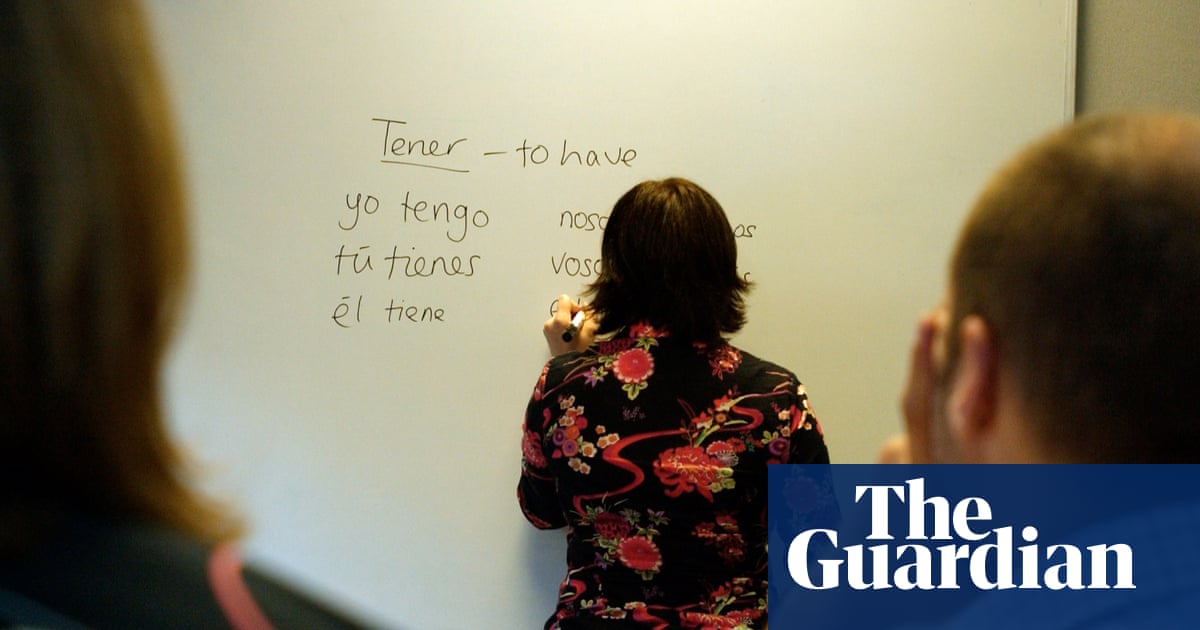
5 days agoDon't stop at Duolingo, set realistic goals, balance skills: how to start learning a new language
Being multilingual enhances sophistication, cultural understanding, and cognitive abilities, making language learning beneficial for personal and social growth.

Online learning
fromwww.theguardian.com
5 days agoDon't stop at Duolingo, set realistic goals, balance skills: how to start learning a new language
Being multilingual enhances sophistication, cultural understanding, and cognitive abilities, making language learning beneficial for personal and social growth.
fromwww.theguardian.com
4 days agoA moment that changed me: for the first time in my life, a stranger pronounced my name correctly
I would squirm in my chair as my new teacher worked their way through the class register, and my stomach would drop as they attempted to say my full name: Priti Ubhayakar.
Writing
Psychology
fromSilicon Canals
1 week ago9 cognitive habits people develop when they grew up bilingual that have nothing to do with language and everything to do with how their brain learned to hold two realities at once - Silicon Canals
Bilingualism can delay Alzheimer's onset by five years and reshapes cognitive processes beyond language.
fromPsychology Today
1 week agoWhat Reading Fluency Has to Do With Leadership: Nothing
The assumption that difficulty with reading or writing signals lower intelligence or diminished leadership ability is not supported by evidence. Decades of research show little to no correlation between dyslexia and lower general intelligence.
Education
fromFrenchly
2 weeks agoLa Francophonie: How Louisiana Keeps the French Language Alive - Frenchly
The territory was named La Louisiane in 1682 by French explorer René-Robert Cavelier de La Salle, in honor of King Louis XIV, who claimed for France the vast Mississippi River basin. When French settlers later founded New Orleans in 1718, the region quickly became a center of French culture in North America.
History
fromwww.scientificamerican.com
2 weeks agoCan you solve these language puzzles? Test your skills with these problems from North America's biggest linguistics competition
Computational linguistics is a two-way street: You're either using a computer to do things with human language or communicate or translate or teach a foreign language, or you're using computational techniques to learn something about human languages. Her work documenting and preserving endangered languages uses a little bit of both.
Education


OMG science
fromMail Online
3 weeks agoScientists recreate the lost languages of ancient humans
Scientists reconstructed ancient human species languages by analyzing fossilized skeletal imprints of soft tissues like the larynx, tongue, and brain, revealing that Neanderthals likely spoke languages understandable to early Homo sapiens.
Online learning
fromOpen Culture
2 weeks agoLearn Ancient Greek in 118 Free Lessons: A Free Online Course from Brandeis & Harvard
Leonard Muellner and Belisi Gillespie have created 118 YouTube videos covering two semesters of college-level Introduction to Ancient Greek, aligned with the textbook Greek: An Intensive Course.
History
fromwww.theguardian.com
3 weeks agoWhere Duolingo falls down: how I learned to speak Welsh with my mother
A grandson attending his Welsh grandmother's funeral in a Methodist chapel experiences a profound connection to his Welsh heritage through the singing of a traditional hymn, despite not understanding the Welsh language spoken throughout the service.
Artificial intelligence
fromPsychology Today
4 weeks agoAnti-Intelligence: When Language Operates Without a Mind
AI generates language through a fundamentally different structural architecture than human cognition, not through inferior intelligence but through inverted processes detached from lived experience and stakes.
Washington DC
fromFortune
1 month agoWashington roasted for using AI feature with heavily accented English instead of actual Spanish on state helpline | Fortune
Washington state's Department of Licensing automated system incorrectly played English with a Spanish accent when callers selected Spanish-language service, which the agency has since apologized for and fixed.
France news
fromThe Local France
1 month agoAsk the expert: When is the best time to start learning French?
Learning French before moving to France is essential because immersion after arrival is significantly more difficult than expected, as the nervous system enters survival mode while managing multiple life changes simultaneously.
fromThe Nation
1 month agoCan the Dictionary Keep Up?
The Merriam-Webster editor Peter Sokolowski introduced the crowd of assembled nerds to the idea that a dictionary is not a static document but a living object, constantly updated and remade in response to how people write and speak. In a talk titled "The Dictionary as Data," Sokolowski emphasized that the editors at Merriam-Webster look to how the general public uses language to guide their work.
Typography
fromPsychology Today
1 month agoA Science for Social Coherence?
In the practice of psychiatry, we like to think we have better radar than most doctors for identifying incoherent thinking in our fellow humans. Incoherence is one of the crucial signs for potential disasters in the central nervous system-delirium, psychosis, mania, intoxication, stroke, encephalitis. And yet, now in the waning years of my career, I confess that I've practiced this skill of identifying incoherent thinking with only the vaguest definition of coherence, and no measure.
Medicine
Education
fromPsychology Today
1 month agoFluent at Home, Silent at Work: Growing Up Bilingual
Heritage speakers lack formal language instruction in their native language, creating gaps in professional and academic domains that they internalize as personal failure rather than systemic educational gaps.
fromTravel + Leisure
3 weeks agoThis Is the Friendliest Language in the World, According to a New Study-and No, It's Not English
When respondents were asked which languages feel the most welcoming, Portuguese emerged on top, selected by 34 percent of participants. Spanish came in a close second with 33 percent of respondents calling it the friendliest, followed by Italian in third. Together, these languages form a clear cluster associated with warmth and approach.
Psychology
Education
fromIndependent
1 month agoMaire Treasa Ni Cheallaigh: I speak only Irish to my daughter, so why is she not guaranteed a place in our local Gaelscoil?
Irish-medium education opportunities remain limited despite Gaeilge being Ireland's official first language, creating challenges for families seeking immersion in the language.
France news
fromThe Local France
1 month agoEndless rain, Montpellier, and growing up bilingual: 6 essential articles for life in France
France faces prolonged rain; Paris and Montpellier attract Americans; bilingual upbringing requires balance; 2026 mutuelle hikes can be challenged; selling property incurs hidden costs.
Psychology
fromSilicon Canals
4 weeks agoPsychology says people who instinctively soften their language in emails and texts are not being polite. They are running a real-time calculation about how much honesty the relationship can survive. - Silicon Canals
Softened language in communication reflects a calculated assessment of relationship capacity to handle directness, not mere politeness, functioning as a survival mechanism to protect relational dynamics.
fromPsychology Today
2 months agoIs It Better to Learn a Second Language as a Child or Adult?
Parents often hear the warning: "If your child doesn't learn a second language early, they'll never be fluent." Adults, meanwhile, are told: "It's just too late for you to learn now." These claims are familiar and tidy, but misleading. Are they actually true? Is it better to learn a second language as a child or as an adult? The short answer is that it depends on what we mean by "better."
OMG science
Silicon Valley
fromSilicon Canals
1 month agoPsychology says people who still use complete sentences in text messages share 7 cognitive traits that are becoming increasingly rare - Silicon Canals
Maintaining full sentences and proper punctuation in digital messages correlates with stronger impulse control and deeper information processing, reflecting healthier cognitive habits.
fromPsychology Today
2 months agoDon't Get Lost in Translation
Led Zeppelin warned us about the perils of misunderstood communications in relationships. Failing to translate what we are trying to say or do so that someone else gets it is the root of so many problems. But translation is a fantastic find when it goes right. Here are some things I've learned about translating meaning from a lifetime of speaking numerous languages, practicing a wide array of martial arts, and communicating science.
Philosophy
fromPsychology Today
1 month agoAre There Linguistic Conspiracy Theories?
The term "conspiracy theory" calls to mind a variety of dubious claims and controversies, like rumors about Area 51, claims that the Earth is flat, and the movement known as QAnon. At first blush, these phenomena would seem to have little in common with bogus word origins. But there are a variety of false etymologies that spread virally and refuse to go away, in much the same way that stories about chemtrails, black helicopters, and UFOs refuse to die.
Writing
Education
fromeLearning Industry
1 month agoInternational Mother Language Day 2026: The Importance Of Multilingual Competence In Shaping A Competitive Future
Multilingual education strengthens cognitive agility, preserves mother tongues, and offers cultural and economic advantages that increase youth competitiveness in education and the workforce.
fromThe Atlantic
1 month agoWords Without Consequence
For the first time, speech has been decoupled from consequence. We now live alongside AI systems that converse knowledgeably and persuasively-deploying claims about the world, explanations, advice, encouragement, apologies, and promises-while bearing no vulnerability for what they say. Millions of people already rely on chatbots powered by large language models, and have integrated these synthetic interlocutors into their personal and professional lives. An LLM's words shape our beliefs, decisions, and actions, yet no speaker stands behind them.
Philosophy
fromBuzzFeed
2 months agoI Hate To Break It To You, But There's A Huge Chance You've Been Saying Extremely Common Words And Phrases Wrong Your Entire Life
1. Tongue in cheek 2. Old wives' tales 3. Statute of limitations 4. To be specific 5. Nipped in the bud 6. Get down to brass tacks 7. Deep-seated hatred 8. All intents and purposes 9. Wheelbarrow 10. Champing at the bit 11. Jury-rigged 12. Ulterior motive 13. Bald-faced lie 14. Dog eat dog world 15. Chump change 16. Dime a dozen 17. Duct tape 18. Can't see the forest for the trees 19. Quote unquote 20. Could have 21. Chalk it up 22. Iced tea 23. Take for granted 24. Blessing in disguise 25. Bated breath
Writing
fromThe Atlantic
2 months agoThe Last Days of the Southern Drawl
My dad has always had a southern accent: His words fall out of his mouth the way molasses would sound if it could speak, thick and slow. But his "KFC voice," as my sisters and I call it, is country. It's watered-down on work calls and during debates with his West Coast relatives. But it comes out around fellow cattle farmers and old friends from Kentucky, where he grew up.
Writing
Education
fromSilicon Canals
1 month ago7 words highly intelligent people use in conversation that average people mispronounce - Silicon Canals
Correct pronunciation of commonly mispronounced words often reflects extensive reading, attention to language, and habitual auditory correction rather than showing off.
fromThe Local France
2 months agoPODCAST: 'Shame' of Americans in France and explaining the strange noises the French make
Following the news that French troops are now in Greenland as part of a joint NATO force, we take a look at the reaction in the US, and what happens next for France and the rest of Europe. And with the current situation between the two countries, we asked our American readers if they felt they were being treated differently in France.
France news
Psychology
fromwww.theguardian.com
2 months agoI see sounds as shapes. Synaesthesia has given me an extraordinary ability for languages
Auditory-visual synaesthesia produces vivid visual imagery from sound, facilitating exceptional language learning but complicating everyday tasks like driving with loud music.
fromwww.dw.com
1 month agoHow Philippines' schools embraced German language
A German lesson is starting in a public-school classroom in the Philippines, and it opens with a greeting: "Guten Morgen," the teacher says. Students respond carefully, shaping unfamiliar sounds before moving on to short dialogues about directions, food, family, and eventually, culture. German has a reputation of being a difficult language to learn, but this also makes it a valuable assetImage: Stanley Gajete/DW In a Philippine public school, that routine still feels unusual.
Education
Education
fromIndependent
1 month ago'We are your nearest EU neighbour' - ambassador urges Irish primary schools to adopt French in new language drive
Primary schools in Ireland are urged to introduce French, supported by the French embassy supplying 90 language assistants and facilitating teacher exchanges.
fromOpen Culture
1 month agoWhy Some People Think in Words, While Others Think in Pictures & Feelings
Take the sur­prise some have expressed in recent years upon find­ing out that the expres­sion to "pic­ture" some­thing in one's head isn't just a fig­ure of speech. You mean that peo­ple "pic­tur­ing an apple," say, haven't been just think­ing about an apple, but actu­al­ly see­ing one in their heads? The inabil­i­ty to do that has a name: aphan­ta­sia, from the Greek word phan­ta­sia, "image," and prefix - a, "with­out."
Psychology
fromSilicon Canals
1 month agoDo you use these 10 phrases regularly? Psychology says you have an exceptionally strong personality - Silicon Canals
Ever noticed how some people just seem unshakeable? They navigate criticism with grace, stand their ground without being aggressive, and somehow manage to stay authentic even when everyone else is playing politics. After interviewing over 200 people for various articles, from startup founders to burned-out middle managers, I've noticed something fascinating: the strongest personalities often share a common vocabulary. Not fancy words or corporate jargon, but simple phrases that reveal how they think about themselves and the world.
Psychology
[ Load more ]