#maya-astronomy

[ follow ]
History
fromBig Think
3 days ago

Ghost map: Europe's first glimpse of Tenochtitlan shows a city already destroyed

The 1524 map of Tenochtitlan reflects the cultural clash and hybridization between indigenous and European perspectives after the city's destruction.
fromwww.thehistoryblog.com
1 week ago

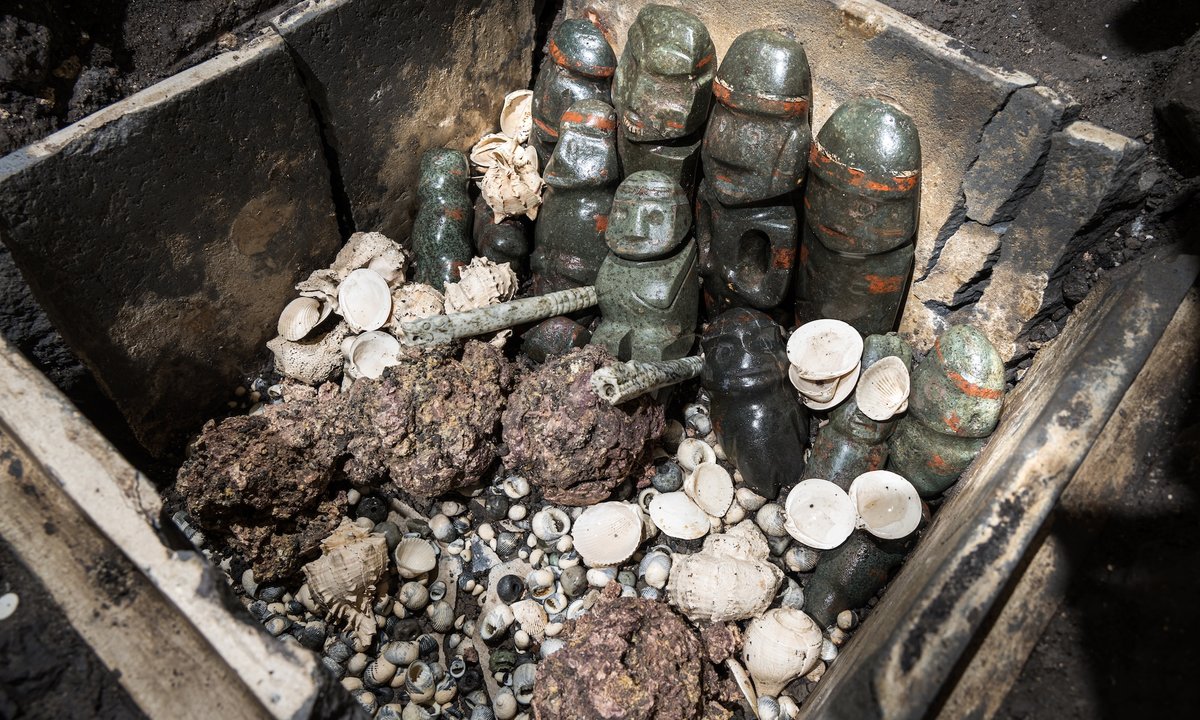
Toltec human sacrifice altar found in Mexico

The momoztli altar measures about one meter square and consists of three sections: a base of andesite quarry stone, a second section of larger slabs, and a top section of river stones and basalt.
History
London
fromwww.standard.co.uk
2 weeks ago

Spring equinox 2026: where and when to see druids in London

The Spring Equinox marks a celebration for Druids and Pagans at Stonehenge, emphasizing the balance of day and night.
Philosophy
fromBig Think
2 weeks ago

Aztec philosophy: How lucky you are to not be in prison right now

Moral luck describes how identical actions result in vastly different moral and legal consequences based on uncontrollable circumstances beyond the actor's intent.
#aztec-archaeology
Science
fromMail Online
3 weeks ago

World's oldest map of the night sky is REVEALED after 2,000 years

Scientists use X-rays to reveal a 2,000-year-old star map by Hipparchus hidden beneath a medieval manuscript, recovering ancient astronomical coordinates with remarkable accuracy.
Travel
fromConde Nast Traveler
3 weeks ago

Where to Eat, Stay, and Play in Tulum, Quintana Roo's Evolving Coastal Escape

Tulum has modernized significantly since the late 2010s while retaining the natural beauty and spiritual essence that originally attracted visitors.
Travel
fromTravel + Leisure
3 weeks ago

This Mexican Beach Town Has Gorgeous Boutique Hotels, Ancient Maya Ruins, and Some of the Whitest Sand in the World

Tulum has transformed from a hidden jungle town into Mexico's premier destination while maintaining natural beauty, cultural richness, and world-class hospitality offerings.
#planetary-alignment
fromNature
1 month ago

How infighting led the Maya civilization to catastrophic collapse

Before the 1970s, ancient Maya history was impenetrable. The civilization's grand ceremonial buildings and striking art, created in parts of Mesoamerica during the Classic Maya period (ad 150-900) had tantalized foreign visitors since the arrival of Spanish conquistadors in the sixteenth century. But no one, including several million twentieth-century speakers of Maya languages, could read the ancient Maya hieroglyphs.
History
fromMail Online
2 months ago

Lost tomb of mysterious 'cloud people' unearthed after 1,400 years

Archaeologists in Mexico have uncovered a 1,400-year-old tomb in the Central Valleys of Oaxaca that had been lost to history. The stone structure, built by the Zapotec culture, known as Be'ena'a, or 'The Cloud People', is adorned with sculptures, murals and carved symbols that suggest ritual significance. The Zapotec believed their ancestors descended from the clouds and that, in death, their souls returned to the heavens as spirits.
World news
US news
fromFuncheap
1 month ago

2026 Azteca Mexica New Year Festival in San Jose (March 13-15)

Calpulli Tonalehqueh hosts the nation’s largest Azteca Mexica New Year: a free, family-friendly, three-day celebration with 500+ dancers and 150+ vendor booths.
National Football League
fromFuncheap
1 month ago

2026 Azteca Mexica New Year Festival in San Jose (March 13-15)

Largest U.S. Azteca Mexica New Year: free, family-friendly three-day celebration March 13–15, 2026, in San Jose with 500+ dancers and 15,000 attendees.
History
fromwww.theguardian.com
1 month ago

Apocalypse no: how almost everything we thought we knew about the Maya is wrong

Classic Maya lowlands likely supported up to 16 million people during AD 600–900, implying unprecedented population density, complex agriculture, and advanced urban organization.
Science
fromwww.scientificamerican.com
2 months ago

Lost ancient Greek star catalog decoded by particle accelerator

Researchers decoded portions of Hipparchus's lost star catalog from a palimpsest using synchrotron imaging, revealing constellation names and measurements.
fromMail Online
1 month ago

Mysterious symbols spanning the globe hint at a lost civilization

His investigation began after identifying recurring giant T-shapes, three-level indents, and step pyramids carved into ancient stones worldwide. 'These specific symbols that are built in different size proportions, and the symbols are found in ancient stones around the world, are not supposed to exist; no cultures are supposed to have any cross-platform,' LaCroix explained. The symbols appear in locations ranging from Turkey's Van region to South America and Cambodia.
History
fromNature
2 months ago

Daily briefing: Symbols on ancient pottery could be earliest evidence of mathematics

Pottery made by people of the Halafian culture, who inhabited northern Mesopotamia between around 6200 and 5500 BC, is painted with flowers that have 4, 8, 16 or 32 petals, and some show arrangements of 64 flowers. These patterns show a clear understanding of symmetry and spatial division long before written numbers came into use around 3400 BC, argue scientists in a new study. The skill might have helped the Halafian people with tasks such as sharing harvests or dividing communal fields, the authors say.
Science
History
fromOpen Culture
1 month ago

Discover Khipu, the Ancient Incan Record & Writing System Made Entirely of Knots

Inca khipus encoded inventories, censuses, and historical narratives via knots, cord position, length, and fiber color, functioning as portable organic data systems.
fromConde Nast Traveler
1 month ago

On New Zealand's Aotea Island, Using the Stars to Get My Bearings

On an empty beach at the bottom of the world, the waves that roll over the sand are midnight blue and lit by the stars and a waxing moon. I'm only vaguely familiar with the constellations that hang above Great Barrier Island, known for centuries to the Māori as Aotea, some 56 nautical miles northeast of Auckland, New Zealand. I'm not all that used to seeing them so clearly,
Science
History
fromMail Online
1 month ago

Lost ancient Egyptian technology rewrites the dawn of civilization

Ancient Egyptians used a sophisticated rotary bow drill over 5,300 years ago, the earliest known metal drill, pushing back complex drilling technology by two millennia.
Science
fromCN Traveller
2 months ago

7 astronomical events worth travelling for in 2026

Major 2026 astronomy tourism opportunities include a total solar eclipse, Artemis II lunar flyby launch, an annular eclipse in Antarctica, and other celestial events.
History
fromNature
2 months ago

Ancient pottery reveals early evidence of mathematical thinking

Symmetrical botanical motifs on ancient pottery reveal structured spatial division and mathematical thinking predating formal written numbers.
[ Load more ]