#pacita-abad
#pacita-abad
[ follow ]
#contemporary-art #art-exhibition #illustration #photography #san-francisco #digital-art #art #ruth-asawa #community
fromItsnicethat
3 weeks agoDiogo Potes' paintings take poetic licence to a whole new level
When I'm painting, I try not to look at too many things so I don't become overly influenced. But we can't really escape ourselves. There are imaginations from other people that I love. Diogo's work is a colourful combo of Alejandro Jodorowsky's strange filmic palettes, Japanese sci-fi and vintage posters.
Graphic design
Portland
fromOregon ArtsWatch * Arts & Culture News
3 weeks agoImperfecta and Daria Loi's many reinventions * Oregon ArtsWatch
Imperfecta, a multifunctional space in Portland, blends gallery, community center, and installation venue, reflecting owner Daria Loi's philosophy of participatory design and interactive exploration.
fromHi-Fructose Magazine - The New Contemporary Art Magazine
1 week agoWorlds Collide: The Art of Mary Iverson - Hi-Fructose Magazine
"Where this series really started was when I was out painting Seattle's industrial areas, and doing plein air realistic renderings. As I focused more on that industry, I got closer and closer in and it became more abstract-looking at the shapes, colors and lines."
Arts
Photography
fromwww.theguardian.com
1 month agoI'm dying for the day heterosexuals have to come out': Catherine Opie and her astonishing shots of queer America
Catherine Opie's photography documents gay, lesbian, and queer Americans historically absent from mainstream art, creating powerful visual representation through portraits and performance-based imagery spanning three decades.
Miscellaneous
fromThe Art Newspaper - International art news and events
1 month ago'My paintings are always really kitchen sink, everything's thrown into them': Christina Quarles on her first solo show in Los Angeles
Christina Quarles creates fluid, elastic paintings exploring bodily vulnerability through layered acrylic and digital techniques, with recent work becoming more untethered following personal trauma from the Eaton fire.
fromThe Art Newspaper - International art news and events
1 week agoBritish artist Simon Fujiwara tackles Guernica, syphilis and the death of a Japanese pornstar in Luxembourg survey exhibition
This depicts Guernica after the battle. The figures are no longer fighting. They're in a giant pile. They're exhausted and there's a sunrise on a new day behind them. The title of the work is A Whole New World (for Who?). It's asking what's going to happen after the conflicts that we have. Who's going to be taken into that new world?
Arts
Miscellaneous
fromHi-Fructose Magazine - The New Contemporary Art Magazine
1 month agoPrudence Flint's Paintings Capture Moments of repose that are ripe for interruption - Hi-Fructose Magazine
Large-scale paintings require solitude and internal dialogue management, while working from photographs allows for extended evolution distinct from life drawing.
Arts
from48 hills
2 weeks agoFor Iranian artist Shiva Ahmadi, 'ornamentation becomes a form of resistance' - 48 hills
Shiva Ahmadi's interdisciplinary art practice channels personal experiences of displacement, political upheaval, and immigrant anxiety into visually seductive works that address brutal global issues affecting marginalized communities.
Arts
fromwww.amny.com
2 weeks agoA Living Canvas: Adrian K and the alchemy of art, appetite, and atmosphere at Pinky Swear | amNewYork
Adrian K's three-month residency at Pinky Swear merges art with social participation, using reclaimed materials to create work that balances ethereal beauty with urgent activism and circular economy principles.
fromPsychology Today
2 months agoThe Loneliness Hiding Behind the Filipino Smile
In the Philippines-where extended families share meals daily, church communities gather weekly, and people spend hours each day on social media-57% of citizens report feeling very or fairly lonely, according to Meta-Gallup's 2023 Global State of Social Connections report, the second-highest rate globally. Separate surveys suggest Filipino youth are among the loneliest in Southeast Asia.
Public health
fromHyperallergic
2 weeks agoWhen a Palestinian Artist Asserts Her Own Humanity
There is a scene in "Morgenkreis | Morning Circle" (2025), a 16-mm film by Berlin-based Palestinian artist Basma al-Sharif, that unfolds at the threshold of a daycare center. A young boy clings to his father, his fists locked into the fabric of his coat, his arms wrapped tightly around him. The father gently tries to pry himself free while a daycare worker crouches nearby, attempting to distract the child and coax him inside. It is an ordinary moment, one that anyone who has ever been a child - or cared for one - recognizes instantly, as well as the gut-wrenching feeling it provokes.
Arts
fromThe Art Newspaper - International art news and events
2 weeks agoNext edition of Getty's PST Art initiative will focus on Los Angeles's connections around the Pacific Rim
The next PST Art will highlight exchange around the Pacific across several centuries, from the arrival of Chinese porcelain in the Spanish missions to the influence of Japanese visual culture on the city's architecture and design, to the ongoing impact of contemporary Korean pop culture.
Arts



Arts
fromArtnet News
3 weeks agoIndira Cesarine on the Feminist Issues Driving the Untitled Space
Indira Cesarine founded Untitled Space to platform marginalized voices in art, operating as gallerist, artist, editor, and curator while exploring female identity through personal and collective experience.
fromArtnet News
4 weeks agoMichele Pred's Art of Resistance Is More Necessary Than Ever
Going out and demonstrating is really important. But if you don't feel comfortable demonstrating, you can volunteer for organizations, you can donate to organizations, you can sign petitions, you can call your senator. There's no excuse not to be involved on some level.
Arts
Arts
fromThe Art Newspaper - International art news and events
1 month ago'It doesn't put walls around everything': behind the plans for Manila's new contemporary art centre
The Ayala Foundation is developing Kontempo Center for Contemporary Art in Manila, led by artistic director Reuben Keehan, emphasizing exhibitions and public programming over permanent collections.
fromColossal
1 month agoRendered in Handmade Pigments, Rupy C. Tut's Warriors March Toward Belonging
The privilege of belonging and being seen as a part of a place, without needing explanations, is not available to my characters, who are finding ways to navigate and battle that out-of-place-ness. If the environment is meant to assuage, then the character's bodysuit is chaotic distress. Similarly, if the bodysuit is meant to pacify the narrative of the character's purpose, then the environment is lurking with dangers and chaotic, unsafe possibilities nearby.
Arts
Arts
fromwww.7x7.com
1 month agoAAPI art and culture are in the spotlight at the upcoming San Francisco Art Fair.
The 14th Asian American and Pacific Islander Art Fair in San Francisco celebrates cultural contributions through partnerships with major institutions and features diverse artists, curators, and culinary programming.
Arts
fromThe Art Newspaper - International art news and events
1 month agoThe many faces and identities Frida Kahlo are explored in exhibition catalogue
Frida Kahlo evolved from obscurity to global icon through posthumous appropriation by diverse movements that identified with her multifaceted persona and art across social, political, and commercial sectors.
fromHyperallergic
1 month agoMarigold Santos Takes Root
The only thing most people know about epiphytes, if they know about them at all, is that they're rootless. That's not quite true - they develop highly specialized root systems adapted to wherever they land. In Epiphytic Elucidations at Patel Brown Gallery, Calgary-based artist Marigold Santos takes this fact as more than a metaphor. The exhibition uses epiphytes - plants that grow on other plants without harming them - as a framework for the expansive ways diasporas form through material labor.
Arts
Arts
fromJuxtapoz
1 month agoJuxtapoz Magazine - Judith F. Baca: Great Wall of Los Angeles: The 1970s- A Decade of Defiance and Dreams @ Jeffrey Deitch, Los Angeles
The Great Wall of Los Angeles expands to depict 1970s Indigenous reclamation, prison and campus uprisings, Chicano antiwar protests, and art's role in testimony.
Arts
fromwww.amny.com
1 month agoKing Paris shows the sovereignty of light through his contemporary masks on display in Manhattan | amNewYork
Embellished masks and reflective surfaces in West African traditions use radiance and material brilliance to convey authority, spiritual meaning, and social order through performance.
fromJuxtapoz
1 month agoJuxtapoz Magazine - Hayv Kahraman: Libations @ Vielmetter, Los Angeles
the artist's newest body of work responds to an urgent question precipitated by the catastrophic events of the past year: What does one do when the world collapses? The works attempt to make sense of her experience of the fire and its enduring aftermath, while continuing her exploration of the poetics of loss, displacement, and migration. Kahraman views these works as an offering, a libation, to a burning world.
Arts
fromColossal
2 months agoAbsurd Scenarios Stretch Across Paco Pomet's Uncanny Canvases
From figures with multiple legs and noodles for arms to frolicking trees, Paco Pomet summons the absurd. Known for his uncanny oil paintings rendered mostly in monochrome and enlivened by colorful details of overly stretchy limbs or celestial objects, a sense of nostalgia greets surreal scenarios. The artist often derives his imagery from vintage black-and-white photographs, adding an absurd dimension to history.
Arts
fromColossal
2 months agoThrough Tender Paintings and Carvings, Hilda Palafox Revels in Care and Communion
In her manifesto, Borderlands/La Frontera, Anzaldúa presents what she calls a new mestiza consciousness, which advocates for ambiguity and moves "toward a more whole perspective, one that includes rather than excludes." Groundbreaking when it was published in 1987, this theory pushed queer, feminist, and cultural scholars to consider how identity is both fluid and informed by several overlapping factors. It also helped to lay the groundwork for branches of study like ecofeminism,
Arts
Arts
fromArtnet News
1 month agoMajor Contemporary Art Center Planned in Manila-and a Rundown of the Latest in Asia's Art World | Artnet News
Major Asian art fairs broaden regional visibility, showcase MENASA artists, and generate modest sales while building important institutional and dealer relationships.
fromHyperallergic
2 months agoArt for Dignity
As if demolishing the East Wing, gutting arts agencies, and slapping his name and face on several federal buildings weren't enough, the US president now wants to do away with a DC building known as the "Sistine Chapel of New Deal art." This week, we reported on a burgeoning campaign to save the Wilbur J. Cohen Federal Building, which houses murals by Ben Shahn, Philip Guston, Seymour Fogel, and other major American artists. We will continue to follow this story.
Arts
fromColossal
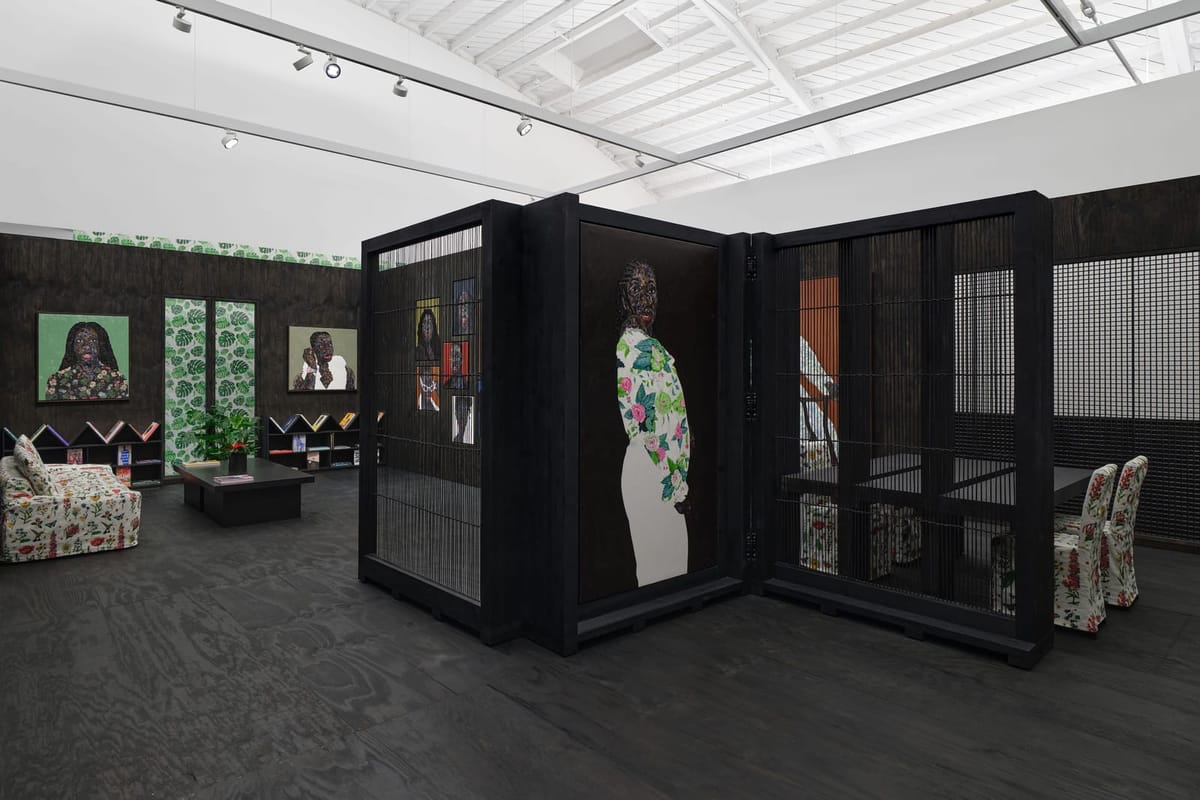
1 month agoAmoako Boafo Weaves His Portraiture into an Architectural Replica of His Accra Studio
Although this truism is typically offered as a negative, it can also be read as a positive that provides comfort and stability amid new environments. In I Bring Home with Me, Ghanaian artist Amoako Boafo recreates his Accra studio in an architectural reproduction within Roberts Projects ' Los Angeles gallery. Boafo is known for his stylized portraiture of Black people, whose skin the artist renders in swirling gestures made with his fingers.
Arts
fromThe Mercury News
1 month agoSan Jose artist brings wind, light to bear in her paintings
Artist Ayelet Gal-On does not just paint; she builds, layering oil, acrylic and plaster on canvas. Gal-On's signature subjects for "Taken by the Wind, Swept by the Light," her upcoming solo exhibition at Gallery 9 in Los Altos, are white dresses that appear to hang on a line, defying the stillness of the canvas. "I love the process of playing with color," says the artist.
Arts
fromHyperallergic
2 months agoMitchell Johnson: Two San Francisco Exhibitions of Large-Scale Paintings
"Color, color relationships, pattern and form are the hallmarks of Mitchell Johnson's achievement. Contemplating the growth and movement of his efforts over the years, we experience his intent, instinct and intuition. We become aware of his affinities with Morandi and Albers, and with Bonnard, Vuillard and Fairfield Porter. Johnson has remarked that he tries to "combine Morandi's feeling for composition with Albers' intelligence about color." And he exhibits an inspirational and perhaps emotional relationship with the work of Fairfield Porter."
Arts
Arts
fromdesignyoutrust.com
2 months agoMike Mitchell Captures Pop Icons In Wholesome Absurdity and Colourpop Minimalism
A wide-ranging showcase of contemporary and historical visual art highlights diverse mediums, techniques, emotional themes, and cultural commentary from posters to sculptures and digital works
fromHyperallergic
2 months agoNo One Was "Picasso's Woman"
As an editor, you learn to pay attention to the nuances of language. How we phrase something can speak volumes about our perspectives. Some words are fine in one context, but in another they might be detrimental. "Victim" is an example - who wants "victimhood" to encompass their whole person? And possessives are a minefield of power relationships; for instance, a person experiencing mistreatment at the hands of a partner should be defined by neither the treatment nor the tormenter
Arts
[ Load more ]