#palestinian-childhood
#palestinian-childhood
[ follow ]
#gaza #displacement #lebanon #conflict #humanitarian-crisis #resilience #mental-health #eid-al-fitr #identity


#identity

fromSilicon Canals
9 hours agoMental health
There's a specific kind of grief that belongs to people who outgrew their hometown but never fully arrived anywhere else. They're not homesick for the place. They're homesick for the version of themselves that didn't yet know the place was too small. - Silicon Canals
fromSilicon Canals
23 hours agoPsychology
Psychology says people who feel like they've been living someone else's life aren't confused or ungrateful - they're often the ones who were so good at adapting in childhood that they never stopped adapting long enough to find out who they actually were - Silicon Canals
Mental health
fromSilicon Canals
9 hours agoThere's a specific kind of grief that belongs to people who outgrew their hometown but never fully arrived anywhere else. They're not homesick for the place. They're homesick for the version of themselves that didn't yet know the place was too small. - Silicon Canals
Returning to one's hometown reveals a paradox of searching for a lost self rather than a changed place.
Psychology
fromSilicon Canals
23 hours agoPsychology says people who feel like they've been living someone else's life aren't confused or ungrateful - they're often the ones who were so good at adapting in childhood that they never stopped adapting long enough to find out who they actually were - Silicon Canals
Adapting to others' needs in childhood can lead to feeling disconnected and lost in adulthood.


Psychology
fromSilicon Canals
1 day agoPsychology says people who grew up poor and became successful often can't fully enjoy it - not because they're ungrateful, but because some part of them never stopped waiting for it to disappear - Silicon Canals
Successful individuals often struggle with feelings of scarcity and anxiety about their financial stability, despite their achievements.
Parenting
fromSilicon Canals
1 day agoChildren raised in the 1960s and 70s developed their resilience the same way muscle develops under resistance - not by being protected from the load but by being required to carry it, repeatedly, without assistance, until the carrying became the unremarkable default rather than the exceptional achievement - Silicon Canals
Independence and resilience were fostered in children of the '60s and '70s through unstructured play and learning from failure.
Relationships
fromSilicon Canals
1 day agoThe most painful version of not belonging isn't being rejected by strangers. It's sitting at your own family's dinner table, surrounded by people who share your last name, and feeling like you're watching the evening through glass. - Silicon Canals
Belonging can exist alongside profound loneliness, where one feels unseen even in the presence of family and friends.
#emotional-health
Retirement
fromSilicon Canals
3 days agoI'm 66 and I spent forty years trying to stay positive through everything - and what I actually created was a life where nobody knew me well enough to notice when I was drowning - Silicon Canals
Staying positive can lead to hidden struggles and emotional isolation, as individuals often mask their true feelings to appear strong.
Mental health
fromSilicon Canals
3 days agoI grew up in the 1970s and the closest thing I had to therapy was my uncle telling me to 'walk it off' after I broke my collarbone - and that phrase became my entire emotional philosophy for the next fifty years - Silicon Canals
Some emotional wounds cannot be healed by simply ignoring them; they require acknowledgment and processing.
Relationships
fromSilicon Canals
3 days agoMost people don't realize that children who grow up without affection don't struggle with love as adults. They struggle with trusting it, because it never felt safe to depend on - Silicon Canals
Emotional unavailability stems from a lack of early affection, leading to difficulties in accepting love despite an inherent capacity for it.
Psychology
fromSilicon Canals
1 day agoYou can tell someone had a tough childhood if they apologize for taking up space - not in the dramatic way, but in the small daily way, the sorry before the question, the thank you after the ordinary kindness, the slight surprise every time someone is simply decent to them, as though decency was never something they learned to expect - Silicon Canals
Some individuals habitually apologize, reflecting deeper issues of self-worth and the learned behavior of minimizing their presence in social situations.

fromwww.aljazeera.com
2 days agoChildren's hospital in Tehran keeps hopes and smiles alive during war
Resident doctors and interns at the Children's Medical Center have been pooling their own money with some donations to organise activities for the children suffering from underlying health conditions.
NYC parents
Psychology
fromSilicon Canals
2 days agoPsychology says people who apologize constantly without realizing it are more damaged than they appear - because they internalize blame and absorb conflict, a survival response from childhood, which never switches off even when they're safe - Silicon Canals
Excessive apologizing often stems from childhood experiences of mistreatment and can lead to chronic self-blame in adulthood.
fromHyperallergic
1 week agoLebanese Artist Ali Sbeity Reportedly Killed in Israeli Strike
Ali Sbeity painted vibrant portraits and landscapes of his rural hometown in Southern Lebanon, often sharing his works on his Facebook. He participated in numerous local arts exhibitions and created murals for schools in Beirut.
Arts
Psychology
fromSilicon Canals
4 days agoPeople who grew up calculating whether they could afford both the drink and the entree before anyone else sat down don't stop doing that math when they earn six figures. The arithmetic isn't financial anymore. It's a loyalty ritual to a younger version of themselves who promised never to be caught without an exit. - Silicon Canals
Child poverty in the U.S. leads to adult poverty more than in Denmark, Germany, the UK, or Australia, with lasting effects beyond financial circumstances.
Berlin food
fromwww.aljazeera.com
2 weeks agoBaking in rubble: Gaza woman keeps Eid traditions alive despite shortages
Gazans persist in baking traditional Eid cookies despite border closures, ingredient shortages, and lack of cooking gas, maintaining cultural traditions while generating income for families.
fromThe Art Newspaper - International art news and events
1 week agoTextiles weave tales of Palestine's rich but troubled history
Textiles are a window into the communities that created them, with every motif and line signalling a different memory, tradition or identity. Often seen as folk art, these pieces of embroidery and weaving bring together dozens of narrative threads, from Japan to South America. But nowhere is it more fraught with meaning than in Palestine.
Arts
Psychology
fromSilicon Canals
4 days agoThere's a particular kind of strength that belongs to people who rebuilt their entire personality after 40 - not because something broke them, but because they finally had enough distance from their childhood to see what was never theirs to carry - Silicon Canals
Personality changes after forty often reflect a deeper honesty about one's true self rather than a crisis or breakdown.
Psychology
fromSilicon Canals
6 days agoPeople who always laugh at their own pain aren't just funny. They survived childhoods where being sad meant being a burden, and that had nothing to do with resilience, and their humor is a dissociation technique that everyone mistakes for strength - Silicon Canals
Some individuals cope with pain by making jokes immediately, masking deeper emotional struggles rooted in childhood environments that discourage expressing feelings.
fromHyperallergic
2 weeks agoWhen a Palestinian Artist Asserts Her Own Humanity
There is a scene in "Morgenkreis | Morning Circle" (2025), a 16-mm film by Berlin-based Palestinian artist Basma al-Sharif, that unfolds at the threshold of a daycare center. A young boy clings to his father, his fists locked into the fabric of his coat, his arms wrapped tightly around him. The father gently tries to pry himself free while a daycare worker crouches nearby, attempting to distract the child and coax him inside. It is an ordinary moment, one that anyone who has ever been a child - or cared for one - recognizes instantly, as well as the gut-wrenching feeling it provokes.
Arts
fromwww.theguardian.com
1 month agoAny other child would have died': the miraculous survival of Nada Itrab
The daughter of undocumented immigrants from Morocco, Nada had lived there since she was four. Only one other person was travelling with Nada. Grover Morales was a neighbour with a saintly air. In La Florida, the poor neighbourhood in which he and Nada's family lived, Morales made a point of greeting everyone, regardless of race or faith. He read religious books, not just the Christian Bible, but also the Torah and the Qur'an.
Miscellaneous
Berlin food
fromTruthout
3 weeks agoRamadan Revolved Around My Grandma. Bombs Took Her House. Famine Took Her Life.
A Palestinian family's Ramadan traditions centered on their grandmother are forever altered after her death during famine conditions in Gaza, leaving an irreplaceable absence in their annual observance.
fromTruthout
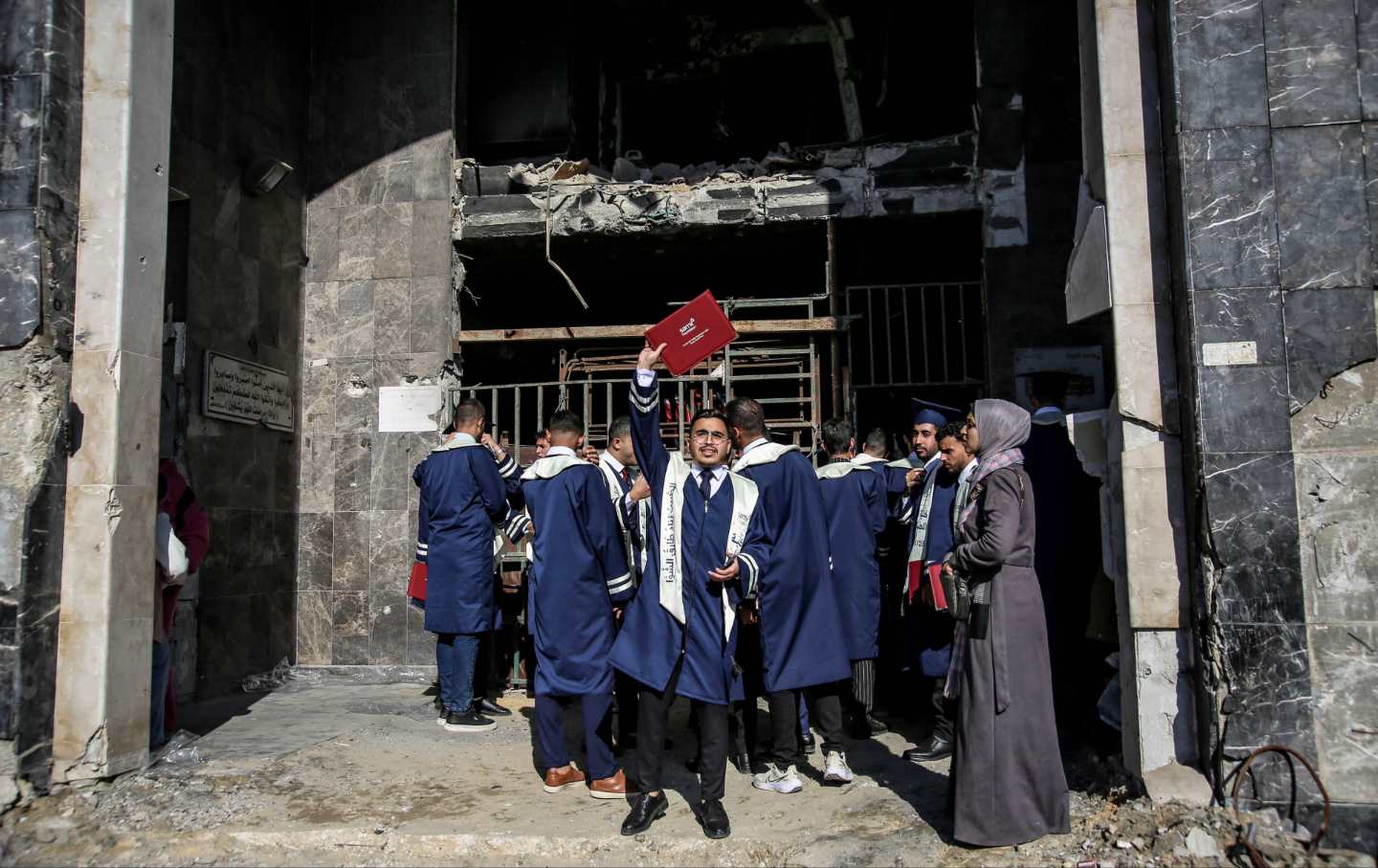
1 month agoFor Gaza's Students, International Scholarships Offer Both Hope and Heartbreak
Since September 30, 2025, the Italian government has undertaken a major operation to offer a future for Gaza's students. While evacuation to Italy was previously available to Palestinians only for medical treatment and family reunification, the Italian government has now taken the unprecedented step of opening the nation's universities under the Italian Universities for Palestinian Students project, allowing Gazan students to pursue their studies abroad away from the war.
Left-wing politics
World politics
fromwww.theguardian.com
1 month agoSeven of my relatives were killed in Gaza. For me, Herzog's visit was never an abstract debate | Shamikh Badra
Australian state prioritized conferring legitimacy on a leader accused of incitement while suppressing peaceful protest and failing to address genocide-related legal obligations.


fromHyperallergic
2 months agoMs. Rachel Sells Artworks by Children From Gaza
In her latest effort to raise funds for Palestinian children, Rachel Accurso, the early childhood educator and YouTuber best known as Ms. Rachel, will present an exhibition and sale of artworks by children from Gaza in New York City this week. Accurso, whose joyful educational videos have surpassed as many as one billion views, has vocally opposed Israel's genocide in Gaza, and particularly the killing of children, on her popular social media platforms, drawing significant right-wing backlash and harassment.
Arts
fromwww.aljazeera.com
1 month agoGaza mother's grim ordeal: A search for missing son among mutilated bodies
With exhausted steps and eyes filled with tears, Hanaa al-Mabhuh moves between the hall displaying photographs of bodies and the morgue at al-Shifa Hospital in a grim search for any trace of her missing son. The 56-year-old mother wipes away tears with the back of her hand and stares at the decomposed faces on the screen, torn between the desire to find out what happened to her youngest child, while at the same time fearing he might be among the dead handed over by Israel under a US-brokered ceasefire deal.
World news
fromwww.aljazeera.com
2 months agoGaza is not a real estate fantasy
But urgency should never become an excuse for illusion, spectacle, or political shortcuts. The contrast between rhetoric and reality could not be sharper. While United States President Donald Trump and a group of world leaders gathered in Davos, Switzerland, to sign the charter of the so-called Board of Peace and unveil glossy reconstruction plans, the killing in Gaza continued. Since the ceasefire came into effect on October 10, no fewer than 480 Palestinians have been killed.
World news
[ Load more ]