#parker-mushinski
#parker-mushinski
[ follow ]
#contemporary-art #art #art-exhibitions #art-exhibition #art-market #architecture #exhibition #nature #new-york-city
fromHi-Fructose Magazine - The New Contemporary Art Magazine
1 day agoKyle Cobban Draws From The Unknown - Hi-Fructose Magazine
"It's an amalgamation of the Chicago neighborhood aesthetic with a Bulls fan, quite literally. It's kind of on the nose, but that's how I juxtapose the elements of my work, with the structure of a home and then a figure who is around or in the home."
Chicago Bulls
Renovation
fromdesignboom | architecture & design magazine
5 days agopaul rudolph's historical walker guest house returns in exhibition curated by A$AP rocky
The Walker Guest House, designed by Paul Rudolph, is showcased in Los Angeles with original and modern design elements, highlighting its significance in American modernism.
fromThe Art Newspaper - International art news and events
1 week agoMatisse's explosive finale and a new chapter for Hong Kong? Plus, Schiaparelli and Dali-podcast
The Grand Palais in Paris unveiled an enormous exhibition focusing on the final 13 years of Henri Matisse's life and work, featuring abundant examples of his celebrated gouache cut-outs.
Paris food


Arts
fromThe Art Newspaper - International art news and events
2 days agoPaul Pfeiffer will be inaugural artist-in-residence at Brooklyn's Barclays Center arena
Paul Pfeiffer will be the inaugural artist-in-residence at Barclays Center, focusing on media workshops for those affected by the criminal-justice system.
#museum-expansion
Brooklyn
fromThe Art Newspaper - International art news and events
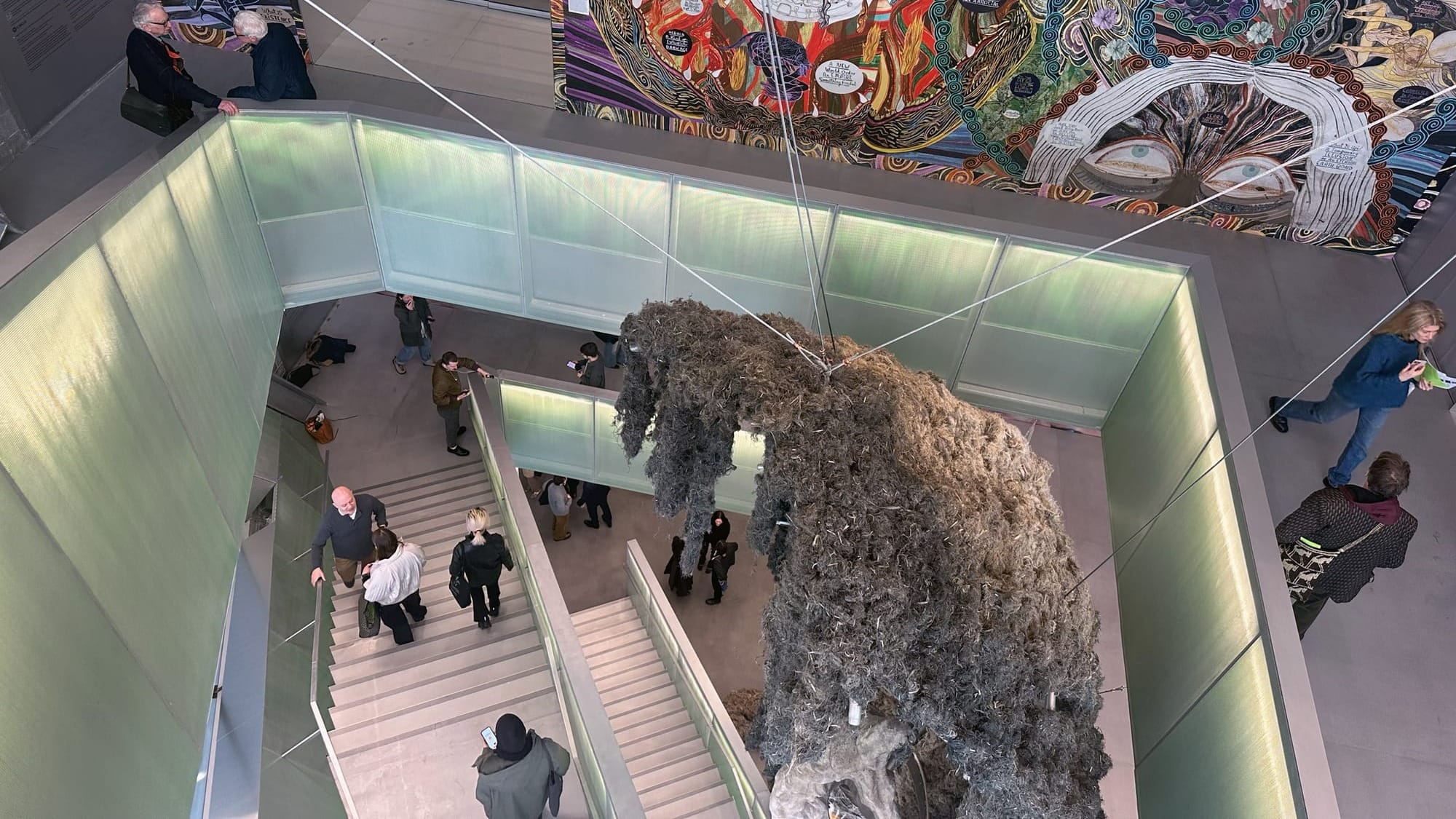
2 weeks agoThe new New Museum: now with twice the space
New York's New Museum opens an $82 million expansion on March 21, doubling its footprint to 120,000 sq. ft with new galleries, artist studios, and public spaces designed by OMA and Cooper Robertson.
Brooklyn
fromThe Art Newspaper - International art news and events
2 weeks agoThe new New Museum: now with twice the space
New York's New Museum opens an $82 million expansion on March 21, doubling its footprint to 120,000 sq. ft with new galleries, artist studios, and public spaces designed by OMA and Cooper Robertson.
#art


Arts
fromIrish Independent
3 days ago'You have to step in and experience it' - artists on the rise of AI-generated art and the 'essential' gallery visit
Miriam Fitzgerald Juskova's exhibit combines paper quilling with mathematics, showcasing intricate art that engages viewers and emphasizes the value of handmade creations.
fromHyperallergic
2 days agoThe Art World Is a Joke
Kamrooz Aram is everywhere this year, from Mumbai Art Week to the Whitney Biennial, and critic Aruna D'Souza is grateful. She pens a beautiful meditation on his work, reading his abstract paintings as not simply a denunciation of Western modernism nor a reassertion of Islamic visual motifs, but something else entirely - something gestural, exuberant, riotous, and incomparably his own.
Arts
fromJuxtapoz
4 days agoJuxtapoz Magazine - Last Days to See Kate Meissner's New Paintings @ Lyles & King's Project Space, NYC
"These works are an exploration of the human body's elasticity and capacity to metamorphose. Informed by my own experience of pregnancy and the birth of my first child last year, these paintings are a meditation on physiological transformation and the body's underlying animalistic and mammalian nature."
Arts
fromwww.scientificamerican.com
1 month agoHow a poet uses AI to write and why her work is now at MoMA
Poetry and artificial intelligence can appear as oppositesone deeply human; the other cold and mechanical. Sasha Stiles sees them as expressions of the same impulse. Poetry, the Kalmyk- American poet argues, is one of our most ancient and enduring technologies, a system of meter and rhyme invented to store vital information. She views AI as its natural heir. Stiles's path to AI began with literature, not code.
Artificial intelligence
fromArtnet News
2 days agoAt Art Basel Hong Kong, Wet Paint Hits Galleries, Malls, a Semi-Secret Space, and More | Artnet News
Hong Kong's particular and seductive Metabolist city planning is an ode to consumption as a great totalizer of culture, and to contemporary art as merely a niche commodity form among many others.
Arts

Design
fromThe Art Newspaper - International art news and events
1 month agoHow an artist's sketch was turned into a museum
A museum design translates a blue-house and white-tower sketch into a tiled architectural language reflecting regional materials, cultural markers, and historic South–West Asian trade links.

fromHyperallergic
2 weeks agoWhat Do We Really Think of the New New Museum?
The new New Museum is many things: contemporary, perhaps, but also a science, history, anthropology, and many other museums in one. It echoes the desire of its patron class to own the world and its affiliated courtier class to deliver it to them on a silver platter, or encased in perforated metal, in this case.
Arts
Arts
fromwww.amny.com
2 weeks agoA Living Canvas: Adrian K and the alchemy of art, appetite, and atmosphere at Pinky Swear | amNewYork
Adrian K's three-month residency at Pinky Swear merges art with social participation, using reclaimed materials to create work that balances ethereal beauty with urgent activism and circular economy principles.
Arts
fromArtnet News
3 weeks agoBlink and You'll Miss It! 3 New York Shows With Painfully Short Runs | Artnet News
Gallery exhibition runs have lengthened from weeks to five or six weeks due to increased competition and high mounting costs, though a countermovement of brief, limited-time shows is emerging.
fromHyperallergic
3 weeks agoEmbracing Friction in the Art World
On Franklin Street in Brooklyn's Greenpoint neighborhood, one non-commercial gallery fosters 'a small, stubbornly human space for friction.' Friction—the ubiquitous buzzword that captures the simultaneous delight and discomfort of doing things the slow way—is at the heart of artists Pap Souleye Fall and Char Jeré's current show at Subtitled NYC. It also reflects the overall spirit of this little exhibition space and of a burgeoning movement to reject our culture of optimization in favor of a bumpier, more intimate, less alienating experience.
Arts
fromHyperallergic
3 weeks agoArt Problems: How Do I Get Gallery Representation?
Dealers like artists with established sales records because it lowers their already considerable financial exposure. Renting a gallery space in Tribeca costs anywhere between $8,000-30,000 a month on top of staff, marketing, and daily operations. With that kind of overhead, very few business owners can afford to take on the financial risk of untested artists.
Arts
Arts
fromJuxtapoz
3 weeks agoJuxtapoz Magazine - Let Us Gather in a Flourishing Way @ Buffalo AKG Art Museum
Fifty-eight contemporary Latinx artists innovate within painting traditions, challenging historical exclusion and interrogating boundaries while celebrating personal, culturally specific expressions that enrich American and contemporary art.
Arts
fromThe Art Newspaper - International art news and events
1 month agoA new home for Asian contemporary art opens in landmarked building in Manhattan's Chinatown
Wang Contemporary opens at 58 Bowery as a global platform for Asian and Asian American creativity, inaugurating with MSCHF's paper plane installation during Lunar New Year.
fromJuxtapoz
2 months agoJuxtapoz Magazine - Misfits: Daniel Nunez Explores a New Freedom @ GR Gallery, New York
"The four large-scale canvases that constitute the core of ' Misfits' maintain the fundamental elements of the artist's visual lexicon while radically reconfiguring compositional structure and spatial organization. These works advance a design freedom that is simultaneously forceful and controlled, achieving a balance between expressive intensity and formal restraint. As such, the series marks a decisive moment in Nuñez artistic evolution and possibly an initial step toward a more profound and transformative reorientation of his practice."
Arts
fromHyperallergic
1 month agoThese Are the Artists in MoMA PS1's Greater New York Show
Taking over the museum's transformed school building starting April 16, the cross-borough survey will celebrate MoMA PS1's 50th anniversary with a bevy of site-specific installations, new commissions, and rarely seen work by 53 artists and collectives living and working across New York City. A complete list of participants is included at the end of this article. This year, Greater New York will coincide with the Whitney Biennial for the first time in the show's history.
Arts
fromHyperallergic
2 months agoA View From the Easel
Mornings are best for concentrated work. In the winter, I turn on the heat at 8am and get started around 10am. Summer, I start around 9am. I have two areas in the studio for projects. The large, heavy wood sculptures are carved in the front section of the studio, closest to the roll-up wide door. Smaller sculptures are placed on a hydraulic workbench. Before I start, I focus, connect with the Source, and ask for guidance.
Arts
fromHyperallergic
1 month agoA View From the Easel
I work outside, carving and shaping the stone. Outside my house, I have a table, an extension cord, and tools. It's very cold and I have to wear all my winter clothes. When it's too cold, I do the filing and finishing work inside after I shape it outside. I listen to all kinds of music. I listen to Eminem all the time; his albums are all my favorites. For drawings, I work at Kinngait Studios or at home on my kitchen table.
Arts
Arts
fromThe Art Newspaper - International art news and events
2 months agoNew experimental art organisation opens in New York
Summer Guthery and Francesca Sonara launch Times, a small, nimble three-year Manhattan art space prioritizing artists' needs, flexibility, and rejection of perpetual-growth institutional models.
[ Load more ]