#portable-handheld
#portable-handheld
[ follow ]
#technology #remote-work #mobile-gaming #smartphones #productivity #apple #samsung #innovation #user-experience


Digital life
fromSilicon Canals
2 days agoPeople who check their phone within five minutes of waking up are training their brain to start every day in reaction mode - and it's costing them more than they realize - Silicon Canals
Starting the day with phone use can negatively impact mental state and set a stressful tone for the day.
Psychology
fromSilicon Canals
4 days agoPsychology suggests if you still write things down on paper instead of your phone you aren't resisting progress - you've found something that works and are practicing the increasingly rare skill of not replacing it simply because something newer arrived, and that skill, applied consistently, turns out to predict a surprising number of other things about how you make decisions - Silicon Canals
Handwriting enhances cognitive engagement and memory retention compared to typing, leading to better decision-making and creativity.
UX design
fromYanko Design - Modern Industrial Design News
4 days ago8 Best Desk Gadgets Every Digital Nomad Quietly Keeps in Their Bag & Finally Deserves a Permanent Home - Yanko Design
Digital nomads curate essential tools that transition from travel to a permanent workspace, enhancing both functionality and personal connection.

Psychology
fromSilicon Canals
1 week agoThe real technology problem isn't screen time. It's that your phone learned your emotional patterns faster than any person in your life ever did, and now it meets needs that no human relationship has been given the chance to meet. - Silicon Canals
Phones have become the most emotionally attuned presence in people's lives, affecting their relationships with others.

Typography
fromdesignboom | architecture & design magazine
3 weeks agowireless gaming controllers for pre-teens grip around hands with sea horse-inspired ridges
LEVION wireless gaming controller thumbstick caps feature a seahorse-inspired ridged design optimized for pre-teens aged 9-12, with curved ergonomic shaping and horizontal ridges for comfortable extended gameplay.
fromYanko Design - Modern Industrial Design News
6 days agoCRKD's $30 ATOM+ Is a Pocket Gamepad That Finally Solved Stick Drift - Yanko Design
The TMR, or Tunnel Magnetoresistance, thumbsticks are arguably the ATOM+'s most significant selling point. Unlike traditional analog sticks that use physical contact points that wear down with use, TMR technology relies on magnetic sensors to read input, which means accuracy doesn't degrade over time.
Gadgets
fromdesignboom | architecture & design magazine
5 days agobody agency and the ways wearable devices let people regain control of their physical forms
Body agency is a power returned after an incident took it away from the user's physical form, and some wearable devices and technologies have this exact goal in mind.
Wearables
fromYanko Design - Modern Industrial Design News
1 week agoSony's Latest PlayStation Patent Turns a DualSense and Your Phone Into One Gaming Controller - Yanko Design
Sony's new filing describes a smartphone mounted directly onto a DualSense controller, with the phone functioning as a live secondary input device. Its touchscreen, motion sensors, and hardware would all be available to developers as genuine control surfaces, feeding into the game in real time rather than simply mirroring it.
Gadgets
Wearables
fromThe Verge
3 weeks agoBackbone's versatile pro controller is nearly matching its best price to date
The Backbone Pro mobile controller offers dedicated gaming hardware with full-sized controls, extended battery life, and unified software for accessing games across multiple platforms at a discounted price of $139.99.
Gadgets
fromYanko Design - Modern Industrial Design News
2 weeks ago$73 Lenovo Gamepad Turns the Legion Y700 Into a Switch Lite Rival - Yanko Design
Lenovo's Legion Gamepad G9 2026 is a dedicated accessory for the Legion Y700 Gen 5 tablet, featuring an 8-direction D-pad, macro buttons, and wired USB-C connection to eliminate latency.
fromYanko Design - Modern Industrial Design News
2 weeks agoThis Wireless Mouse Splits in Half to Reveal a Hidden Game Controller - Yanko Design
The Phase is a wireless mouse that splits into two independent halves, functioning as a traditional mouse when connected and transforming into a split gamepad when separated.
fromYanko Design - Modern Industrial Design News
3 weeks agoThis seahorse-inspired game controller concept is made for smaller hands - Yanko Design
Game controllers have not changed much in shape since the mid-1990s. They're still two-handed symmetrical slabs built around adult grip dimensions, loaded with enough buttons to pilot a small aircraft. For a 10-year-old just getting into gaming, picking one up for the first time is a bit like being handed a TV remote and told to perform surgery, no sweat.
Gadgets
Gadgets
fromYanko Design - Modern Industrial Design News
4 weeks agoThis Square Phone Rotates Open to a BlackBerry or Game Boy Setup - Yanko Design
The iFrog RS1 is a modular square phone with a rotating base that transforms into either a physical keyboard or gamepad, designed as a customizable platform for carriers and brands rather than a finished retail product.
Gadgets
fromYanko Design - Modern Industrial Design News
1 month agoLenovo Unveils a Foldable Gaming Handheld That Replaces Your Laptop - Yanko Design
Lenovo's Legion Go Fold Concept addresses the travel dilemma of carrying multiple devices by combining a foldable handheld gaming device with laptop functionality through a flexible display and detachable controllers.
Gadgets
fromEngadget
1 month agoThe Lenovo Legion Go Fold gaming handheld concept looks awkward but its versatility is endless
Lenovo's Legion Go Fold concept device uses a flexible OLED display that bends to 7.7 inches for portability or extends to 11.6 inches for immersive gaming, with detachable controllers enabling multiple usage modes.
fromThe Verge
1 month agoYour next laptop could be a foldable phone
For almost as long as phones have been around, people have wanted those phones to also be laptops. It seems so simple: Your phone has plenty of computing power, access to all your apps and data, an always-on connection. The only problem? Your phone's screen is too small for many tasks, and so is its keyboard. Or at least, they were, until foldable phones made it possible to carry a truly gigantic screen in your pocket. Now all bets are off.
Gadgets
Gadgets
fromEngadget
2 months agoCES 2026: Hyperkin and Gamesir made a modular game controller for your smartphone, tablet and even your Switch
A fully modular mobile controller lets users swap sticks, D-pads, and buttons, fits phones, Switch and iPad, and offers Bluetooth, rumble, and customizable layouts.
fromYanko Design - Modern Industrial Design News
2 months agoGameSir x Hyperkin modular controller could be the endgame accessory for mobile gamers - Yanko Design
The X5 Alteron controller gets the best of both worlds: GameSir's ergonomic engineering that makes it the first choice for gamers, and Hyperkin's knack for designing retro controllers. What sets the modular controller apart is the swappable module system that allows gamers to completely change the layout from symmetrical to asymmetrical thumbsticks, to changing the D-pad and face buttons. Designer: GameSir and Hyperkin
Gadgets


fromYanko Design - Modern Industrial Design News
2 months agoMorphable Shows How a Game Controller Could Adjust to Your Hands - Yanko Design
Settling in for "just one more run" usually means your thumbs, wrists, or forearms start complaining long before the game is done. Most controllers are fixed objects that expect your body to adapt, which can lead to repetitive strain or numbness. You either push through the discomfort or take breaks that feel like interruptions, but rarely can you adjust the hardware itself to match how your hands actually feel in that moment.
Gadgets
fromKotaku
2 months agoNew Anbernic Smart Controller Contains Heartbeat Sensor
The RG GO1, which doesn't have a price or specific release date yet, features a 2.5-inch IPS LCD screen in the center of the controller. This can be used for various tasks, including reprogramming buttons and turning on rapid fire settings. The just-revealed controller also includes heartbeat sensors in the grips. Why? Anbernic says it will let you "monitor your well-being during intense sessions."
Gadgets
fromYanko Design - Modern Industrial Design News
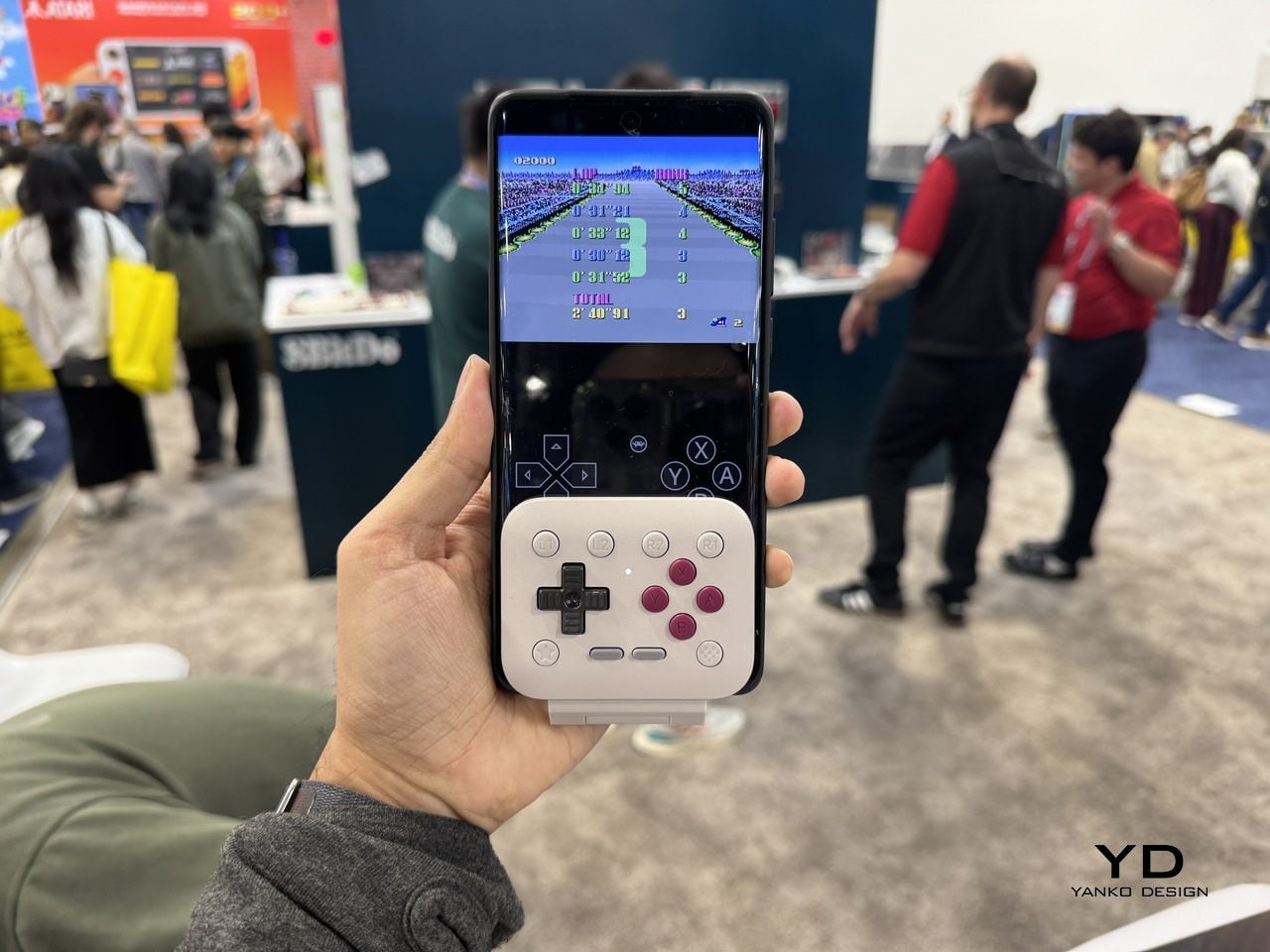
2 months agoMCON Slim Hands-on at CES 2026: The UltraThin MagSafe Controller That Turns Your iPhone Into a Gaming Console - Yanko Design
Designed by 21 year-old Josh King, the MCON Slim is clearly his magnum opus. The youngster (incubated by Dale Backus' Ohsnap) mentioned how the smartphone was such a powerful device, but all we ever use it for is doomscrolling and emails. The MCON was supposed to prove to the world that the smartphone can be an incredible handheld gaming device, comparable to the Razer Switchblade or even dare I say the Nintendo Switch.
Gadgets
[ Load more ]