History
fromMail Online
2 days agoArtefact found in 'cradle of Christianity' rewrites history of baptism
A rare marble artefact discovered in Hippos may change the understanding of early Christian baptism practices involving three anointing oils.
Similar to four others unearthed nearby earlier this month, it is sitting upright at the bottom of a one-metre-wide pit. The skeleton's hands are resting in its lap. Like the others, its back is against the eastern wall, its face directed westward.
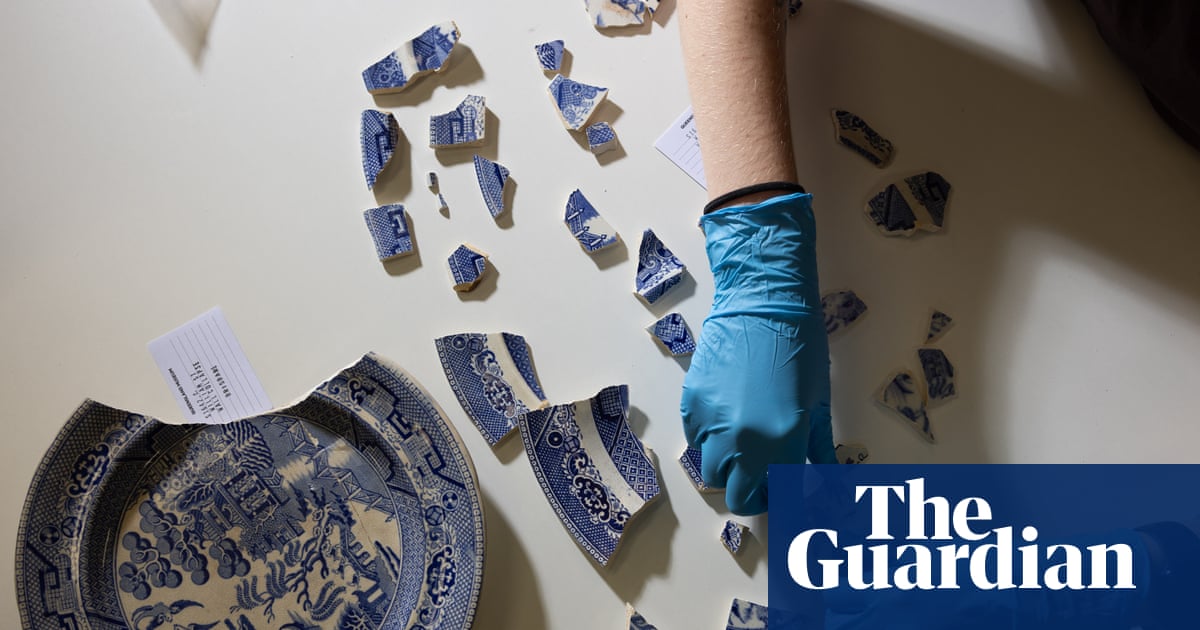
The significant number of ancestors held in UK museums is extremely distressing and symbolic of the colonial origins of these collections. We hope that the responses gathered by The Guardian will be shared with the relevant communities to support them in bringing their ancestors home.
The two socketed axes were discovered last year by a metal detectorist who recognized that their careful positioning could not have been a natural process. He reported the find to the Westphalia-Lippe Regional Association (LWL). The subsequent excavation of the find site revealed a far more complex depositional context. Beneath the axes is a pit carved into the rock.
This short captures Tim Bovard, the staff taxidermist for the Natural History Museum of Los Angeles County, as he reflects on over five decades spent perfecting his craft. Sparked by a childhood fascination with the museum's dioramas that never faded, Bovard has devoted his career to shaping what he calls the 'illusion of life' - a process that requires both scientific precision and imaginative interpretation.
When you reach a certain age, one of the things you notice at the turn of the year is the "stuff" you have accumulated. Old newspapers, documents and books jostle with the detritus of life, from pieces of dead coral from Barbados to an old label that never made it onto a bottle of Guinness. I have spent the last decade preaching to my adult children, telling them to stop buying things.
When Thomas Jefferson wrote about the "inalienable" rights of man in the US Declaration of Independence 250 years ago, it's possible he lifted the term from the French. And long before it was ever used as an adjective to describe human rights, it defined royal property. To this day, "inalienability" remains a cornerstone of public collections in France-and many other countries-impacting museums and their ability to deaccession, including for purposes of restitution.
The traditional museum experience, pausing in front of an object, and absorbing its history visually or by reading its description, has long shaped how collectors and others relate to cultural treasures. Yet, over the last few decades, digital technology has quietly rewritten many of those rules, changing not only how collections are exhibited but also how they are documented, preserved, and even inherited.
An extraordinary archaeological discovery in eastern Germany has reunited a medieval bronze cross with the mould used to cast it-more than four decades after the mould itself was found. The object, a so-called wheel cross dating to the 10th or 11th century, offers rare and tangible evidence of early Christianisation among the Slavic populations of the region between the Elbe and Oder rivers.
When universities began to emerge in Europe during the eleventh and twelfth centuries, they soon became important centres of knowledge. Their libraries could hold hundreds of books, and many of the most valuable volumes were kept under close control - sometimes even chained to desks. We have few details about how medieval university libraries operated, but a revealing set of rubric headings survives from the University of Angers in western France.
Two exceptionally rare and beautifully carved Mithraic altars found in Inveresk, East Lothian, Scotland, are going on display for the first time. They are not just the only Roman altars ever found in Scotland, but are among the finest examples of Roman sculpture in Roman Britain. They are also uniquely early in date, having been made in 140s A.D. during Antoninus Pius' reoccupation of southern Scotland, whereas most other archaeological materials related to the worship of Mithras in Britannia date to the 3rd century.