Graphic design
fromThe Verge
7 hours agoReally, you made this without AI? Prove it
Labeling human-made content is essential as AI-generated works proliferate, creating confusion and skepticism among audiences.
Elisava's Master's in Graphic Design is ingrained with societal, cultural and critical contributions to the creative industry, going beyond its aesthetic output while fostering self-awareness in creatives.
ROOM FOR DREAMS becomes a living manifesto for utopian optimism, creative courage, and the power of imagination through a multilayered approach where large scale installations, cinematic storytelling, live conversations, and ritual-driven encounters converge.
"Nostalgia is my favorite feeling," said Madison Feely '26, who referenced childhood classics including "Where the Wild Things Are" and "Little Women" in her collection, "Homebody." She emphasized that her designs celebrate a well-lived childhood, honoring the authors and illustrators who allow her to relive it each time she opens their books.
The question of how fashion is archived - what enters the museum; what is deemed worthy of preservation; whose clothes are considered culturally significant enough to outlast the bodies that wore them - has long sat uneasily at the centre of fashion history itself. Institutions have tended to answer it, or ignore it, in much the same way: couture gowns under glass, luxury garments mounted on conservation-grade mannequins in blockbuster exhibitions - an implicit hierarchy of the designed over the worn, the authored over the anonymous.
The ridges of eucalyptus bark, the geometries of shell formations, moss-covered trees, Indigenous grasslands and the hidden networks of fungi beneath the soil. These landscapes produce organic yet abstract patterns - natural systems that quietly shape the way we see and design the world around us.
What if I took my design lens and built out my essentials capsule for the Everlane customer? I felt like that would be a really amazing opportunity for me to introduce myself as a designer to an audience outside of EB Denim.
I would listen with awe and think, 'That must have been a real challenge. It must be exquisitely crafted and probably a little bit groundbreaking too.' So it feels slightly absurd to admit that my last typeface, Nave, also took around ten years to complete. Not because I spent a decade polishing outlines or expanding the character set, but because I took so many wrong turns trying to chase a vision I hadn't properly defined.
Suspended within the exhibition space, the piece occupies the room with a soft mass of red and white textiles. Dense embroidery traces arteries and vessels across the surface, while clusters of beads and pearls gather along the contours. Even with this ambitious new scale, it maintains the tactile intimacy of Shin's smaller works.
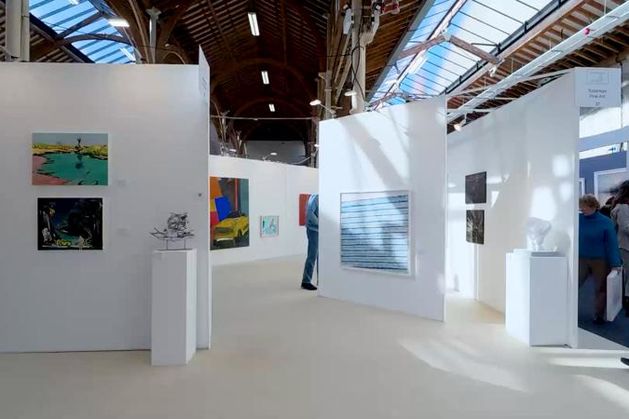
On Franklin Street in Brooklyn's Greenpoint neighborhood, one non-commercial gallery fosters 'a small, stubbornly human space for friction.' Friction—the ubiquitous buzzword that captures the simultaneous delight and discomfort of doing things the slow way—is at the heart of artists Pap Souleye Fall and Char Jeré's current show at Subtitled NYC. It also reflects the overall spirit of this little exhibition space and of a burgeoning movement to reject our culture of optimization in favor of a bumpier, more intimate, less alienating experience.
What we found was that errata sheets were not only spaces for corrections but also sites of humor, legal maneuvering, and reinterpretation. With this exhibition, we wanted to share ways in which even small corrections can reshape meaning and authority.
When you participate in a major tech event, you naturally want to stand out. Print materials can ensure making a professional first impression. In this article we look at how you ensure that your tech company's exhibition stand definitely stands out. Even if you participate in 2026 at the Web Summit in Portugal, the London Tech Week, TechEx Europe in the RAI Amsterdam or FOSDEM in our own country (Brussels). Which HelloPrint print materials are suitable for dressing up a booth?
In the early 19th century, the invention of the loom threatened to turn the labor market upside down. Until then, cloth was made by skilled artisans, but the loom enabled more cloth to be made more quickly by less-skilled workers. One could even argue that the Jacquard loom, a loom that allowed for complex weaving patterns via punch cards, was the first computer.
Sand Art is a game by Kory Jordan and published by 25th Century Games for two to four players ages 10 and up. It takes about an hour to play, and has you collecting resources and then coloring in a bottle, making art in a bottle out of sand, in case the name didn't give away the plot. Gameplay Overview: Sand Art has you gathering and mixing sand, which is used to fill your bottle.
But unlike other versions, this one requires no subscription, lets you swap out the surrounding frame and doesn't require an app to upload the art. Instead, a built-in mic picks up your idea, sends it to OpenAI and creates an image that pops up in a few moments on the screen. The on-board accelerometer even knows whether the device is in landscape or portrait orientation, and applies the correct format.
"We started by asking everyone to collect images regularly. Just spontaneous snapshots as we went. Of everything. Sketches, screens, notes, half thoughts, moments in motion. Over time it became this huge grab bag of elements," Simon says.
In the show, "dirty" extends to anything that breaks fashion's pact with propriety. Here are clothes caked in grime, blotted with makeup, stiffened by salt, pieced from trash, frayed, and faded. The garments span decades, from the 1980s through the mid-2000s, when the likes of Vivienne Westwood and Jean Paul Gaultier built their fame on defying convention, to today, when corporatization has made such daring increasingly rare. But forgoing practicality frees certain designers from the demands that the body be polite-and thereby policed.
You'll get a pre-made faux leather cover to decorate and personalise with a range of buttons, charms, stamps and fabric pieces. You'll learn to experiment with collage and layering techniques and combine different types of embellishments to add texture, colour and personality to your journal.
A graphic designer that isn't limited to working in 2D, Ward Goes has been working in aluminium of late. His recent solo show in Rotterdam, Literally Anything, was full of things that moved beyond the screen or printed page, including some wonderful metal signage and archival storage. The exhibition at Alley Space was the result of the designer's decision to pursue more tactical investigations alongside his commissioned work at the start of 2025.
The collaboration brings together Designtex's deep expertise in high-performance contract textiles and nanimarquina's poetic command of craft, tactility, and the beauty of the imperfect. For both teams, the partnership emerged from an immediate sense of kinship - a shared language of material integrity, color sensitivity, and a respect for heritage techniques reinterpreted for contemporary spaces. "We did that by using performance yarns and intentionally embedding imperfections into the weaving process."
It captures seven different femininities during an all-day pool party, enjoying themselves while revealing their distinctive styles. Creative Direction, Production & Styling by Maria Gkin. Photography by Eliza Poultidou. The models are Vanessa Otilia, Cyka, Alvina Chamberland and Angelica Komninak. The concept examines the thin line between what is seen as acceptable and what has been labelled ugly or immoral, explored through each woman's personal story. Textures, colours, makeup and styling come together, breaking down stereotypes and highlighting fashion as a means of freedom
If you're based in London, you've probably walked past one of Sean Thomas' meticulously hand-painted designs. Whether that was grabbing a sandwich at Dom's Subs, dining in at Forza Win (an Italian restaurant in Peckham that the designer has shaped the visual identity of over the last three years), or picking up a copy of Hoxton Mini Press' new book on Britain's best bakeries at your local bookshop.
Our mission is to bring together the worlds of design, architecture, art, and technology, fostering creative thought and global dialogue. We are driven by a philosophy of 'Utopian Optimism' and a 'What If' mindset, believing in the power of design to shape a better future. We believe that design is not decoration, but transformation. It is how we learn to see, connect, and rise.
I'm a midweight designer looking to step into another job elsewhere but I keep hearing so many conflicting things about portfolio formats and I don't want to have to recreate three versions all on different platforms just to apply for a job. I can't find any solid advice on what agencies are looking to see regarding format and if sending a PDF makes you look dated.
The show features the work of 14 contemporary artists who use the rug as a medium to engage with cultural concerns related to religion, technology, social justice, housing, and the environment. The diverse roster of artists from the United States, Europe, the Middle East, and Asia work across a variety of media, including yarn, cardboard, repurposed carpets, and hair combs, to transform this functional object into a site of experimentation - manipulated, reinterpreted, and made new.
Tattoos and fermentation rarely appear in the same conversation, yet across the world, they share a quiet kinship. Both are practices of transformation, crafts that reshape raw material over time through care and relationships to the land, the spiritual, and the community. Tattooing inscribes identity and ancestry onto skin, while fermentation preserves, nourishes, and binds communities through shared taste and ritual. Both create change, brewing something more than themselves through embodied knowledge passed between generations.