#secret-burial

[ follow ]
Design
fromArchDaily
5 days ago

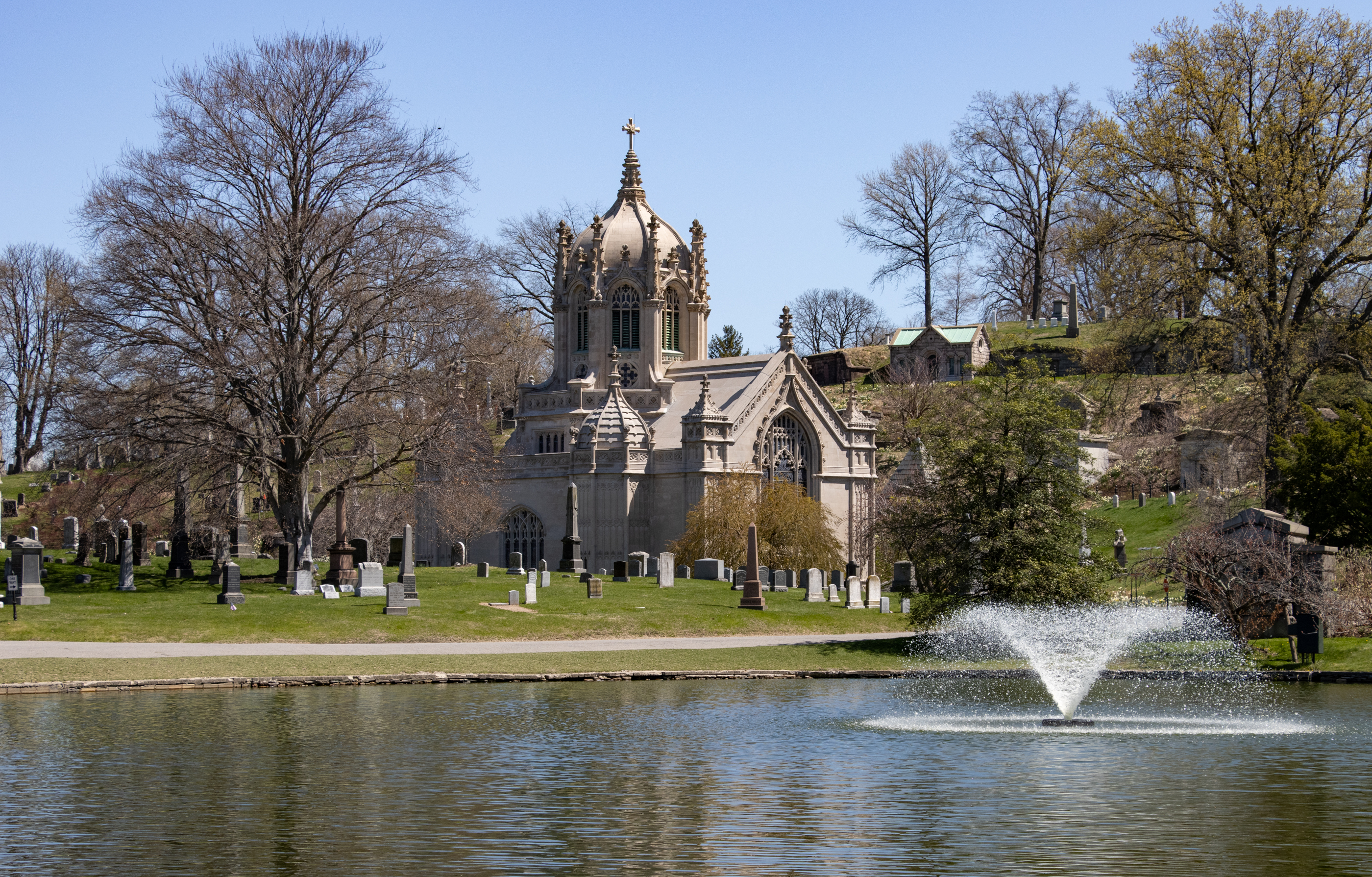
Cities of the Dead: 10 Projects Exploring Burial Architecture

Cemeteries reflect cultural attitudes towards death, embodying social and political significance through their design and organization.
#mass-grave
Roam Research
fromwww.nature.com
1 week ago

Ashes from Pompeii shed light on rituals in ancient Rome

People in Pompeii used incense burners to burn aromatic resins from distant regions like sub-Saharan Africa and India.
fromMail Online
5 days ago

Mystery of 'second Sphinx' deepens as new footage reveals hidden clues

The footage captured by Trevor Grassi shows dozens of square shafts carved into bedrock, many extending deep underground but primarily filled with sand, raising new questions about what may lie beneath the surface.
OMG science
London
fromianVisits
1 week ago

Tickets Alert: Tours of Brompton Cemetery's subterranean catacombs

Visitors can explore the hidden catacombs beneath Brompton Cemetery during guided tours, which occur a few times a year.
#ancient-egypt
fromMedievalists.net
1 week ago

Who Lies in Winchester's Medieval Mortuary Chests? - Medievalists.net

This project demonstrates the combined power of science, the study of human remains and historical research to discover new information about the six mortuary chests and their occupants which would not have been available to us a generation ago.
History
fromThe Local France
2 weeks ago

Mysterious ancient skeletons discovered sitting upright in France

Similar to four others unearthed nearby earlier this month, it is sitting upright at the bottom of a one-metre-wide pit. The skeleton's hands are resting in its lap. Like the others, its back is against the eastern wall, its face directed westward.
France news
London politics
fromwww.theguardian.com
2 weeks ago

Graves in England and Wales could be reused after 100 years

The Law Commission proposes modernizing England and Wales burial laws by allowing grave reuse after 100 years, reopening closed burial grounds, and establishing national standards for the first time in over 170 years.
France news
fromwww.theguardian.com
2 weeks ago

Ancient skeleton discovered sitting upright in France

Archaeologists in Dijon, France discovered multiple Gaulish skeletons buried seated upright facing west around 300-200 BC, raising questions about burial practices and whether individuals were interred alive.
London food
fromIndependent
3 weeks ago

An Irish Goodbye: 'You'd be surprised how often you visit the pyramids when you actually live here'

A creative director from Northern Ireland relocated to Cairo in 2024 after experiencing an immediate emotional connection to the city's unique energy during a visit.
UK news
fromMail Online
4 weeks ago

Death of traditional funeral: Brits ditch burials and cremations

UK residents increasingly choose eco-friendly burial alternatives like green burials, aquamation, artificial reefs, and space burial over traditional casket burials and cremations.
#roman-archaeology
Public health
fromwww.theguardian.com
4 weeks ago

A death scholar on why we need to stop being naive about dying: I always hear, Can't you just put me into a nice meadow?'

Australia will experience peak death around 2040 as baby boomers age, doubling annual death rates and straining healthcare systems, while end-of-life control and autonomy become increasingly valued among those with resources.
fromVulture
4 weeks ago

A World Forever in the Shadow of Apocalypse

At least that's the mood director Gianfranco Rosi evokes in his mesmerizing documentary Pompei: Below the Clouds, which won a Special Jury Prize at the Venice Film Festival last year and is finally being released theatrically in the U.S., ahead of a March 27 streaming premiere on Mubi. The apocalypse Rosi presents is not just the legendary one that destroyed the ancient Roman town of the film's title but an ongoing one that encompasses the calamities of our modern era as well as the rejuvenation that sometimes accompanies destruction.
Film
History
fromwww.dw.com
2 weeks ago

Ancient graffiti reveals scenes of everyday life in Pompeii

Ancient graffiti reveals insights into the lives of everyday people in Pompeii, showcasing spontaneous expressions from various social classes.
Roam Research
fromArs Technica
4 weeks ago

How moss helped convict grave robbers of a Chicago cemetery

Cemetery officials were caught grave-robbing after becoming reckless, with moss analysis providing crucial evidence for prosecution.
History
fromMedievalists.net
2 weeks ago

Two Medieval Men Found Buried in Prehistoric Site - Medievalists.net

Medieval men were buried in the Menga dolmen, a Neolithic monument in Spain, over 4,000 years after its construction, demonstrating the site's enduring symbolic importance across millennia.
fromwww.thehistoryblog.com
3 weeks ago

Samnite burials of children with bronze warrior belts found

The excavation ultimately unearthed 34 burials, 15 of them belonging to children between two and ten years old when they died. The graves are clustered in groups, probably reflecting family nuclei. Most the grave types are earthen pits covered with roof tiles angled against each other.
History
fromwww.thehistoryblog.com
3 weeks ago

Coffins of Amun's singers, sealed papyri found at Luxor

The coffins are elaborately painted in vivid polychrome. They were stacked in layers and carefully arranged so the 22 coffins fit into the constricted space. They were placed in 10 horizontal rows and the lids separated from the body of the coffin to maximize the limited space. There are no personal names on most of the coffins, but there are titles. The most common title found in the coffin is Singer of Amun or Chantress of Amun.
History
Medicine
fromwww.npr.org
1 month ago

That ain't perfume! Ancient bottle contained feces, likely used for medicine

Chemical analysis of ancient Roman vessels confirmed a two-millennium-old medicinal recipe by Galen combining human feces and fragrant materials.
History
fromwww.thehistoryblog.com
1 month ago

Origin of repatriated erotic mosaic uncovered

A Nazi-looted mosaic depicting an intimate domestic scene was repatriated to Pompeii, but research revealed it originated in Latium, not Pompeii or its surrounding region.
Science
fromArs Technica
2 months ago

Earliest African cremation was 9,500 years ago

A 9,500-year-old intact hunter-gatherer cremation pyre containing an adult woman's remains was found at Mount Hora, Malawi, indicating organized communal ritual and labor.
History
fromMail Online
1 month ago

The first non-binary person? Stone Age woman was buried like a MAN

Stone Age societies in Hungary practiced flexible gender roles, with some individuals buried according to non-traditional gender norms, indicating tolerance for complex identities 7,000 years ago.
#book-of-the-dead
fromBrooklyn Eagle
2 months ago
Brooklyn

PREMIUM Rare, ancient 'Books of the Dead', part of Brooklyn Museum's Egyptian collection, restored for viewing for the first time

fromBrooklyn Eagle
2 months ago
Brooklyn

PREMIUM Rare, ancient 'Books of the Dead', part of Brooklyn Museum's Egyptian collection, restored for viewing for the first time

Careers
fromwww.theguardian.com
2 months ago

Experience: I'm Britain's best gravedigger

A gravedigger finds meaning and peace in preparing natural burials, treating each grave with care and helping bodies return to nature.
#human-composting
fromBrooklyn Paper
1 month ago
Brooklyn

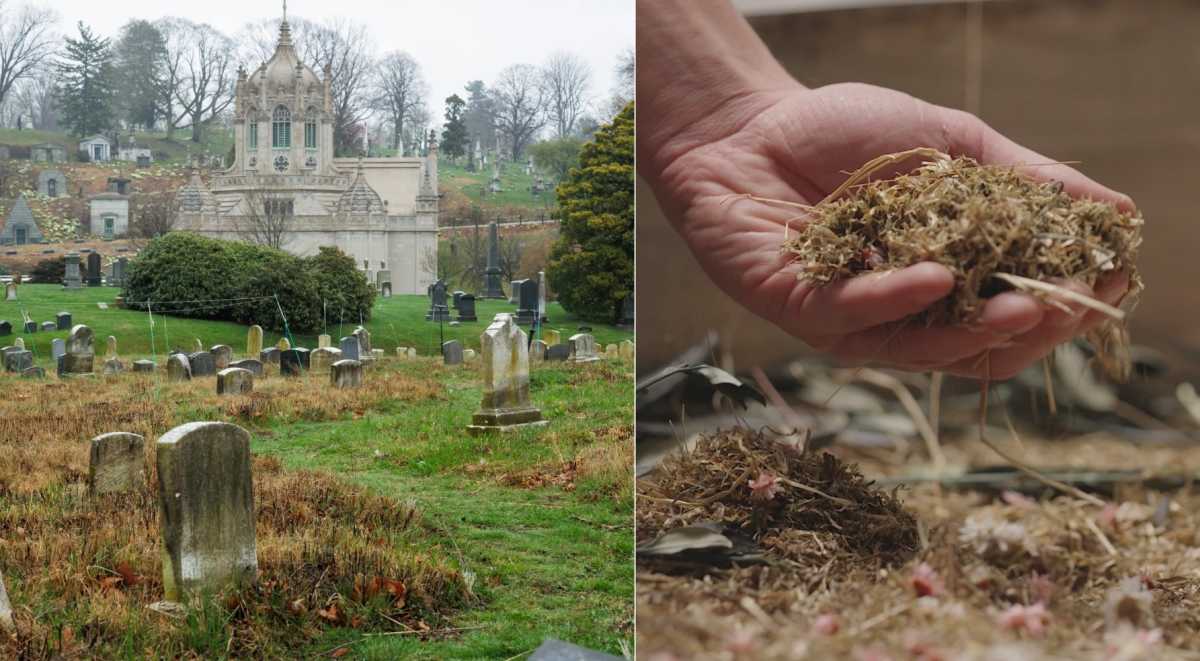
Ashes to ashes, corpse to compost: Green-Wood Cemetery to offer 'human composting' starting in 2027 * Brooklyn Paper

fromBrooklyn Paper
1 month ago
Brooklyn

Ashes to ashes, corpse to compost: Green-Wood Cemetery to offer 'human composting' starting in 2027 * Brooklyn Paper

fromMail Online
2 months ago

Long-lost Egyptian scroll fuels debate over real-life biblical giants

An ancient Egyptian papyrus held by the British Museum has been cited as possible evidence supporting some of the Bible's most controversial claims about giants. The 3,300-year-old document, known as Anastasi I, has been in the museum's collection since 1839 and has recently resurfaced on the Associates for Biblical Research, renewing interest in its possible links to biblical accounts. The papyrus describes encounters with the Shosu people, said to stand 'four cubits or five cubits' tall, up to eight feet in height.
Books
fromMail Online
2 months ago

Lost tomb of mysterious 'cloud people' unearthed after 1,400 years

Archaeologists in Mexico have uncovered a 1,400-year-old tomb in the Central Valleys of Oaxaca that had been lost to history. The stone structure, built by the Zapotec culture, known as Be'ena'a, or 'The Cloud People', is adorned with sculptures, murals and carved symbols that suggest ritual significance. The Zapotec believed their ancestors descended from the clouds and that, in death, their souls returned to the heavens as spirits.
World news
#archaeology
fromMedievalists.net
1 month ago

Viking-Age Woman Buried with Her Dog in Norway - Medievalists.net

Excavations carried out in 2025 by the Arctic University Museum of Norway revealed that the artefacts came from a boat burial. The grave contained the skeleton of a woman placed inside a boat measuring about 5.5 metres in length. She had been buried together with a dog, suggesting the animal may have been an important companion in life.
History
Arts
fromianVisits
2 months ago

A crumbling head and every English word: the Mithraeum's latest puzzling artwork

Mark Manders' exhibition above the London Mithraeum pairs a striking monumental head with enigmatic language-focused works that resist clear interpretation.
fromwww.thehistoryblog.com
1 month ago

Centurion's tombstone reused in someone else's grave

Both of the cyst graves feature funerary markers reused as building material. One of them contains the partially preserved tombstone of Legio I Italica centurion Gaius Valerius Verecundus was engraved with a wreath of which only traces remain and an inscription that describes him as having been heavily pressed by fate.
History
fromBig Think
2 months ago

7,000-year-old underwater wall raises questions about ancient engineering - and lost-city legends

Nine meters (30 feet) beneath the waves, they found it: a vast, man-made stone wall, averaging 20 meters (66 feet) wide and two meters (6.6 feet) tall. The structure consists of some 60 massive granite monoliths, set directly onto the bedrock in pairs at regular intervals. Smaller slabs and packing stones fill in the gaps, locking the whole into a single, deliberate construction. With an estimated total mass of around 3,300 tons, this is the largest underwater structure ever discovered in France.
France news
fromThe Art Newspaper - International art news and events
1 month ago

Ornate 1,400-year-old Zapotec tomb discovered in Mexico

"At Monte Albán alone, more than 200 tombs of varying size and decoration reflect social, political and economic differences among the ancient Zapotecs," Javier Urcid, an anthropology professor at Brandeis University in Massachusetts, tells The Art Newspaper. "Built beneath residences, tombs were reused over generations-with additional burials and occasional changes to offerings or decoration. The inscribed genealogies verified membership in family lineages."
Science
fromHyperallergic
2 months ago

Request for Proposals: Operator for the Harlem African Burial Ground Cultural Education Center

For two centuries, from the mid-1600s to the mid-1800s, free and enslaved New Yorkers of African descent were buried at the Harlem African Burial Ground. Over time, the history of this site was lost - erased by the subsequent redevelopment of the land. Today, the Harlem African Burial Ground project is a community-driven vision to honor and memorialize this historic site with a new outdoor memorial and indoor cultural education center, while also addressing affordable housing and jobs needs in the East Harlem community.
Arts
History
fromwww.thehistoryblog.com
1 month ago

1,000-year-old gold-filled tomb unearthed in Panama

A richly furnished elite Coclé tomb (800–1000 A.D.) at El Cano reveals ornate gold and ceramics, indicating centralized chiefdoms with long-distance exchange and ritual complexity.
History
fromWorld History Encyclopedia
1 month ago

The Family in Ancient Mesopotamia: Providing for Each Other Through Life and Past Death

Family was the essential unit providing social stability, continuity of traditions, and forming the basis for palace and temple hierarchies in ancient Mesopotamia.
History
fromwww.thehistoryblog.com
2 months ago

Unique bone box found in Roman-era grave

A tiny Roe-deer bone box with sliding lid and ring-and-dot decoration was buried as a prized cosmetic container in a Late Roman woman's grave.
History
fromwww.thehistoryblog.com
1 month ago

Early Bronze Age chieftain burial found in France

A richly furnished Early Bronze Age chieftain's pit grave (c.1900–1800 B.C.) with Armorican flint arrowheads, bronze daggers, and rock crystal was found at Ecouche-les-Vallees, Normandy.
fromwww.thehistoryblog.com
2 months ago

Monumental Republican tombs found in Rome suburb

An monumental early Republican-era funerary complex has been discovered in a suburb of Rome. The excavation of the Via di Pietralata east of Rome also uncovered a stretch of an ancient road, a small cult building and two monumental basins dating back to the 3rd and 2nd centuries B.C. Remains from this early in the Republican era are scarce in the Eternal City, which make these finds very archaeologically significant.
History
fromMail Online
1 month ago

Mysterious symbols spanning the globe hint at a lost civilization

His investigation began after identifying recurring giant T-shapes, three-level indents, and step pyramids carved into ancient stones worldwide. 'These specific symbols that are built in different size proportions, and the symbols are found in ancient stones around the world, are not supposed to exist; no cultures are supposed to have any cross-platform,' LaCroix explained. The symbols appear in locations ranging from Turkey's Van region to South America and Cambodia.
History
History
fromenglish.elpais.com
1 month ago

The underground odyssey that led archaeologists to a Zapotec burial site

Looting revealed a hidden Zapotec Tomb of the Owl near La Cantera, which took six years to locate and links to the ancient Zapotec civilization.
History
fromWorld History Encyclopedia
1 month ago

Ghosts in Ancient Mesopotamia: Just Another Aspect of Life

Ghosts were integral to Mesopotamian belief: deceased spirits required proper burial and ongoing remembrance or they could return to haunt the living.
History
fromwww.thehistoryblog.com
2 months ago

Bronze Age tombs with luxury imported goods found in Cyprus

Two 14th-century BCE chamber tombs in Larnaca contained locally made and widely imported luxury goods, demonstrating extensive long-distance trade networks.
fromMail Online
2 months ago

Mystery of Egypt's pyramids deepens as hidden megastructure revealed

More than 200 scans from multiple satellites, including Italy's Cosmo-SkyMed and the US-based Capella Space, showed uniform results suggesting massive pillars about 65 feet in diameter wrapped in spirals and plunging nearly 4,000 feet deep. Those pillars appear to end in 260-foot cubic chambers beneath all three pyramids and the Sphinx, which Biondi described as 'huge chambers' measuring roughly 260 feet in length and width.
History
History
fromMedievalists.net
2 months ago

'Princely' Early Medieval Burial Discovered in England - Medievalists.net

A 7th-century elite Anglo-Saxon burial site in Suffolk includes a princely grave with a fully harnessed horse, weapons, and two individuals.
History
fromMail Online
2 months ago

Father of alien archaeology says pyramids not built by human hands

Erich von Däniken claimed extraterrestrials aided ancient civilizations in building pyramids, but archaeological evidence attributes pyramid construction to organized human labor.
fromwww.thehistoryblog.com
1 month ago

Rare Mithraic altars found in Scotland go on display for the first time

Two exceptionally rare and beautifully carved Mithraic altars found in Inveresk, East Lothian, Scotland, are going on display for the first time. They are not just the only Roman altars ever found in Scotland, but are among the finest examples of Roman sculpture in Roman Britain. They are also uniquely early in date, having been made in 140s A.D. during Antoninus Pius' reoccupation of southern Scotland, whereas most other archaeological materials related to the worship of Mithras in Britannia date to the 3rd century.
fromwww.thehistoryblog.com
2 months ago

Late Antique necropolis with deliberately broken pottery found in France

Adjacent to the masonry house is a burial ground in use from the 4th century through the first half of the 6th century. Approximately 60 individual inhumation burials have been unearthed, arranged in rows that are increasingly dense with graves as they approach the dwelling. The deceased were buried in cysts formed by reused tegulae (large clay roof tiles) or by rubble walls that supported wooden planks. They were placed in the graves in supine position facing west, north or south.
History
fromMedievalists.net
2 months ago

Byzantine Monastic Site Found in Upper Egypt - Medievalists.net

The team identified multiple buildings aligned roughly west-east, in several sizes, ranging from about 8 × 7 metres to 14 × 8 metres. Within these structures are rectangular halls-some interpreted as spaces for worship-alongside smaller rooms that may have served devotional or practical functions for the monks. Excavators also noted evidence of plastered wall surfaces and tiled floors, as well as architectural features such as entrances and surviving supports, including beams.
History
History
fromwww.mercurynews.com
1 month ago

Today in History: February 16, Tutankhamen's tomb unsealed

Feb. 16 features major historical events including King Tutankhamen's burial chamber unsealing (1923), Fort Donelson surrender (1862), Castro becoming Cuba's premier (1959), and several modern political and transportation incidents.
History
fromwww.thehistoryblog.com
2 months ago

Rich graves of three elite warriors found in Hungary

Three elite 10th-century Hungarian Conquest cavalry graves in Akaszto contained elite weapons, gilded harness fittings, and an unprecedented intact silver belt with textile remains.
History
fromTime Out London
1 month ago

A new 'Cleopatra' immersive experience in London will be all about Ancient Egypt

Cleopatra: The Experience opens at Immerse LDN as a 3,000 square metre, nine-gallery immersive exhibition tracing the late Ptolemaic dynasty with artefacts, AR, VR and staged environments.
[ Load more ]