#supernova-remnant
#supernova-remnant
[ follow ]
#dark-matter #astronomy #cosmology #stellar-evolution #supermassive-black-holes #star-formation #sagittarius-a


Science
fromwww.scientificamerican.com
2 weeks agoSomething extremely weird is happening to our galactic neighbor. Scientists think they know why
The Small Magellanic Cloud's unusually slow stellar rotation results from a hundred-million-year-old collision with the Large Magellanic Cloud that disrupted its normal dynamical state.


Science
fromwww.scientificamerican.com
3 weeks agoHave astronomers found a runaway monster black hole or just a very weird galaxy?
Astronomers discovered RBH-1, a potentially runaway supermassive black hole traveling at over three million kilometers per hour, though ambiguous data makes its true nature uncertain.

OMG science
fromEngadget
2 weeks agoHubble catches rare view of a comet crumbling
Hubble Space Telescope captured accidental images of Comet K1 breaking into at least four pieces as it exited the solar system, revealing unusual chemical composition and offering insights into early solar system formation.
OMG science
fromwww.scientificamerican.com
2 weeks agoA boom in gravitational waves leaves scientists with more questions than answers
A global network of gravitational-wave observatories has detected 218 candidate events, revealing complex structures in cosmic mergers and providing unprecedented insights into the universe.
Science
fromwww.theguardian.com
1 month agoNew image reveals secrets of Milky Way galaxy in stunning detail
The Alma telescope captured an unprecedented detailed image of the Milky Way's center, revealing previously unknown filaments of matter flowing to form stars and planets, advancing understanding of galactic formation.
fromBig Think
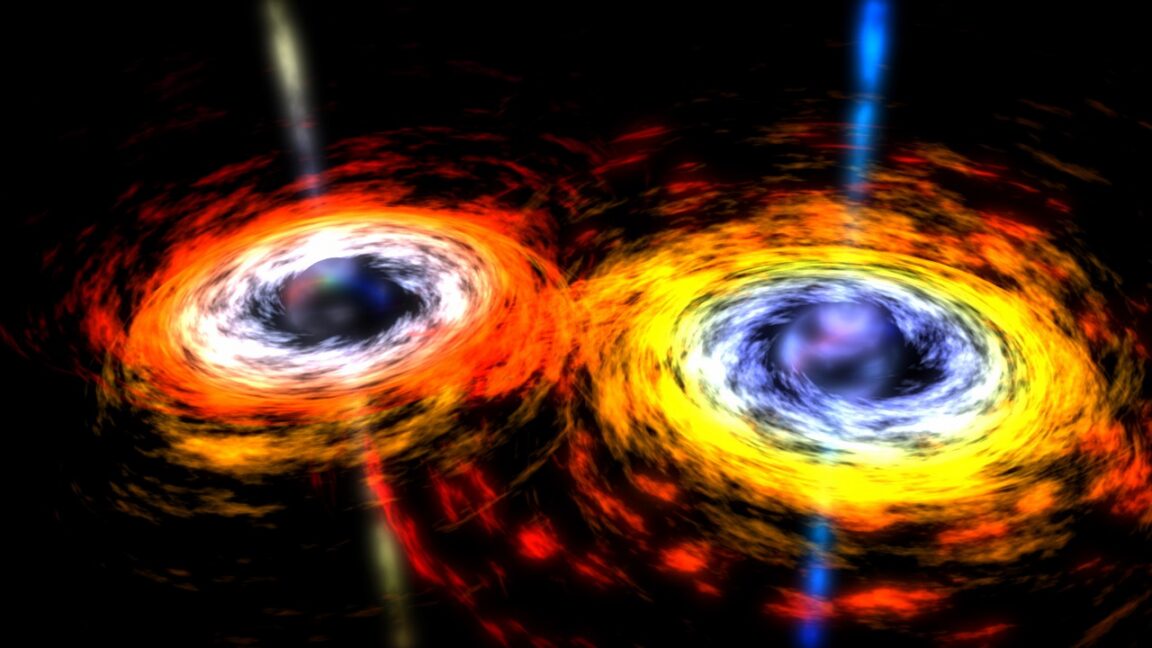
2 weeks agoOJ 287 has the most supermassive pair of black holes ever
The closest supermassive black hole pair, in NGC 7727, was discovered in 2021. Just 89 million light-years away, these 154,000,000- and 6,300,000-solar-mass black holes are just 1,600 light-years apart. Approximately 0.1% of young quasars are expected to be doubles, with typical separations of ~10,000 light-years.
OMG science
Science
fromwww.scientificamerican.com
1 month agoAstronomers spot a young sun blowing bubbles inside the Milky Way
NASA's Chandra X-ray Observatory captured the first image of a young sunlike star's astrosphere, a protective bubble of hot gas 120 light-years away, revealing how stellar winds shape these cosmic structures.
OMG science
fromFuturism
3 weeks agoScientists Spot Two Planets That Collided, Resulting in Carnage That Will Send Prickles Through Your Scalp
Astronomers detected a planetary collision around star Gaia20ehk through unusual brightness fluctuations and infrared signatures consistent with massive debris and extreme heat from impact.
OMG science
fromMail Online
3 weeks agoAstronomers watch the birth of a magnetar for the first time
Astronomers observed the birth of a magnetar, an extremely dense neutron star with the universe's most powerful magnetic fields, through a superluminous supernova's unusual flickering light pattern over 200 days.
fromMail Online
1 month agoSee the Milky Way like NEVER before in largest image of its kind
One of the most exciting aspects is the rich chemistry we detect. We see dozens of different molecules, including some complex organic molecules that contain carbon, the same element that forms the basis of life on Earth. From ACES, we are learning more about how the ingredients for planets, and potentially life itself, can arise in the universe.
Science
OMG science
fromwww.scientificamerican.com
3 weeks agoThe sun and thousands of its twins migrated across the Milky Way just in time
The sun migrated from the Milky Way's crowded center to its current outer position, accompanied by thousands of similar stars that unexpectedly crossed the galactic corotation barrier.
fromBig Think
1 month agoRecord-breaking natural laser discovered 11 billion light-years away
an electron within a molecule gets excited to a higher-energy state, the electron de-transitions back to the lower energy state, where it emits light of a very specific wavelength in the process. Then, pumped or injected energy re-excites an electron within that very same molecule back into that higher-energy state, over and over.
Science


#dark-matter




OMG science
fromFuturism
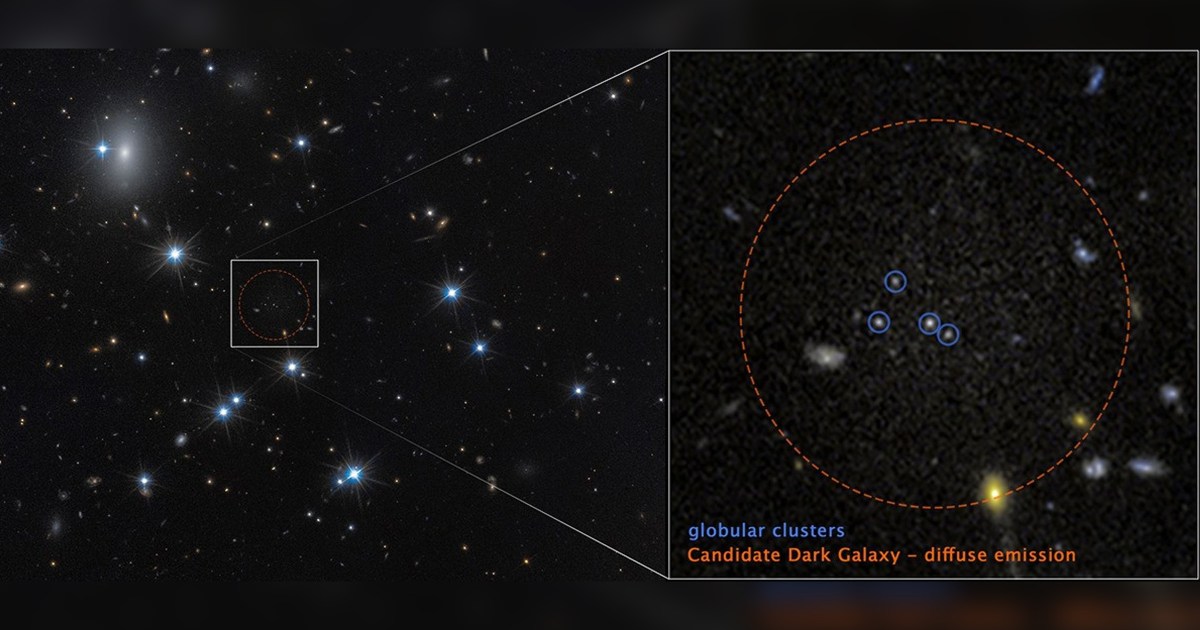
1 month agoHubble Spots Bizarre Galaxy That Appears to Be 99.9 Percent Dark Matter
Astronomers discovered galaxy CDG-2, composed of at least 99.9 percent dark matter, representing one of the most dark matter-dominated galaxies ever found and a candidate for theoretical dark galaxies.
fromFuturism
1 month agoAstronomers Spot Huge Microwave Laser Blasting Into Space
This system is truly extraordinary. We're seeing the radio equivalent of a laser halfway across the universe. Fundamentally, masers and lasers are focused beams of light in the same frequency. In the realm of astrophysics, these can arise from clouds of dust being excited into a higher energy state from the light emitted by other sources, like stars and black holes.
OMG science
fromBig Think
2 months agoWhat the Universe looks like: from nearby to far away
Looking skyward fills us with wonder. Off-world, the Sun, planets, stars, and galaxies all await. Our Solar System encompasses our own cosmic backyard. Farther away, stars and star clusters abound within the Milky Way. Hundreds of billions of stars exist just within our home galaxy. Inside our Local Group, only Andromeda surpasses us in mass, size, and stars. More than 5 million light-years away, galaxies abound in groups and clusters.
Science
Science
fromwww.scientificamerican.com
1 month agoScientists may have discovered a pulsar at the Milky Way's hearta result that could reveal new physics
A pulsar near Sagittarius A* would enable more precise measurements of spacetime and gravitational effects around the Milky Way's central supermassive black hole.
fromFuturism
2 months agoAstronomers Intrigued By Impossible Structure Around Dead Star
A dead star 730 light years away appears to be forming a powerful structure around itself - and despite their best efforts, astronomers aren't sure how. The cosmic corpse, designated RXJ0528+2838, is an incredibly dense stellar remnant known as a white dwarf, with a Sun-like star orbiting around it. This binary arrangement isn't uncommon throughout the universe, but what is strange is the structure surrounding the former body: a highly energetic and luminescent cloud known as a nebula,
Science
fromwww.scientificamerican.com
2 months agoThe Milky Way's Central Black Hole May Have Appeared Shockingly Different Just a Few Hundred Years Ago
Supermassive black holes are mysterious bodies. Scientists aren't entirely sure how these beating hearts at the centers of most large galaxies formed. That includes Sagittarius A* (Sgr A*), the supermassive black hole at the center of our own Milky Way galaxy. Now a new preprint study is shedding light on Sagittarius A* by studying what happens as material falls toward the black hole.
Science
fromwww.scientificamerican.com
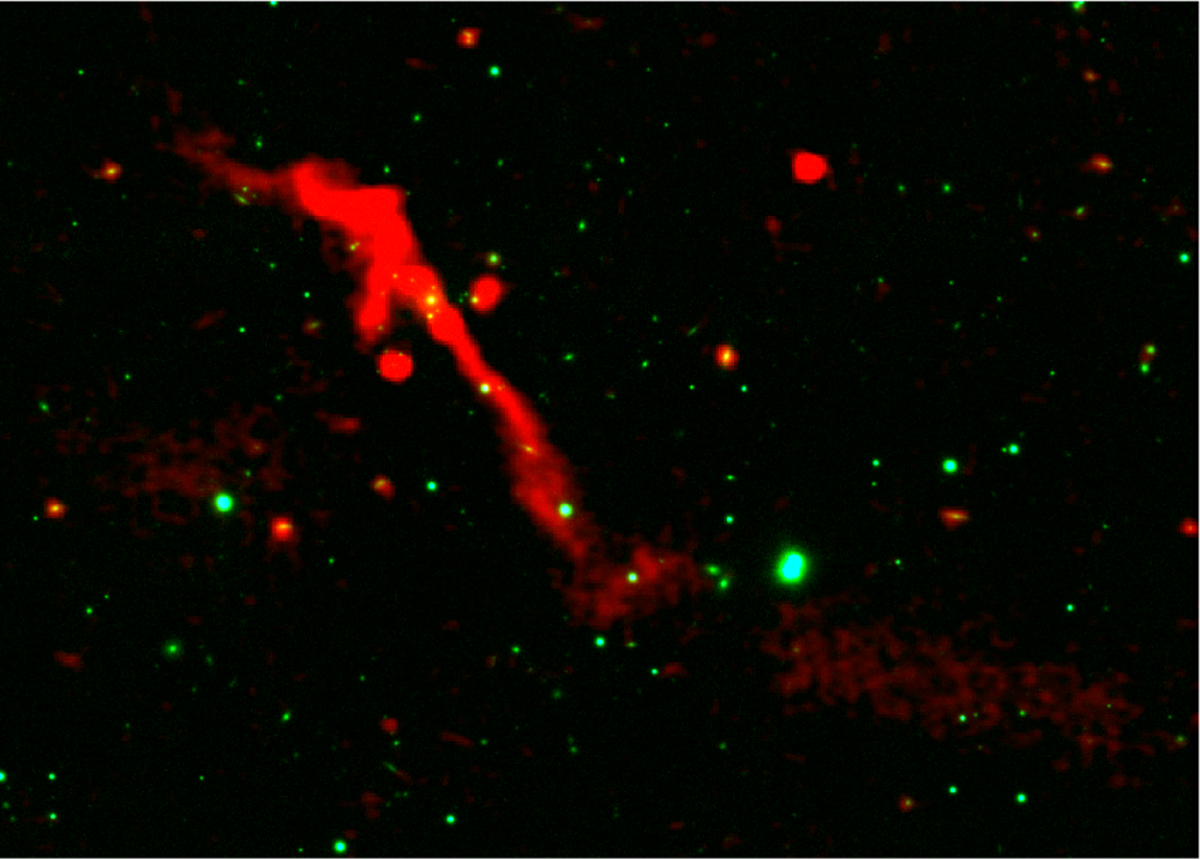
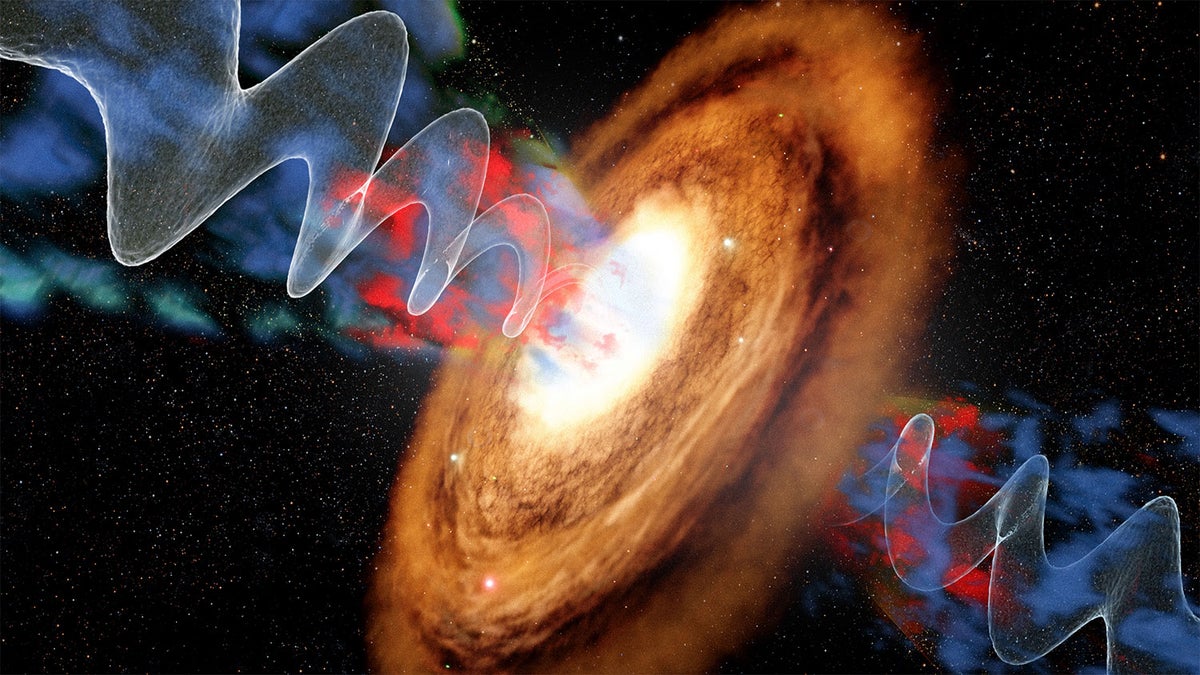
1 month agoHow can galaxies ever collide in an ever-expanding universe?
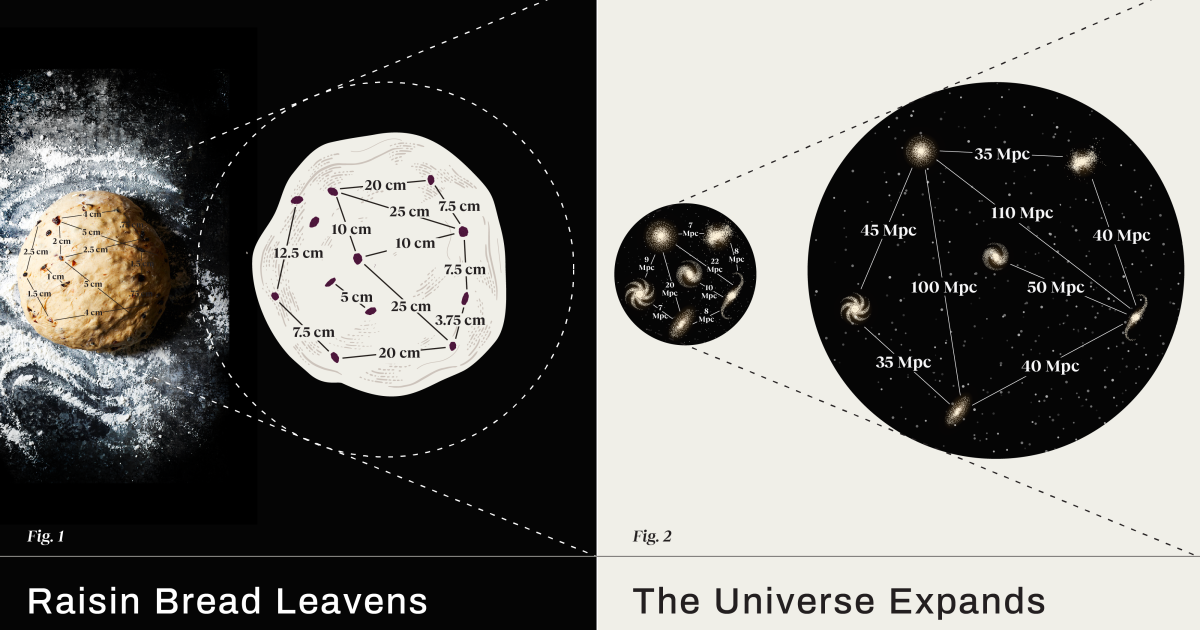
Okay, first thing first: the universe is in fact expanding. We've known this for more than a century now, and it's the basis for modern cosmology. This idea is called the big bang modelwhich is an unfortunate name because it brings to mind a cosmos expanding like an explosion, with galaxies moving away from each other through space like shrapnel. But in fact space itself is expanding, and that's different.
Science
fromwww.npr.org
1 month agoHave astronomers witnessed the birth of a black hole?
A bright star in a nearby galaxy has essentially vanished. Astronomers believe that it died and collapsed in on itself, transforming into the eerie cosmic phenomenon known as a black hole. "It used to be one of the brightest stars in the Andromeda galaxy," says Kishalay De, an astronomer with Columbia University and the Flatiron Institute. "Today, it is nowhere to be seen, even with the most sensitive telescopes."
Science
fromwww.scientificamerican.com
1 month agoAstronomers spot one of the largest spinning structures in the universe
The first time that University of Oxford astronomer Lyla Jung saw the cosmic configuration on her monitor, she almost didn't believe it was real. But it wasand Jung and her colleagues went on to identify one of the largest rotating structures ever found in space: a chain of galaxies embedded in a spinning cosmic filament 400 million light-years from Earth. The finding, published in Monthly Notices of the Royal Astronomical Society, may give astronomers new insights into galaxies' formation, evolution and diversity, Jung says.
Science
fromwww.scientificamerican.com
2 months agoThe biggest explosions in the universe, ranked
The universe is exploding. Or parts of it are. The night sky may seem calm, even serene, but that masks events of a catastrophic and nearly unimaginable scale. Across the galaxy and even the cosmos itself, immense outbursts of energy occur that could easily vaporize our planet. Happily, space is vast, and the terrible distance between these events and us diminishes what we see to a faint glowusually.
OMG science


fromNature
2 months agoA young progenitor for the most common planetary systems in the Galaxy - Nature
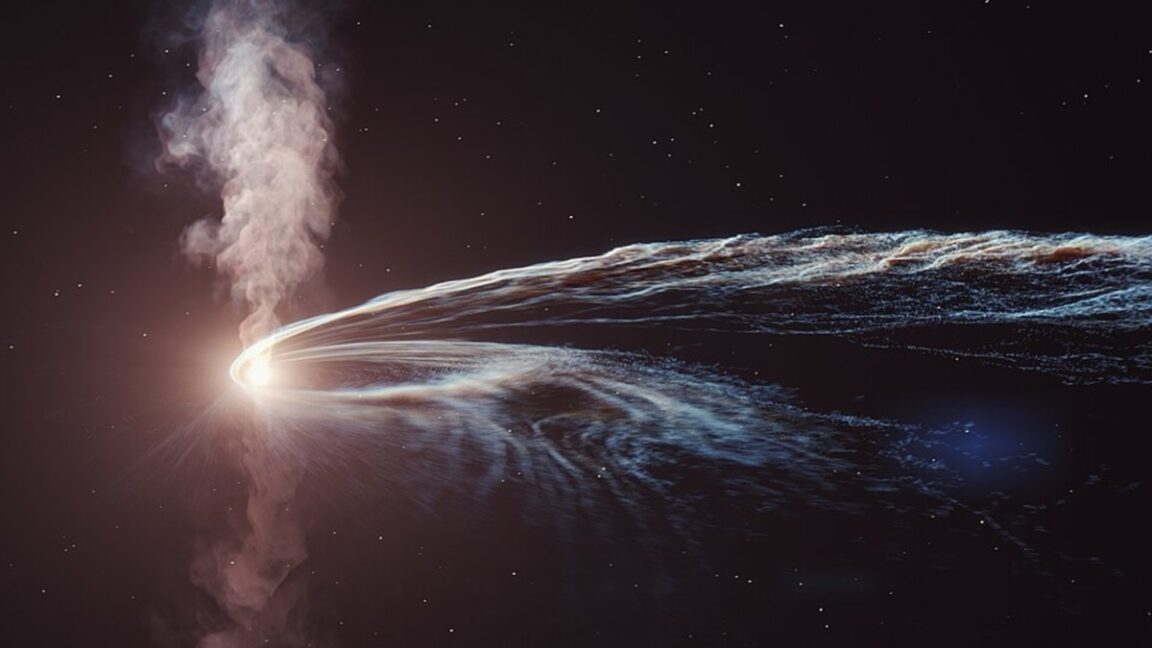
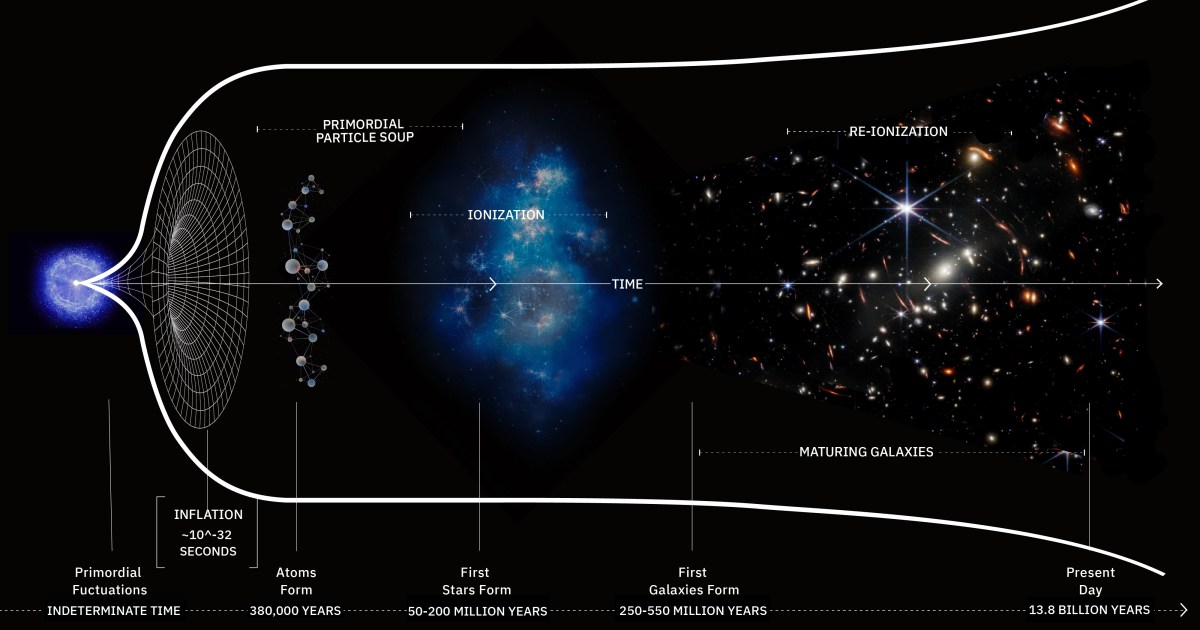
V1298 Tau is a young (10-30 Myr), approximately solar-mass star (1.10 ± 0.05 M⊙ ) in the Taurus star-forming region2,4,5,6,7,8. Observations by NASA's Kepler space telescope in its extended K2 mission9 revealed transits of the star by four different planets, each larger than Neptune2,3. The V1298 Tau planets occupy a sparsely populated region of the observed exoplanet period versus radius plane. As a young system of large planets, it provides a crucial snapshot of planetary architecture
Science
fromBig Think
2 months agoAstronomers are on "Cloud 9" with a new, starless gas cloud
Out there, in the vast Universe, are clumps of matter that come in many different sizes and masses. We might be most familiar with galaxies like our Milky Way: with hundreds of billions of solar masses worth of stars, even more gas and plasma, and more than a trillion solar masses worth of dark matter. At smaller masses, however, it takes longer, and becomes more and more difficult, for clouds of normal matter to collapse.
Science
fromwww.scientificamerican.com
2 months agoAstronomers May Have Unlocked the Reason for Betelgeuse's Bizarre Dimming
Astronomers may have finally solved one of the weirdest mysteries of our night sky: why Betelgeuse, a massive star in the constellation Orion, seems to fade and brighten as if it were operated by a heavenly dimmer switch. Using the Hubble Space Telescope and ground-based observatories, scientists observed Betelgeuse for almost eight years and found that patterns in the star's light suggested the wake of another, unseen star was passing through its atmosphere.
Science
[ Load more ]