New York Mets
fromFaithandfearinflushing
1 day agoGlass Calf Full
The Mets celebrated multiple victories, but concerns arose over Juan Soto's calf tightness after he exited the game early.
"We're constantly striving to strike a balance between work that respects academic rules of composition, established visual codes and good readability, with something more spontaneous, adventurous, playful, even naive."
David Bellion spent over a decade in top-flight football, playing for clubs like Manchester United and Sunderland, before becoming Red Star FC's creative director, focusing on brand development and cultural connections.
Viewpoints are structures designed for observing the landscape from elevated positions. They act as devices that organize the gaze and establish a direct relationship between the body and the territory.
Kamrooz Aram is everywhere this year, from Mumbai Art Week to the Whitney Biennial, and critic Aruna D'Souza is grateful. She pens a beautiful meditation on his work, reading his abstract paintings as not simply a denunciation of Western modernism nor a reassertion of Islamic visual motifs, but something else entirely - something gestural, exuberant, riotous, and incomparably his own.
You can be alone, with a camera in your hand, and you can walk. In that moment, the medium sheds the expectations attached to narrative production. You don't need to have something specific in your mind. You don't need to have in mind that you have to do something with it at some point. This is freedom.
When Jay Chiat commissioned Gaetano Pesce in 1994, he envisioned a workplace free from assigned desks and rigid partitions. The Italian designer responded with a space conceived as a flexible field of movement. The office functioned almost like a small city, where meeting areas and work zones formed an informal network of routes and gathering points.
"These paintings merge the landscape and the intimacy of windows through the framing of the car, bridging the two realms I've typically explored separately. The car becomes a meditation on transition, on existing simultaneously here and elsewhere."
As cultural institutions continue to proliferate worldwide in this digital era, the museum itself appears increasingly in need of redefinition. Rather than offering a single model or solution, Architecture for Culture: Rethinking Museums, written by architectural historian and curator Béatrice Grenier, argues for a more contextual and plural understanding of what a museum can be: an institution shaped by its environment, its public, and the specific cultural questions it seeks to address.
Photographer Henri Cartier-Bresson (19082004) travelled all over the world and extensively throughout Europe. After producing numerous series of photographs for magazines in Germany, Spain, Italy, Greece, Switzerland and France, Cartier-Bresson wanted to bring them together in a book and in 1955, he published Les Europeens (The Europeans). This book of photographs aims to show what makes each of the peoples of this geographical area unique while highlighting their similarities. This exhibition brings together some of the most important photographs from the book.
Sand Art is a game by Kory Jordan and published by 25th Century Games for two to four players ages 10 and up. It takes about an hour to play, and has you collecting resources and then coloring in a bottle, making art in a bottle out of sand, in case the name didn't give away the plot. Gameplay Overview: Sand Art has you gathering and mixing sand, which is used to fill your bottle.
This depicts Guernica after the battle. The figures are no longer fighting. They're in a giant pile. They're exhausted and there's a sunrise on a new day behind them. The title of the work is A Whole New World (for Who?). It's asking what's going to happen after the conflicts that we have. Who's going to be taken into that new world?
There's this push and pull between feeling unease and discomfort, the nature of the spaces, and why they feel uncomfortable. But there is also tenderness and warmth, people adapting to these spaces and finding ways to make them comfortable.
On Franklin Street in Brooklyn's Greenpoint neighborhood, one non-commercial gallery fosters 'a small, stubbornly human space for friction.' Friction—the ubiquitous buzzword that captures the simultaneous delight and discomfort of doing things the slow way—is at the heart of artists Pap Souleye Fall and Char Jeré's current show at Subtitled NYC. It also reflects the overall spirit of this little exhibition space and of a burgeoning movement to reject our culture of optimization in favor of a bumpier, more intimate, less alienating experience.
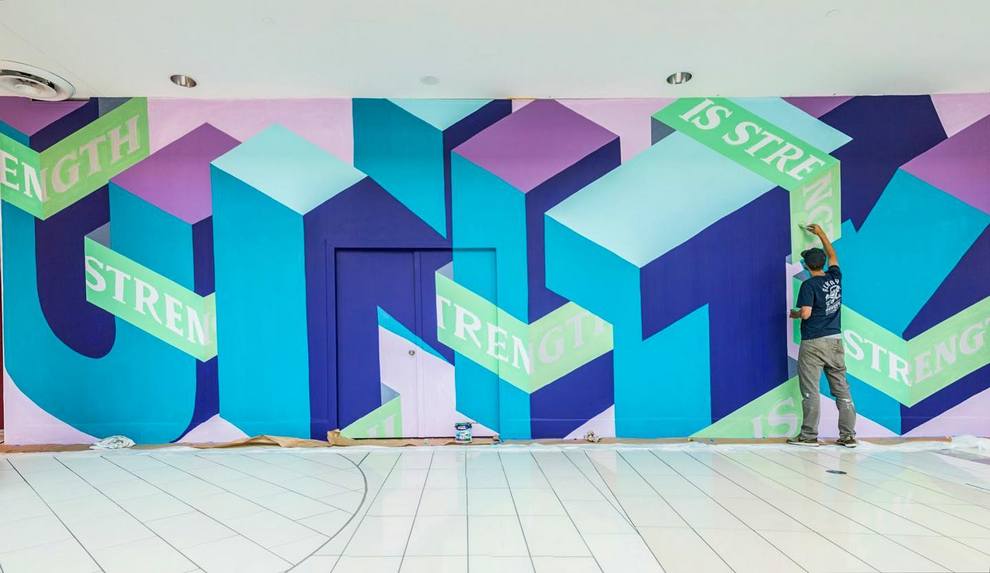
If you've walked around any of France's cosmopolitan cities in recent years, you're sure to have come across some stunning murals. Painted onto the side of buildings, in hidden corners, and just about anywhere an artist can paint, street art is booming. We're not talking old-school graffiti here, hastily sprayed names on walls, and anti-social stuff like that. Today's street art is commissioned by city or town councils and created by prominent street artists from around the globe says Suzanne Pearson.
Regina Silveira has spent the better part of three decades considering the relationship between media and meaning, particularly as it relates to Latin America. First presented in 1997, "To Be Continued..." features 100 black-and-white reproductions of photos, newspaper clippings, propaganda, advertisements, and more. Silveira nests each image into an oversized puzzle piece, which cuts off faces and scenes to leave fragments of pop culture icons, flora and fauna, and even the occasional mugshot spliced next to one another.
Sprouting from the roof of the San Francisco Museum of Modern Art, artist Rose B. Simpson's newly installed bronze sculpture "Behold" has its gaze fixed on the cityscape before it. The Tewa of Khaʼpʼoe Ówîngeh artist, herself a mother, crafted a tender portrait of an interconnected parent and child that "asks us to be human with each other, to change our narrative through wonder, witness and a foundation in the soft warmth of our humanity," she said in a statement.