#domain-authority
#domain-authority
[ follow ]
#seo #digital-marketing #google #google-search #content-strategy #ai #search-visibility #search-rankings


Online marketing
fromEntrepreneur
1 day agoMost Restaurants Are Missing Out on the Platform That Brings Customers In - Here's What a Google Strategist Recommends
YouTube serves as a powerful discovery engine for restaurants, enhancing audience reach and customer loyalty through diverse content formats.

Marketing tech
fromLondon Business News | Londonlovesbusiness.com
2 days agoTop five outsourced and white label SEO for agencies packages compared - London Business News | Londonlovesbusiness.com
White-label SEO allows agencies to scale fulfillment quickly while maintaining brand identity, but careful selection of providers is crucial.
#ai-search-engines
Marketing tech
fromThe Berkshire Eagle
5 days agoMulti-Engine AI Visibility Gap Widens as Brand Citation Rates Vary 9x Across Major AI Search Engines
The Multi-Engine AI Visibility Gap is a critical issue in digital marketing strategy for 2026, highlighting disparities in brand visibility across AI search engines.
Marketing tech
fromThe Berkshire Eagle
5 days agoMulti-Engine AI Visibility Gap Widens as Brand Citation Rates Vary 9x Across Major AI Search Engines
The Multi-Engine AI Visibility Gap is a critical issue in digital marketing strategy for 2026, highlighting disparities in brand visibility across AI search engines.
Web design
fromSearch Engine Roundtable
1 month agoGoogle Says Most Sites Don't Need To Disavow Links But That's Not All Sites
While most sites don't need disavow files, some sites may benefit from using them strategically, particularly when dealing with problematic links from specific top-level domains.
Miscellaneous
fromSearch Engine Roundtable
1 month agoDaily Search Forum Recap: February 25, 2026
Google experienced a brief search outage, expanded AI Shopping features with product recommendations and see-more buttons, while Google Business Profiles verification requires caution and Anthropic updated crawler documentation.
fromDigiday
1 month agoZero-click reality is rewriting the rules of search for brands
Worries over whether the changing dynamics of search marketing will affect major brands have finally reached the boardroom. In several earnings calls this month, executives at high-profile advertisers like Airbnb and Expedia fielded questions from analysts over the impact of generative AI chatbots or Google's AI Overviews feature on their businesses. It's a sign that alarm bells are ringing. "It's going to be really tricky for brands to play in this new space," said Daniel Moreno, a senior SEO and GEO consultant at Dept U.K.
Marketing
fromForbes
4 weeks agoThe New SEO: From Rankings To Recommendations In AI Search
For most of the last two decades, SEO mostly meant one thing, where you ranked on Google (and occasionally Bing). The customer journey was familiar. Someone searched, scanned a list of links, clicked and explored. Now the journey is increasingly 'ask, get an answer, take action.' And the platforms shaping that journey include ChatGPT, Claude, Gemini, Perplexity and Google itself, which is inserting AI summaries, what Google calls AI Overviews, into search results.
Marketing tech
Online marketing
fromMarTech
1 month agoWhy organic search is becoming a brand trust channel | MarTech
Organic search has shifted from a discovery channel to a trust-first channel, requiring marketers to prioritize brand control and factual accuracy over visibility metrics and traditional keyword rankings.
Marketing tech
fromHubspot
in 3 weeksAI and SEO: What AI means for the future of SEO [Expert Tips & Interview]
AI is fundamentally transforming SEO by changing consumer search behavior, forcing search engines to adopt AI features, and requiring marketers to develop new optimization strategies while leveraging AI tools.
fromInc
2 months agoSEO Isn't Enough Anymore-Here's How to Make Your Brand AIVisible
AI visibility means your content is included, cited, and recommended in AI-generated answers. If you think ranking at the top of the SERPs is still the way to go, think bigger. AI has become a primary factor in online search strategy. If AI systems can't read your brand, you could become invisible. Below, I share how AI visibility differs from SEO and five strategies to make your brand AI-visible.
Marketing tech
fromHubspot
2 months agoSEO audits: How to conduct one that drives traffic growth [+ checklist]
At its core, an SEO audit is a step-by-step review of your website's technical health, content quality, and search visibility. An SEO audit identifies technical, on-page, content, and link issues on a website. It helps SEO teams identify, prioritize, and fix the issues that block traffic, rankings, and, importantly, conversions. Businesses and SEO teams should create audits to identify opportunities that advance business goals and growth.
Online marketing
fromSearch Engine Roundtable
2 months agoDaily Search Forum Recap: January 9, 2026
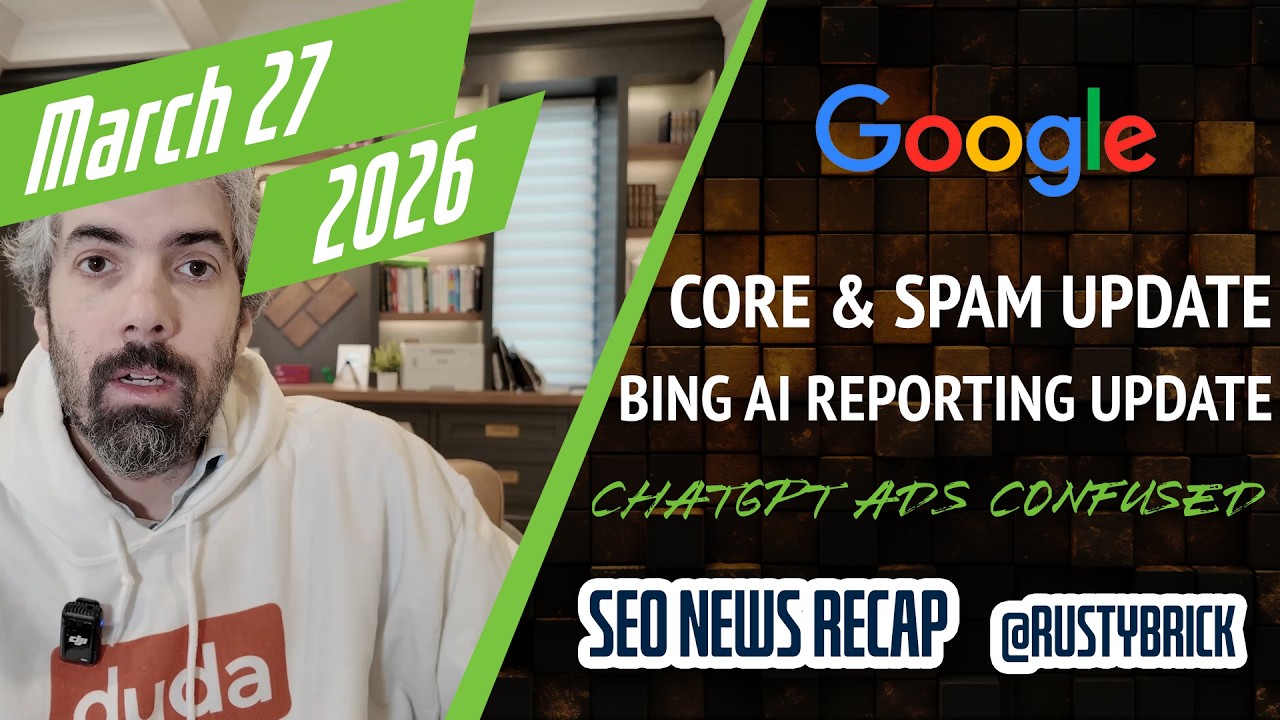
Here is a recap of what happened in the search forums today, through the eyes of the Search Engine Roundtable and other search forums on the web. Google said don't turn your content into chunk-sized pieces for LLMs. Google also spoke about hiring a GEO or AEO and buying AI-optimization tools. Microsoft launched Copilot Checkout and Brand Agents. Bing is testing a retro-style local pack. Microsoft Advertising reminds advertisers about the email settings. And I posted the weekly SEO video recap.
Online marketing
fromPractical Ecommerce
2 months agoGoogle's Core Updates, Explained
Google changes its algorithm frequently. Some are more widespread than others. Unlike Spam Updates, Core Updates generally do not penalize but, instead, alter how the algorithm treats certain queries and their intent. For example, a Core Update may result in more "best of" listings (rather than product categories) in search results. Ecommerce sites may lose traffic, but not because of anything they've done, so no fix is required.
Marketing tech
[ Load more ]