#joani-tremblay
#joani-tremblay
[ follow ]
#art #photography #contemporary-art #sculpture #identity #exhibition #art-exhibition #architecture #political-art
#photography


Photography
fromItsnicethat
2 days ago"What if everyone started making out?" Andrea Marti's horny photo series tackles Gen Z's lack of intimacy head on
Andrea's photographic series reimagines intimacy in a digitally isolated world, inspired by Raquel S. Benedict's essay and Tom Wood's nostalgic club scenes.

fromItsnicethat
2 days agoBravas Graphix are the rave connoisseurs behind some of Brussels' most explosive posters
"We're constantly striving to strike a balance between work that respects academic rules of composition, established visual codes and good readability, with something more spontaneous, adventurous, playful, even naive."
Typography
fromBBC
2 days agoMore than the Score - David Bellion gets creative in Paris - BBC Sounds
David Bellion spent over a decade in top-flight football, playing for clubs like Manchester United and Sunderland, before becoming Red Star FC's creative director, focusing on brand development and cultural connections.
English Premier League
Design
fromdesignboom | architecture & design magazine
4 days agoartwork uses floating fabric corridor and bodily movement to visualize climate change
Ryo Yamada's Perception Corridor is an immersive installation in Edinburgh that explores perception and environmental awareness through a 40-meter fabric corridor.
fromBOOOOOOOM!
2 weeks agoIllustrator Spotlight: Cezar Berje
Cezar Berje's visual approach is a mix of chaos-vibrant colours, symbols, and new age psychedelia. His illustrations often suggest universes within universes, with each part of the image telling its own story through symbols and references.
Graphic design
fromPortland Mercury
3 weeks agoAt Cooley Gallery, Pop Art by a Nun, Plus Portland-Made Sculptures and Textiles
Upon entry, Kent's "IF" (1965) lures the eye upward. The serigraph-a silkscreen print in fine art parlance-hangs high on the wall with a subtle vulnerability. Two orange letters hover toward the composition's top edge, as if pushing to transcend the picture plane. A feeling of possibility emerges through the conjunction and its visual form.
Portland
#art


Arts
fromIrish Independent
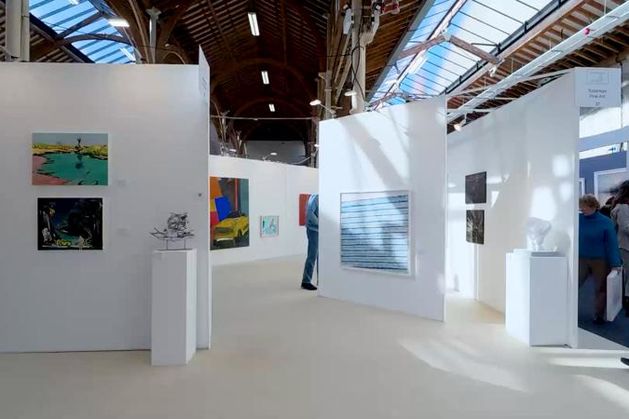
4 days ago'You have to step in and experience it' - artists on the rise of AI-generated art and the 'essential' gallery visit
Miriam Fitzgerald Juskova's exhibit combines paper quilling with mathematics, showcasing intricate art that engages viewers and emphasizes the value of handmade creations.
Portland
fromOregon ArtsWatch * Arts & Culture News
3 weeks agoImperfecta and Daria Loi's many reinventions * Oregon ArtsWatch
Imperfecta, a multifunctional space in Portland, blends gallery, community center, and installation venue, reflecting owner Daria Loi's philosophy of participatory design and interactive exploration.

Berlin music
fromKALTBLUT Magazine
1 month agoUnveil the Pulse of Memory: Filipp Jenikae's Visual Symphony at Galerie Sara Lily Perez - %
Filipp Jenikäe's exhibition explores how urban spectacle, collective memory, and personal experience merge through dynamic paintings of cities, crowds, and athletic figures.
London music
from48 hills
1 month agoNoise Pop Diary: Sideswiped by TikTok fame, Julie Doiron had many more tales to tell - 48 hills
Julie Doiron's decades-old song "August 10" unexpectedly became a TikTok hit, yet her live Noise Pop audience consisted primarily of longtime fans rather than social media-driven newcomers.
Arts
fromOregon ArtsWatch * Arts & Culture News
1 week ago'A Division of Vision': H. Eliz Snowcarp's art for people who see things differently * Oregon ArtsWatch
H. Eliz Snowcarp's installation challenges exclusion in the art world by promoting tactile interaction and inclusivity for those with different abilities.
Arts
from48 hills
2 weeks agoFor Iranian artist Shiva Ahmadi, 'ornamentation becomes a form of resistance' - 48 hills
Shiva Ahmadi's interdisciplinary art practice channels personal experiences of displacement, political upheaval, and immigrant anxiety into visually seductive works that address brutal global issues affecting marginalized communities.
Film
fromFilmmaker Magazine
1 month agoCaroline Golum's Revelations of Divine Love Finds a North American Distributor in Several Futures-Take a First Look at Exclusive Photos
Several Futures acquired North American distribution for Caroline Golum's Revelations of Divine Love, a medieval-set independent film adapting Julian of Norwich.
fromBoard Game Quest
1 month agoSand Art Review
Sand Art is a game by Kory Jordan and published by 25th Century Games for two to four players ages 10 and up. It takes about an hour to play, and has you collecting resources and then coloring in a bottle, making art in a bottle out of sand, in case the name didn't give away the plot. Gameplay Overview: Sand Art has you gathering and mixing sand, which is used to fill your bottle.
Board games
fromBOOOOOOOM!
2 weeks ago"Always Were" by Artist Opal Mae Ong
Ong's work contains a deep reverence for the otherworldly, combining the remnants of ancestral knowledge with speculative visions to form a kind of personal myth-making. The title of their latest series, "Always Were", is intentionally fragmentary suggesting a temporal and grammatical ambiguity that points to the liminal nature of Ong's figures and the time and place they inhabit.
Arts
fromArtnet News
2 weeks agoVeronica Fernandez Builds an Uneasy Monument to Childhood Imagination
There's this push and pull between feeling unease and discomfort, the nature of the spaces, and why they feel uncomfortable. But there is also tenderness and warmth, people adapting to these spaces and finding ways to make them comfortable.
Arts
fromArtnet News
3 weeks agoMarina Abramovic Is the Unlikely Star of the New Balloon Museum
As a child, I imagined a place far behind our own sky. A planet with its own weather, its own atmosphere, its own logic entirely. It was my own version of science fiction. How did it feel on this planet? Was it snowy, windy, or could you sense the first green breath of spring-I called it Planet Z.
Arts
fromHyperallergic
3 weeks agoEmbracing Friction in the Art World
On Franklin Street in Brooklyn's Greenpoint neighborhood, one non-commercial gallery fosters 'a small, stubbornly human space for friction.' Friction—the ubiquitous buzzword that captures the simultaneous delight and discomfort of doing things the slow way—is at the heart of artists Pap Souleye Fall and Char Jeré's current show at Subtitled NYC. It also reflects the overall spirit of this little exhibition space and of a burgeoning movement to reject our culture of optimization in favor of a bumpier, more intimate, less alienating experience.
Arts
Design
fromwww.amny.com
2 months agoBetween Worlds': Musah Swallah art exhibit in Chelsea shows the transformation of surface into message amNewYork
Musah Swallah uses canvas, wood, and cork to foreground material history while making saturated color the structural, inheriting and advancing modern and African painting lineages.
fromArtnet News
4 weeks agoMichele Pred's Art of Resistance Is More Necessary Than Ever
Going out and demonstrating is really important. But if you don't feel comfortable demonstrating, you can volunteer for organizations, you can donate to organizations, you can sign petitions, you can call your senator. There's no excuse not to be involved on some level.
Arts

Photography
fromItsnicethat
2 months ago"Professionalism kills creativity": Thalia Gochez on the importance of having fun as a photographer
Thalía Gochez uses intimate portraiture to uplift BIPOC narratives, stress perseverance, challenge professionalism's limits on creativity, and bridge subject, photographer, and viewer.
Arts
fromwww.theguardian.com
1 month agoThe Guardian view on an explosion of solo exhibitions by women: move over old masters | Editorial
Major UK art institutions are finally increasing exhibitions of female artists after decades of severe underrepresentation, marking a significant shift from historical gender disparities in museum programming.
fromThe Art Newspaper - International art news and events
1 month agoThe stories we tell ourselves: Sophie Calle at the Orange County Museum of Art
We tell ourselves stories in order to live. For more than 50 years, the French artist Sophie Calle has worked in the space between facts and their retelling, demonstrating how the narratives we share about ourselves are always partial, constructed. Working across photography, text, film and installation, she reveals how fantasy and projection intervene in our best attempts to see and be seen.
Arts
fromBerlin Art Link
1 month agoAn Interview with Monia Ben Hamouda | Berlin Art Link
Monia Ben Hamouda's work weaves calligraphy, material transformation and ancestral memory into sculptures and installations that oscillate between language and form. In conversation, we traced the conceptual and sensory threads of her practice, unfolding through key works that reflect on heritage, embodiment and translation. Using materials such as iron, stone and pigment, her installations become sites where history is not only referenced but physically felt.
Arts
fromHyperallergic
1 month agoMarigold Santos Takes Root
The only thing most people know about epiphytes, if they know about them at all, is that they're rootless. That's not quite true - they develop highly specialized root systems adapted to wherever they land. In Epiphytic Elucidations at Patel Brown Gallery, Calgary-based artist Marigold Santos takes this fact as more than a metaphor. The exhibition uses epiphytes - plants that grow on other plants without harming them - as a framework for the expansive ways diasporas form through material labor.
Arts
Arts
fromThe Art Newspaper - International art news and events
2 months agoRemembering Gathie Falk, Canadian artist whose singular practice sparked comparisons to Surrealism and Pop art
Gathie Falk transformed everyday objects into poetic artworks across six decades, creating ceramics, paintings, sculptures and performances that celebrated ordinary life.
Arts
fromdesignyoutrust.com
2 months agoArtist Paints Smoky Lounges And Quiet Strangers, Letting Halffinished Details Turn Viewers Into Coauthors Of The Scene
A wide-ranging visual roundup showcases creative reinterpretations, vintage design, activist art, photography, illustration, and humorous cultural works spanning contemporary and historical styles.
fromColossal
2 months agoRegina Silveira Pieces Together an Evolving Narrative of Latin America
Regina Silveira has spent the better part of three decades considering the relationship between media and meaning, particularly as it relates to Latin America. First presented in 1997, "To Be Continued..." features 100 black-and-white reproductions of photos, newspaper clippings, propaganda, advertisements, and more. Silveira nests each image into an oversized puzzle piece, which cuts off faces and scenes to leave fragments of pop culture icons, flora and fauna, and even the occasional mugshot spliced next to one another.
Arts
Arts
fromwww.theguardian.com
1 month agoIt's about hurling yourself into the unknown': Charmaine Watkiss on turning a UK museum upside down
Charmaine Watkiss connects Caribbean, African and UK botanical knowledge and diaspora histories through portraits and sculpture emphasizing medicinal plants and ancestral herbal traditions.
fromHyperallergic
2 months agoYoko Ono's Art Is an Exercise in Hope
CHICAGO - With her iconic long dark hair curtaining her demure countenance, Yoko Ono has been in my personal pantheon of women makers for most of my life. When I was a distraught teenager in a midwestern suburb, she was there - singing discordant arias from my bedroom stereo. Her siren call couldn't quite be deciphered, but, like a feminist signal from afar, it cut through the fog of oppressive cultural forces.
Arts
fromColossal
2 months agoStephanie Temma Hier Juxtaposes Uncanny Ceramic Sculptures with Embedded Paintings
The Brooklyn-based artist is formally trained as a painter and self-taught as a ceramicist, and she fuses the two modes of working into a complementary practice. Hier begins by sculpting a wide range of forms, and after several rounds of firing with both handmade and commercially available glazes, she adds a painting. The pairings arise intuitively, sometimes through free association, trial and error, or by homing in on a color.
Arts
Arts
fromHi-Fructose Magazine - The New Contemporary Art Magazine
1 month agoAccepting Their Strangeness: the Sculptures of Clementine Bal - Hi-Fructose Magazine
Bal's sculptures blend personal life influences, playful open-eyed characters, and layered materials to portray intimate, universal experiences of rest, parenthood, and whimsical strangeness.
[ Load more ]