#neural-data
#neural-data
[ follow ]



fromNature
4 days agoDopaminergic mechanisms of dynamical social specialization - Nature
Social foraging strategies illustrate the balance between competition and cooperation, where individuals either produce resources or exploit the efforts of others, navigating ecological and social constraints.
Psychology
#biological-computing
OMG science
fromwww.theguardian.com
2 weeks agoA petri dish of human brain cells is currently playing Doom. Should we be worried?
Scientists have created biological computers using lab-grown human brain cells that learn to play video games, demonstrating neural tissue can process information and adapt behavior in digital environments.
Science
fromTheregister
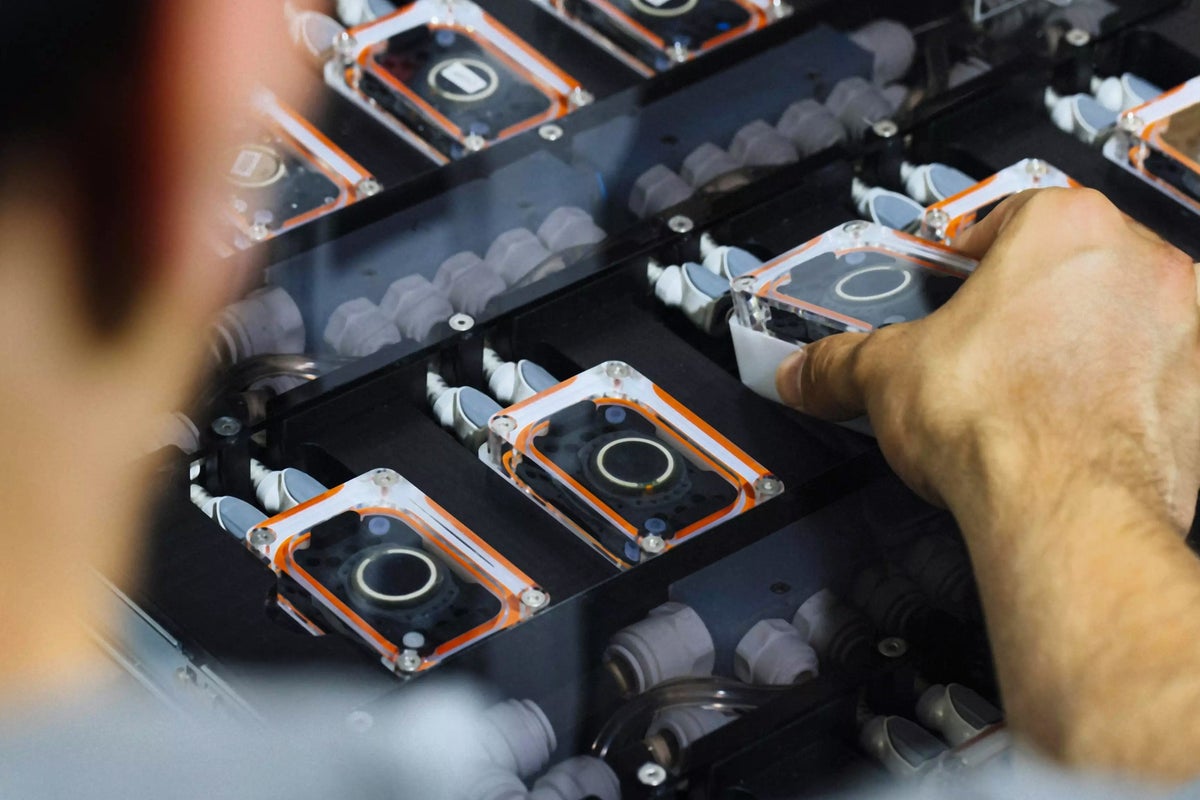
3 weeks agoInside datacenter where day starts with cerebrospinal fluid
Cortical Labs operates biological computers powered by living neurons that require daily maintenance with cerebrospinal fluid and precise atmospheric conditions to function and learn faster than classical computers while consuming less energy.
US news
fromwww.npr.org
1 month agoScientists make a pocket-sized AI brain with help from monkey neurons
Scientists compressed an AI visual system model from 60 million to 10,000 variables while maintaining performance, revealing how biological brains achieve efficiency and potentially advancing both neuroscience and artificial intelligence.
#brain-computer-interfaces
Medicine
fromNature
2 weeks agoDaily briefing: China approves world-first brain-computer interface device
China approved the first brain-computer implant outside clinical trials for paralyzed patients, while US courts blocked vaccine schedule changes and AI leaders warn against manipulative chatbot design.
Medicine
fromNature
2 weeks agoDaily briefing: China approves world-first brain-computer interface device
China approved the first brain-computer implant outside clinical trials for paralyzed patients, while US courts blocked vaccine schedule changes and AI leaders warn against manipulative chatbot design.
#brain-initiative

Data science
fromNational Institute of Mental Health (NIMH)
4 weeks agoBRAIN Initiative: Data Archives for the BRAIN Initiative
The BRAIN Initiative data ecosystem provides domain-specific archives for long-term storage, curation, and community access to neuroscience research data, with continued funding essential for maintaining reproducible pipelines and accommodating exponential data growth.
Data science
fromNational Institute of Mental Health (NIMH)
4 weeks agoBRAIN Initiative: Data Archives for the BRAIN Initiative
The BRAIN Initiative data ecosystem provides domain-specific archives for long-term storage, curation, and community access to neuroscience research data, with continued funding essential for maintaining reproducible pipelines and accommodating exponential data growth.
Science
fromFuturism
2 weeks agoResearchers Upload Fly's Brain to Matrix, Let It Control Virtual Body
Eon Systems created a computational model of a fruit fly's 125,000 neurons and 50 million synapses that exhibits multiple behaviors in a virtual environment with 95% accuracy in predicting motor behavior.
Artificial intelligence
fromThe Verge
2 weeks agoThis is not a fly uploaded to a computer
Eon Systems claimed to create a digital fly brain emulation, but provided no scientific verification, peer review, or detailed methodology—only social media videos that generated hype through influencer endorsements.
Science
fromNews Center
1 month agoLiving 'Mini Brains' Meet Next-Generation Bioelectronics - News Center
Scientists developed a soft 3D electronic mesh that wraps around human neural organoids, enabling comprehensive mapping and manipulation of neural activity across entire miniature brain structures for the first time.
fromBig Think
2 months agoComputational model discovers new types of neurons hidden in decade-old dataset
There was a group of neurons that predicted the wrong answer, yet they kept getting stronger as the model learned. So we went back to the original macaque data, and the same signal was there, hiding in plain sight. It wasn't a quirk of the model - the monkeys' brains were doing it too. Even as their performance improved, both the real and simulated brains maintained a reserve of neurons that continued to predict the incorrect answer.
Science
fromFuturism
2 months agoScientists Preparing to Simulate Human Brain on Supercomputer
The team, which is being led by Jülich neurophysics professor Markus Diesmann, will leverage the Joint Undertaking Pioneer for Innovative and Transformative Exascale Research (JUPITER) supercomputer for their simulation. JUPITER is currently the fourth most powerful supercomputer in the world according to the TOP500 list, and features thousands of graphical processing units. The team demonstrated last month that a " spiking neural network " could be scaled up and run on JUPITER, effectively matching the cerebral cortex's 20 billion neurons and 100 trillion connections.
Science
Science
fromHarvard Gazette
2 months agoWant to speed brain research? It's all in how you look at it. - Harvard Gazette
SmartEM uses machine learning to guide common single-beam scanning electron microscopes in real time, increasing scanning speed sevenfold and democratizing high-resolution connectomics.
fromPsychology Today
1 month agoAI-Decoded Brain Signals May Help Paralyzed Regain Movement
Artificial intelligence (AI) machine learning is making a difference in assistive technology to help restore movement for the paralyzed. A new study in the American Institute of Physics journal APL Bioengineering shows how AI has the potential to restore lower-limb functions in those with severe spinal cord injuries (SCIs) by identifying patterns in brain signals captured noninvasively via electroencephalography (EEG).
Artificial intelligence
Artificial intelligence
fromwww.scientificamerican.com
2 months agoWorld models could unlock the next revolution in artificial intelligence
AI world models representing 4D environments (3D plus time) enable consistent, continuously updated understanding for video, AR, robotics, autonomous vehicles, and progress toward AGI.
fromPsychology Today
1 month agoAI Foundation Model Predicts Diseases From Brain Scans
The human brain is complex. Artificial intelligence (AI) machine learning and medical imaging data are accelerating breakthroughs in brain health, especially in medical diagnostics. A peer-reviewed study published today in Nature Neuroscience unveils an AI foundation model called BrainIAC (Brain Imaging Adaptive Core) that is capable of predicting brain age, dementia, time-to-stroke, and brain cancer from brain magnetic resonance imaging (MRI).
Artificial intelligence
[ Load more ]