Artificial intelligence
fromwww.businessinsider.com
14 hours agoWorkers are feeling AI anxiety and that they might be training their replacements
Workers fear AI will replace their jobs, with 30% believing their roles may become obsolete.
The IAA covers several key sectors, including steel, cement, aluminum, cars and innovative technologies, such as batteries, solar, wind and nuclear. The new rules would set a minimum requirement for projects using public funds. For example, aluminum sector projects would require 25% of the aluminum to be produced in the EU and with low-carbon technologies. For cement, the equivalent rate would be 5%.
When routes are well organized, there are clear directional signs, and speed limits become reasonable. The early installation of warning signs allows transport companies to plan deliveries more accurately and avoid delays. For businesses, time is money. When a truck carrying goods does not spend hours detouring due to an unclear traffic scheme or stuck in traffic where it could have been avoided thanks to competent traffic management, fuel costs, driver wages, and vehicle maintenance costs are reduced.
Recent data from The TalentLMS 2026 L&D Benchmark Report reveals a 19-point perception gap on AI learning support. 83% of HR leaders believe they actively support AI learning, but only 64% of employees agree. This extremely polarized viewpoint raises an uncomfortable question: If leaders are this far off on AI skills support, what else might they be misreading about their teams' capabilities?
You got the selfish, non team player caring only about their own quota who will steal your work to make themselves better. Don't confuse this with being an overachiever. You got the self centered person who's time and work is more important than yours. That person also has been at the company for 600 years so they know it all and thinks they're very smart saying the same jokes over and over.
Using this methodology, they have determined that "AI is far from reaching its theoretical capability: Actual coverage remains a fraction of what's feasible." Researchers at Anthropic have introduced a whole new way to analyze AI's impact on work, arguing that there's still a huge gap between what large language models (LLMs) are capable of, and real-world deployment.
We introduce a new measure of AI displacement risk, observed exposure, that combines theoretical LLM capability and real-world usage data, weighting automated (rather than augmentative) and work-related uses more heavily. AI is far from reaching its theoretical capability: actual coverage remains a fraction of what's feasible.
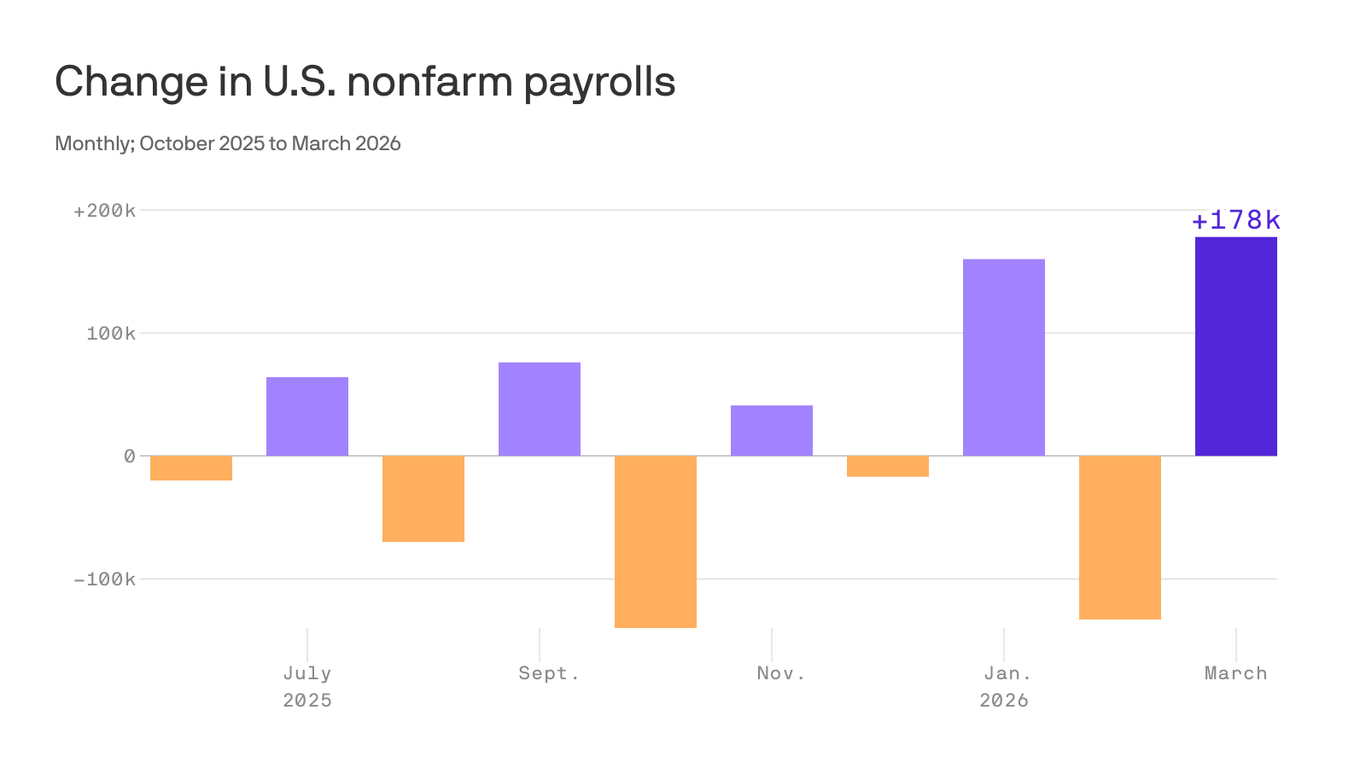
Sectors that showed notable job gains in December include food services and drinking places (+27,000 jobs), health care (+34,000 jobs) and social assistance (+17,000 jobs). On the other end of the spectrum, the retail trade sector lost 25,000 jobs in December. Residential building construction lost 4,200 jobs in December, although employment for residential specialty trade contractors rose by 1,100 jobs. The real estate sector also posted a small increase, adding 2,300 jobs in December.
But if you're innovating within your industry, it's a problem you should expect and prepare for because it means having to operate in two realities-the internal reality where you know the challenges in your industry and how you're going to solve them, and the external reality where nobody else has recognized the problem that needs to be solved. In a highly regulated industry like healthcare, safety, and stability create an inertia that often works against innovation.
The warning comes from the National Institute of Economic and Social Research (NIESR), which said a zero net migration policy would shrink the economy by 3.6 per cent by 2040 and reduce the workforce by around 2.5 million people compared with current forecasts. The result, it argues, would be a £37bn deterioration in the public finances unless offset by higher taxes or cuts to public spending.
While it's appropriate to lament the lack of bipartisan cooperation in Washington, just because something's bipartisan doesn't mean it's a good idea. Exhibit A could be Senator Tammy Baldwin (D-WI) and Senator J.D. Vance's (R-OH) "Invent It Here, Make It Here" bill. Despite the name and its good intentions, it condemns promising federally funded inventions to waste away without doing a thing to build our domestic manufacturing base. It's scheduled to be considered this Thursday in the Senate Commerce, Science and Transportation Committee.
The monthly purchasing managers' index showed employment numbers fell more sharply in January compared with December, continuing a trend that started in October 2024. The PMI survey, which is considered to be one of the most reliable indicators of how a sector is performing, said this was the longest period of job shedding in the UK services sector in 16 years, with firms also choosing not to replace voluntary leavers.
In a note on Saturday, he recalled economist Robert Solow's quip from the 1980s as PCs were transforming the economy: "You can see the computer age everywhere but in the productivity statistics." The same thing can be said today about AI, Slok wrote, noting that data on employment, productivity and inflation are still not showing signs of the new technology.
In Australia, AI has largely been positioned as a way to stretch limited skills capacity in high-cost specialist roles, rather than as a headcount reduction tool. Despite widespread tech layoffs globally and locally over the past few years, Australia's skills shortage has remained largely unchanged. Cuts at large technology firms have often weakened the broader ecosystem, impacting smaller suppliers and subcontractors alongside the firms making redundancies. Rather than releasing excess capacity into the market, layoffs have tended to redistribute pressure across an already constrained talent