Design
fromPsychology Today
13 hours agoThe Future of Brain Health Is Architecture
The built environment significantly influences mental health, mood, and performance, with neuroscience guiding design for improved well-being.
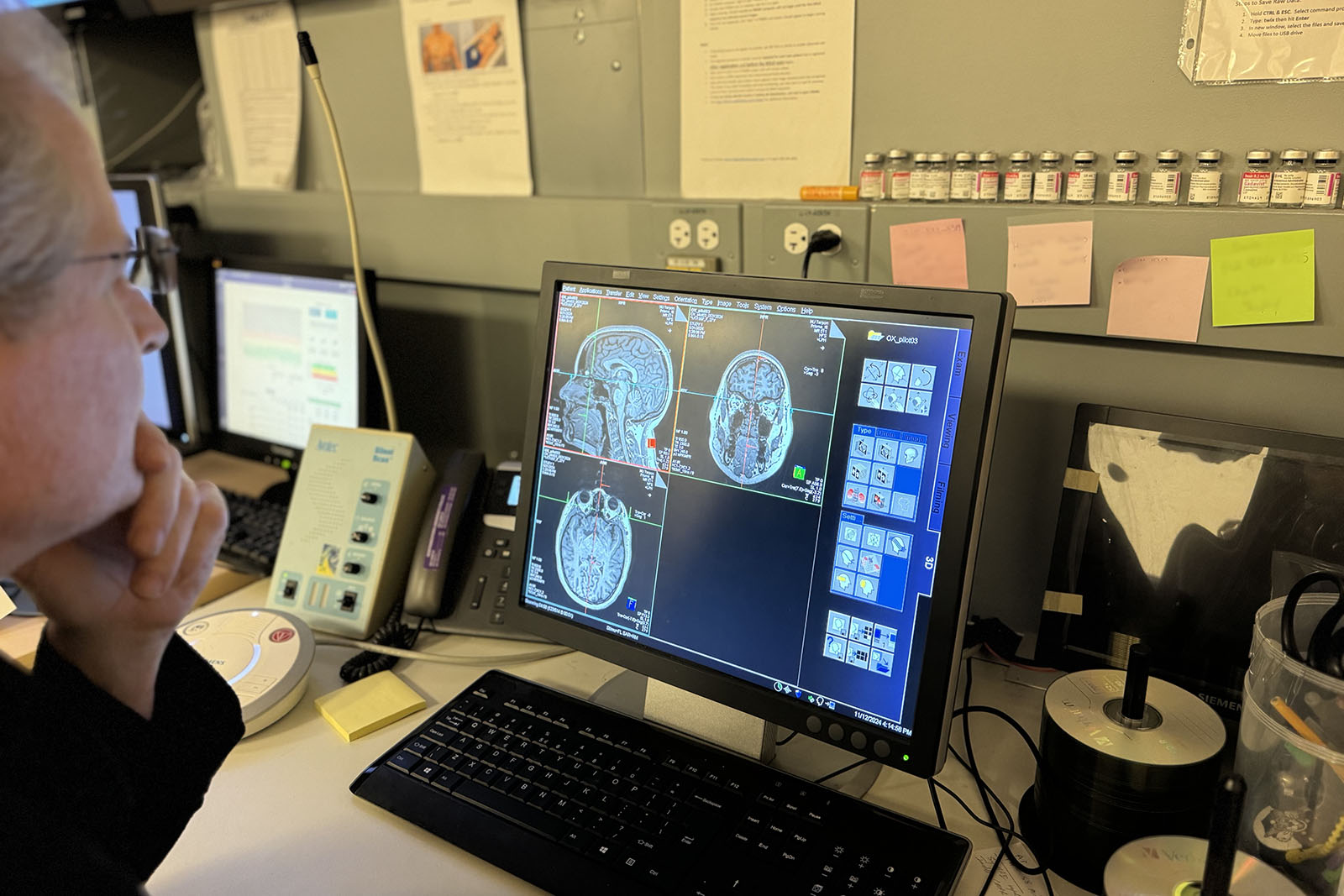
Galen Buckwalter, a 69-year-old research psychologist and quadriplegic, participated in a brain implant study to contribute to science that aids those with paralysis. The six chips in his brain decode movement intention, allowing him to operate a computer and feel sensations in his fingers again.
'In this paper a novel optical illusion is described in which purple structures (dots) are perceived as purple at the point of fixation, while the surrounding structures (dots) of the same purple colour are perceived toward a blue hue.'
Viewpoints are structures designed for observing the landscape from elevated positions. They act as devices that organize the gaze and establish a direct relationship between the body and the territory.
By the early 1900s, player pianos had evolved to more fully reproduce a human performance, including subtle dynamics like tempo changes and the introduction of a damper pedal. The human role went from deskilled to fully deprecated as electric motors replaced foot-powered bellows. With the Seeburg Lilliputian Model L, the only job left for humans who wanted to play the piano in the 1920s was to put in a coin.
The illusion is the latest masterpiece from Olivier Redon, a French-American inventor, who has had his creations used in museums and on TV programmes around the world. For today's puzzles, I present five of Redon's most brilliant images. The challenge is to figure out how he managed to create them.
Accomplishment Hallucination is a cognitive state in which speed feels like competence, output feels like accomplishment, and work feels done when the actual work-the thinking-through, the failure-mode analysis, the sitting with uncertainty until the problem reveals its structure-hasn't happened at all. Physics need not apply. AI can create a similar state in waking life—literally, as your very words assume form before your eyes like a conjuring sorcerer. But, like real life, the code may be buggier than we realize.
One scientist at MIT, Cyrus Clarke, is working to do just that. Alongside a team of fellow researchers, Clarke has developed a physical machine called the Anemoia Device, which uses a generative AI model to analyze an archival photograph, describe it in a short sentence, and, following the user's own inputs, convert that description into a unique fragrance. The word "anemoia" was coined by author John Koenig and included in his 2021 book, The Dictionary of Obscure Sorrows.
To view this video, please enable JavaScript and consider upgrading to a web browser that supports HTML5 video Media Summit and Experiential Marketing | Nov 8, 2022 Raja Rajamannar, Chief Marketing Officer of Mastercard (US), explores how the world of marketing is embracing more sensory and experiential approaches. And looks at what all marketers can learn from this broader approach.
When the Academy Award Nominations were announced late last month, you could be forgiven for thinking they were lifetime achievement awards. In the Best Supporting Actor category, 74-year-old Stellan Skarsgård is competing against 73-year-old Delroy Lindo. (Sean Penn, at 65, and Benicio Del Toro, at 58, also in the category, are mere babes.) Amy Madigan, 75, is up for Best Supporting Actress. One of the Best Adapted Screenplay nominees is in their sixties, and one of the Best Original Screenplay nominees is in his seventies.
At a time when memories are increasingly flattened into folders, feeds, and cloud backups, a new experimental device from MIT Media Lab proposes a far more intimate archive: scent. Developed by Cyrus Clarke, the Anemoia Device is a speculative yet functional prototype that translates photographs into bespoke fragrances using generative AI, inviting users not to view memories, but to inhabit them through the body.
Develop a start-from-scratch mentality. Imagine walking into your kitchen each morning and seeing a completely empty pot-no leftovers, no old recipes, just a blank slate. That's what I face every day as a creator: the daunting but exhilarating task of starting fresh. This mindset is essential for innovation. We can't rest on yesterday's ingredients. We must embrace a beginner's mind, a state of utter unknowing, like a child who can see infinite possibilities and the extraordinary in the ordinary.
When a scientist feeds a data set into a bot and says "give me hypotheses to test", they are asking the bot to be the creator, not a creative partner. Humans tend to defer to ideas produced by bots, assuming that the bot's knowledge exceeds their own. And, when they do, they end up exploring fewer avenues for possible solutions to their problem.
Wooden spoons as microphones, siblings spinning in socks across the floor, a mother laughing as Whitney Houston's "I Wanna Dance With Somebody" fills the room for the third time in a row-this is love. Long before children understand romance, they learn connection this way, through synchronized movement, shared joy, and the safety of familiar songs. Research on rhythm and social bonding suggests that moving in time together can regulate the nervous system and strengthen feelings of connection.
Real estate with ocean views, stunning mountain vistas, and wide-open green spaces sell at premium prices because humans find those settings pleasing [1-5]. Certain color combinations in fashion-such as brown and forest green-blend harmoniously, while others, such as hot pink and orange, clash. And our eyes like certain proportions in visual objects (like buildings and human faces) but not others.
As AI systems become more capable, more accessible, and more embedded in everyday workflows, creativity is emerging as one of the most important human skills in AI development and deployment. Not creativity as decoration or aesthetics, but creativity as problem framing, decision-making, and human judgment. In an era where many organizations are using the same models, tools, and platforms, creative thinking is what separates meaningful outcomes from generic ones.
Did someone with spatial-sequence synaesthesia design the calendar app on mobile phones? Because that's how time and dates look in my brain. If you say a date to me, that day appears in a grid diagram in my head, and it shows if that box is already imprinted with a holiday, event or someone's birthday. Public holidays and special events like Christmas and Easter are already imprinted for the year, and the diagram goes backwards to about 100,000BC
Recent integrative approaches suggest that physics cannot be adequately characterized by magnitude-based distinctions alone, such as those implied by Big-P, little-p, and mini-p physics. While these categories capture differences in scope and historical impact, they fail to address the heterogeneity of physical activity itself. To remedy this, I propose the Five Fs of physics: force, friction, flux, formulation, and foundational structure.